
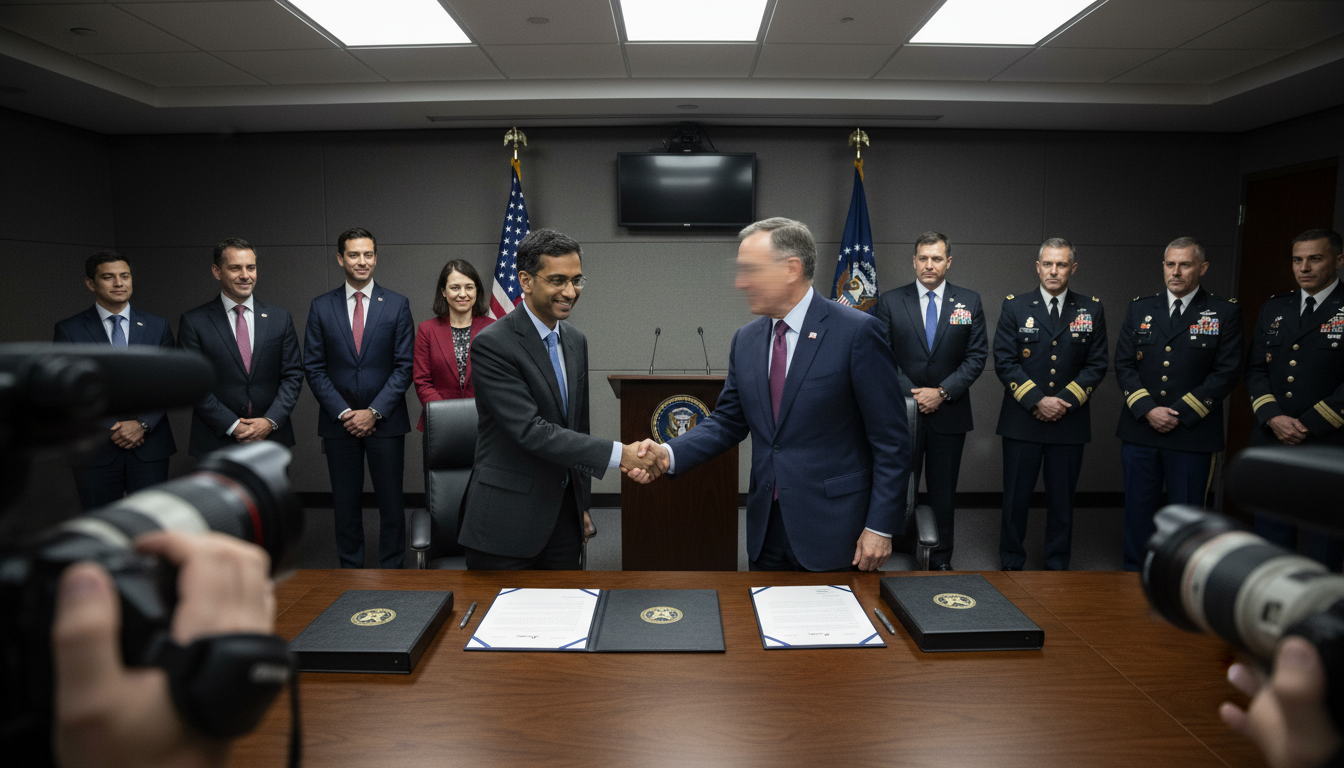
Google DoD AI contract allows U.S. Defense Department “all lawful uses,” company says
Google signs classified AI contract with U.S. Department of Defense, permitting "all lawful uses" while excluding domestic surveillance and autonomous weapons.
The Google DoD AI contract, disclosed April 28, 2026, will let the U.S. Department of Defense use a Google-built artificial intelligence model for classified work, according to U.S. media reports. Details of the agreement remain limited, but the deal is understood to permit a broad range of military applications while expressly excluding certain uses. Google told journalists it would provide its model under industry-standard practices and contractual conditions intended to support national security.
Agreement Grants ‘All Lawful Uses’ to Defense Department
According to reporting in U.S. outlets, the contract authorizes the Defense Department to employ Google’s AI for “all lawful uses,” a phrase that industry analysts say is deliberately broad. The language gives the department flexibility to deploy the model across classified missions and internal operations, though specific tasks and classification levels were not publicly detailed. Company spokespeople declined to release the contract text, citing security and confidentiality obligations.
Google Outlines Sectors for Deployment and Key Limits
Google identified logistics, cybersecurity, fleet maintenance and protection of critical infrastructure as primary areas where its model could assist defense operations. The company emphasized that the model should not, under the contract, be used for large-scale domestic surveillance or weapon systems that operate without appropriate human oversight. Google framed the arrangement as a way to support national security while maintaining guardrails on sensitive civil liberties issues.
Anthropic Excluded After Refusing Expanded Military Use
The announcement follows a parallel development in which another U.S. AI firm, Anthropic, declined to comply with Defense Department requests to broaden the military uses of its technology and was subsequently left out of the contract process. That dispute highlighted divergent approaches among AI developers about how closely to partner with the military and under what restrictions. Industry observers say Anthropic’s stance sharpened public attention on the ethical and business trade-offs at stake.
Internal Pushback and Corporate Governance Concerns
Reports indicate that employees within Google have voiced objections to the company’s decision to sign a classified contract with the Defense Department, mirroring earlier internal debates over government work. Google acknowledged such concerns and said it is providing the model under “industry-standard” oversight and contractual terms intended to ensure responsible use. The company also reiterated its long-standing policy against enabling autonomous weapons or domestic mass surveillance without human supervision.
Potential Military Applications and Operational Considerations
Defense officials may employ the model to analyze logistics chains, prioritize maintenance for naval and air fleets, and detect cyber threats through pattern recognition and anomaly detection, according to the areas Google highlighted. Experts caution, however, that integrating advanced generative AI into classified workflows requires rigorous validation to avoid errors that could have operational consequences. The complexity of securing classified environments and ensuring model robustness against adversarial manipulation remains a central challenge.
Calls for Transparency, Oversight and Legislative Review
Privacy advocates, civil liberties groups, and some technology policy researchers have called for clearer public disclosure of how such contracts are structured and what oversight mechanisms will be in place. They argue that broad phrases like “all lawful uses” should be accompanied by transparency about audit rights, redress mechanisms, and independent review to prevent mission creep. Lawmakers and watchdog organizations are likely to press for explanations about safeguards and accountability given the national-security and civil-rights implications.
The agreement marks a notable moment in the evolving relationship between large AI developers and national defense establishments, underscoring tensions between technological assistance for security and the ethical limits companies set for their products. As details of the contract remain withheld, observers on all sides say the next weeks and months will be critical for clarifying how Google’s model will be governed, tested and monitored in practice.

