
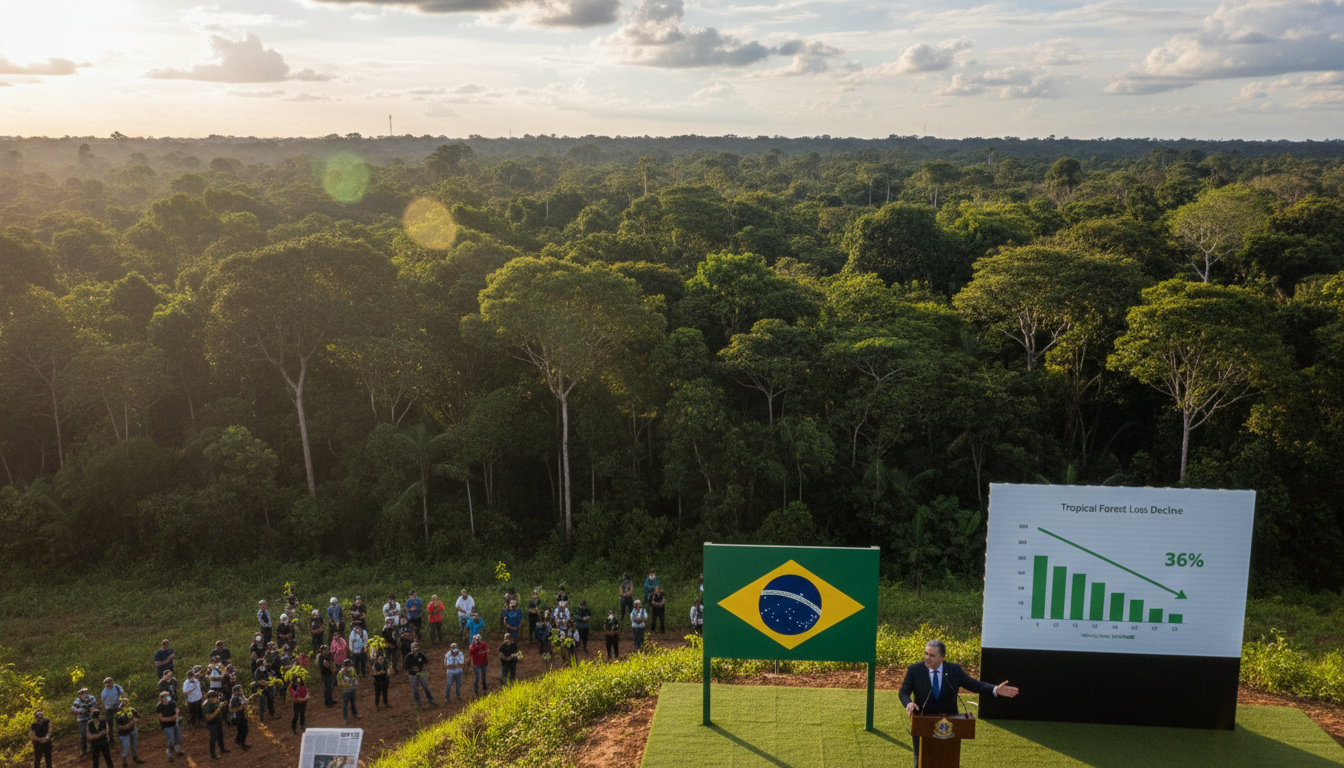
Tropical Forest Loss Falls 36% in 2025 but Remains Alarmingly High, Study Says
Tropical forest loss fell 36% to 4.3 million hectares in 2025, driven partly by Brazil’s policy measures, yet fires and climate risks leave global forests far from 2030 targets.
Tropical forest loss eased last year from a record high but remained at alarming levels, according to a new study by researchers using satellite data. The report found the world lost 4.3 million hectares (10.6 million acres) of tropical primary rainforest in 2025, a decline of 36 percent from 2024, while warning that the reduction is fragile and unevenly distributed.
Global decline masks persistent long-term increase
The 36 percent drop in tropical primary rainforest loss marks a notable year-on-year change, but researchers stressed the longer-term trend remains troubling. The study found 2025 loss was still 46 percent higher than a decade earlier, indicating that recent reductions have not reversed a decade-long escalation in destruction.
Analysts noted that global tree cover loss fell by 14 percent in 2025, a sign that some mitigation measures are having an impact. However, the authors warned that overall progress is insufficient: global forest loss remains about 70 percent above the rate required to halt and reverse forest loss by 2030.
Brazil’s policy reset credited with large reductions
Much of the headline decline was driven by sharp reductions in Brazil, which recorded its lowest deforestation rate on record for non-fire-related loss. Excluding fires, Brazil’s forest loss fell by 41 percent compared with 2024, a turnaround researchers attributed to stronger enforcement and new government measures.
Officials and researchers credited the 2023 relaunch of Brazil’s anti-deforestation action plan and tougher penalties for environmental crimes under President Luiz Inácio Lula da Silva’s administration. Still, the report cautioned that agricultural expansion for soya and cattle ranching and efforts by some local actors to weaken protections continue to threaten the country’s forests.
Fires accounted for a large share of 2025 destruction
Fires played a central role in tropical forest loss, accounting for roughly 42 percent of the destruction recorded in 2025. While many tropical fires are human-caused, researchers highlighted that climatic shifts are intensifying fire seasons and making landscapes more susceptible to ignition and rapid spread.
The report pointed to extreme wildfire seasons in temperate regions as well, noting Canada experienced its second-worst fire year on record in 2025, burning about 5.3 million hectares (13 million acres) of forest. Experts warned that as fires and droughts become more frequent, forests that once sequestered carbon are increasingly emitting greenhouse gases.
Mixed gains in Latin America; central Africa still vulnerable
Beyond Brazil, neighbouring Colombia also recorded meaningful progress, with forest loss falling 17 percent to one of its lowest levels since 2016. Researchers credited a mix of government policies and local agreements that limited clearing for agriculture and ranching in sensitive areas.
By contrast, tropical forest loss remained high in parts of central Africa, particularly in the Democratic Republic of the Congo and Cameroon, where agricultural expansion and weak enforcement continue to drive tree cover removal. The uneven geographic pattern underscores the need for region-specific interventions and sustained monitoring.
Scientists warn gains could be reversed by climate and policy shifts
Although the study described the year-on-year drop as “encouraging,” researchers cautioned that some of the decline reflected a lull following an extreme fire year and that gains could be reversed. The expected return of the El Niño weather pattern mid-year raises the prospect of increased heatwaves, droughts and wildfires that would exacerbate forest vulnerability.
Researchers urged national governments and international partners to sustain and scale up enforcement, land-use planning, and incentives for forest conservation. They emphasized that temporary improvements will not be enough to meet the 2030 goal unless policy commitments are translated into long-term reductions in agricultural-driven clearing and stronger fire management.
The coming months will test whether recent policy shifts and enforcement efforts can be sustained in the face of mounting climate pressure. Continued satellite monitoring and coordinated policy responses will be critical to safeguard remaining tropical primary rainforest and to keep global forest targets within reach.

