
Myanmar Marginalized as ASEAN Frays Over “Civilian” Transition
ASEAN summit in the Philippines exposed deep splits over Myanmar’s nominal shift to civilian rule, leaving its delegation marginalized and legitimacy contested. (158 characters)
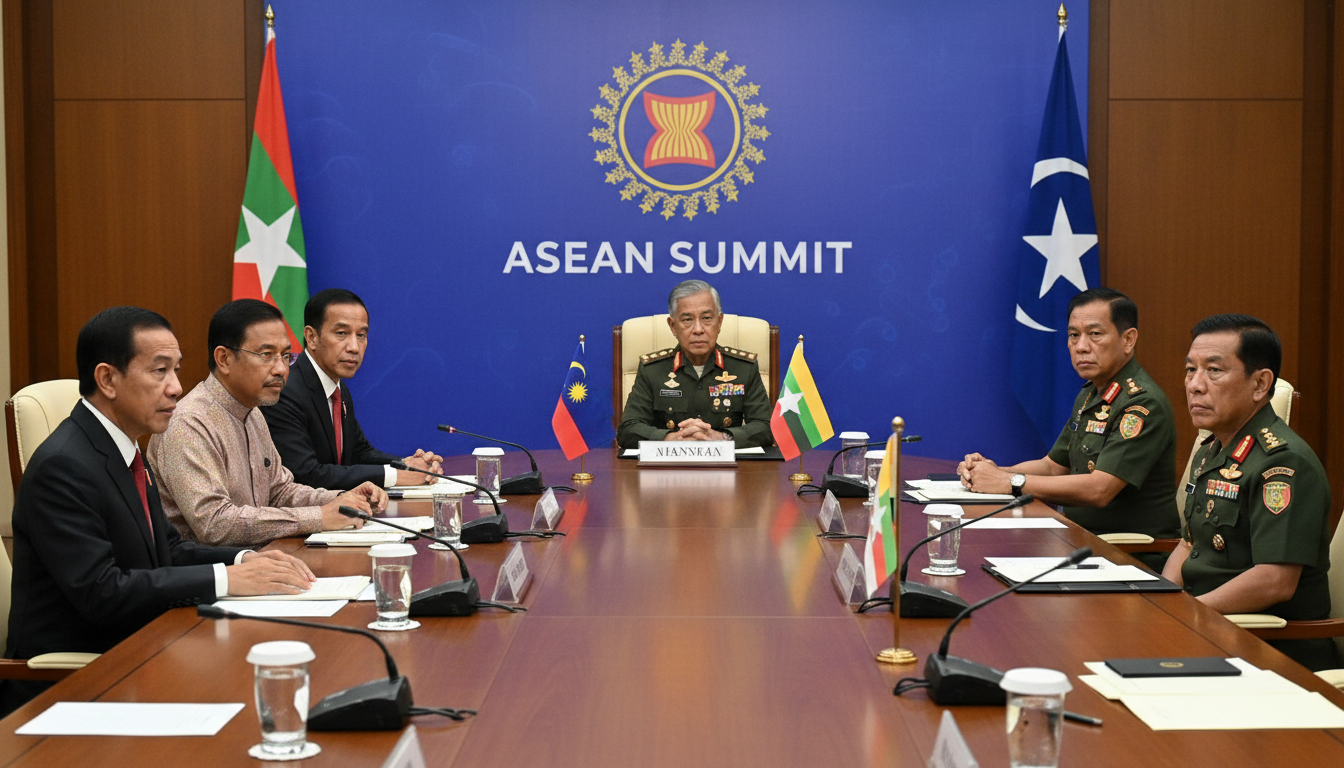
A summit of Southeast Asian leaders in the Philippines concluded with Myanmar once again on the margins as regional states disagreed over the credibility of its declared return to civilian governance. Myanmar’s presence was limited to a low-ranking delegation whose attendance underscored continuing rifts within ASEAN about whether the military-backed transition amounts to a genuine shift in power. The dispute highlights growing impatience among some members with symbolic gestures that fail to meet agreed benchmarks for restoring democratic processes.
Myanmar’s Delegation Kept at the Edge of Summit
Myanmar sent Permanent Secretary U Hau Khan Sum to represent the country at the high-level meeting, but his role was conspicuously peripheral throughout the summit. Delegation seating and the absence of bilateral meetings with senior leaders signaled that many ASEAN capitals continue to withhold recognition of the new arrangement in Naypyidaw.
Organizers and several member states treated Myanmar’s participation as strictly technical rather than political, reflecting an enduring unwillingness to confer full diplomatic legitimacy. That posture mirrors prior summit dynamics and underscores persistent enforcement challenges of ASEAN’s informal norms.
ASEAN Remains Split on Legitimacy of New Government
Crucial members of the bloc described the reported shift toward civilian rule in Myanmar as nominal and insufficient, citing a lack of transparent timelines and meaningful transfer of authority. These members emphasized that any change must be verifiable and accompanied by concrete steps toward inclusive governance and the restoration of democratic institutions.
Other states urged continued engagement as a way to preserve dialogue and humanitarian access, creating a schism between those favoring tougher diplomatic isolation and those advocating conditional contact. The divergence complicates ASEAN’s longstanding principle of consensus, making collective action on Myanmar increasingly difficult.
Statements and Stances from Key Member States
Several capitals reiterated public positions that recognition of any new Myanmar government hinges on compliance with a set of benchmarks, including release of political prisoners and credible elections. Leaders from ASEAN’s smaller democracies pushed for a firmer line, arguing that legitimizing a cosmetic transfer of power would weaken regional credibility on human rights and democratic norms.
Conversely, some neighbouring states emphasized stability and the need to prevent further regional spillovers, arguing that engagement can be calibrated to secure humanitarian corridors and prevent escalation. This tension between normative pressure and pragmatic concerns remained unresolved by the summit’s end.
Diplomatic Isolation and Humanitarian Access
The marginalization of Myanmar at the summit raises immediate concerns about the practical delivery of aid and the safety of vulnerable populations within the country. Humanitarian groups and ASEAN interlocutors have long warned that political rancor can obstruct relief flows, particularly to areas controlled by armed groups or where access is tightly controlled by military authorities.
Diplomacy that remains purely symbolic risks depriving civilians of predictable assistance and complicates coordination with international agencies. Several member states signaled an interest in maintaining humanitarian channels even as they balked at full diplomatic recognition.
Implications for ASEAN’s Unity and International Relations
The dispute over Myanmar’s status has broader implications for ASEAN’s cohesion and its ability to act collectively on regional security issues. Persistent disagreement among members undermines the bloc’s capacity to present a unified front on matters ranging from migration to counterterrorism, and it invites external actors to pursue bilateral approaches that could deepen divisions.
International partners watching the summit may recalibrate their engagement strategies based on how ASEAN handles the dilemma, varying from stepped-up sanctions to increased support for civil society and displaced populations. The outcome will influence not only Myanmar’s trajectory but also the bloc’s standing as a regional mediator.
Signals for Myanmar’s Domestic Politics
For political actors inside Myanmar, the lack of acceptance at the summit represents a diplomatic setback for those seeking immediate legitimacy for the new arrangements. The marginal treatment signals to domestic audiences and opposition groups that international patience is limited and that substantive reforms will be required to win recognition.
That message could embolden opposition factions and ethnic groups who have rejected the transition as insufficient, with potential consequences for internal negotiations and security dynamics. How the Myanmar leadership responds to international pressure will be a key determinant of the country’s next steps.
Despite official language describing a move toward civilian rule, ASEAN leaders left the Philippines summit divided and without a clear endorsement of Myanmar’s new authorities. The bloc faces a critical choice between sustained conditional engagement that prioritizes humanitarian access and firm, unified pressure to demand verifiable democratic reforms. The coming weeks will test whether ASEAN can convert uneasy consensus into effective action or whether the dispute over Myanmar will further weaken regional cooperation.

