
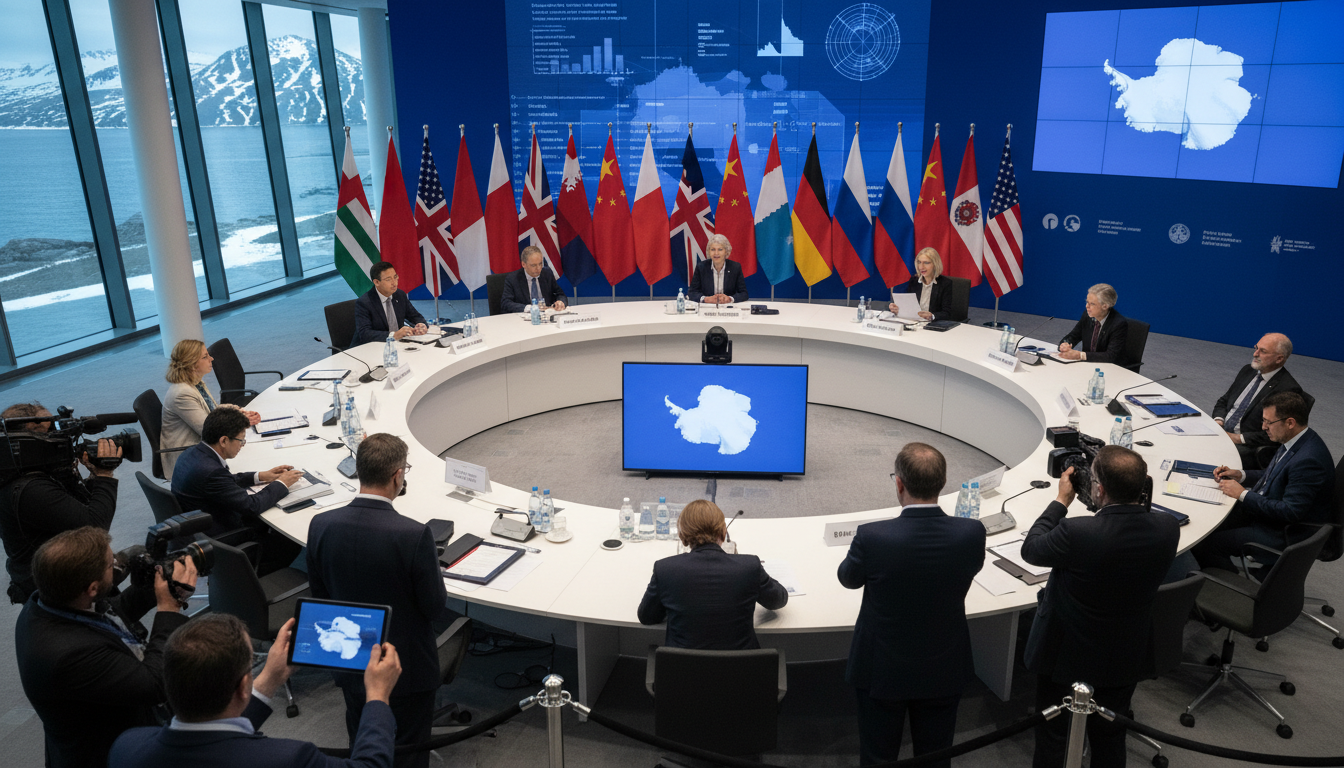
Japan Urges Scientific Focus at Antarctic Treaty Consultative Meeting amid Tourism, Climate and Geopolitical Strains
Japan calls for stronger safeguards for Antarctic science as the Antarctic Treaty meeting faces rising tourism, climate-driven change and geopolitical friction.
Japan’s delegation to the Antarctic Treaty Consultative Meeting is pressing for renewed emphasis on scientific cooperation and environmental protection as debates open over tourism, climate impacts and political tensions. Satoshi Imura, vice director general of the National Institute of Polar Research, told reporters he wants the talks to “ensure that scientific research can proceed smoothly,” framing the meeting as critical for safeguarding Antarctica’s role as a place for peaceful science. Delegates are expected to confront practical issues such as emergency response to growing visitor numbers as well as broader disputes that reflect strained international relations.
Japan’s Position at the Antarctic Treaty Consultative Meeting
Japan’s delegation, led in part by officials from the National Institute of Polar Research, has framed its agenda around protecting research continuity and minimizing human impact on the Antarctic environment. Delegates emphasize the treaty’s founding principles: freedom of scientific investigation, international cooperation, and the freezing of territorial claims. Tokyo has signaled it will seek constructive dialogue to prevent the meeting from becoming a proxy for wider geopolitical rivalry.
Imura, who has led Japanese Antarctic expeditions and now serves as a senior NIPR official, has highlighted the need for focused technical discussions rather than politicized exchanges. He argues the meeting should prioritize practical measures that facilitate operations and data sharing for research teams from all consultative parties.
Rising Antarctic Tourism and Environmental Risks
Delegates will confront a sharp increase in Antarctic tourism, with seasonal visitor numbers rising into the tens of thousands and placing new demands on search-and-rescue, pollution prevention and site management. Japan’s delegation has warned that cruise ship incidents or aircraft accidents could trigger oil spills that would persist for years in cold Antarctic waters, because natural degradation of hydrocarbons is much slower in frigid conditions. The footprint left by frequent shore landings is also a concern, as trampling and local disturbance can accelerate ecological change in fragile coastal ecosystems.
Proposals on the table include strengthened contingency planning, clearer protocols for international rescue coordination, and limits or tighter oversight on shore visits in sensitive areas. Several nations are expected to press for improved incident reporting and joint training exercises to reduce the risk of catastrophic environmental damage.
Climate Change’s Tangible Effects on Antarctic Research
Scientific delegations are increasingly documenting measurable changes across Antarctica, and climate science sits at the center of many talks at the Consultative Meeting. Imura noted that while some Japanese stations have recorded modest local temperature shifts, continent-wide analyses show a steady rise in temperatures, accelerating ice melt and expanding plant growth in parts of the Antarctic Peninsula. These changes are altering fieldwork conditions, seasonality, and the integrity of long-term observational records.
Researchers warned that shifting sea ice and glacial retreat could complicate logistics for stations and field parties, while also affecting the ecosystems that are themselves subjects of study. The meeting will consider how to maintain continuity of long-term monitoring programs and how to safeguard observational infrastructure threatened by warming and coastal change.
Geopolitical Tensions Enter Antarctic Negotiations
A central diplomatic challenge at the Consultative Meeting is preventing global conflicts from undercutting cooperative Antarctic governance. Consultative parties include countries whose bilateral relations are strained, and observers expect those tensions to surface during negotiations. Imura cautioned that allowing the meeting to mirror geopolitical rivalry would stray from the Antarctic Treaty’s neutral, science-focused spirit.
Some delegations are calling for clear reaffirmation that Antarctica remain a zone dedicated to peaceful purposes and scientific collaboration, while others signal they will press national security and resource-use concerns. The outcome of these exchanges could shape future access to research sites and the willingness of states to share data and logistical support.
Debate Over Emperor Penguin Protection and Marine Reserves
One of the most contested agenda items is a proposal to designate the emperor penguin as a specially protected species under the Protocol on Environmental Protection to the Antarctic Treaty. Japan’s delegation and several others have said the designation requires careful consideration, while some consultative parties, notably China and Russia, have historically opposed such moves. Concerns cited include potential downstream restrictions on vessel routing, fishing activities and scientific operations.
Related discussions focus on the establishment and management of marine protected areas around Antarctica, where parties differ sharply on the balance between conservation and the freedom of maritime activities. Negotiators will need to weigh species-specific protections against broader ecosystem conservation measures and the practical implications for scientific and commercial stakeholders.
Seven Decades of Japanese Antarctic Science and Legacy Findings
Japan this year marks roughly 70 years since its Antarctic program began, and Tokyo’s delegation is underscoring historical contributions to global science in the context of current talks. Japanese researchers played a central role in identifying ozone depletion through long-term observations, a discovery that helped catalyze international action to phase out ozone-depleting substances. Japan has also been prominent in ice-core drilling and meteorite collection, contributing data that underpin climate and planetary science.
Delegation members have used the anniversary to argue that long-term, cooperative Antarctic research delivers benefits far beyond any single nation, reinforcing their case for maintaining mechanisms that protect scientific continuity.
International negotiators at the Antarctic Treaty Consultative Meeting face a compact agenda that marries immediate operational concerns with long-term stewardship questions. With tourism rising, climate impacts accelerating and geopolitical frictions present, the meeting will test the treaty system’s capacity to keep Antarctica primarily a place for peaceful science and environmental protection.

