
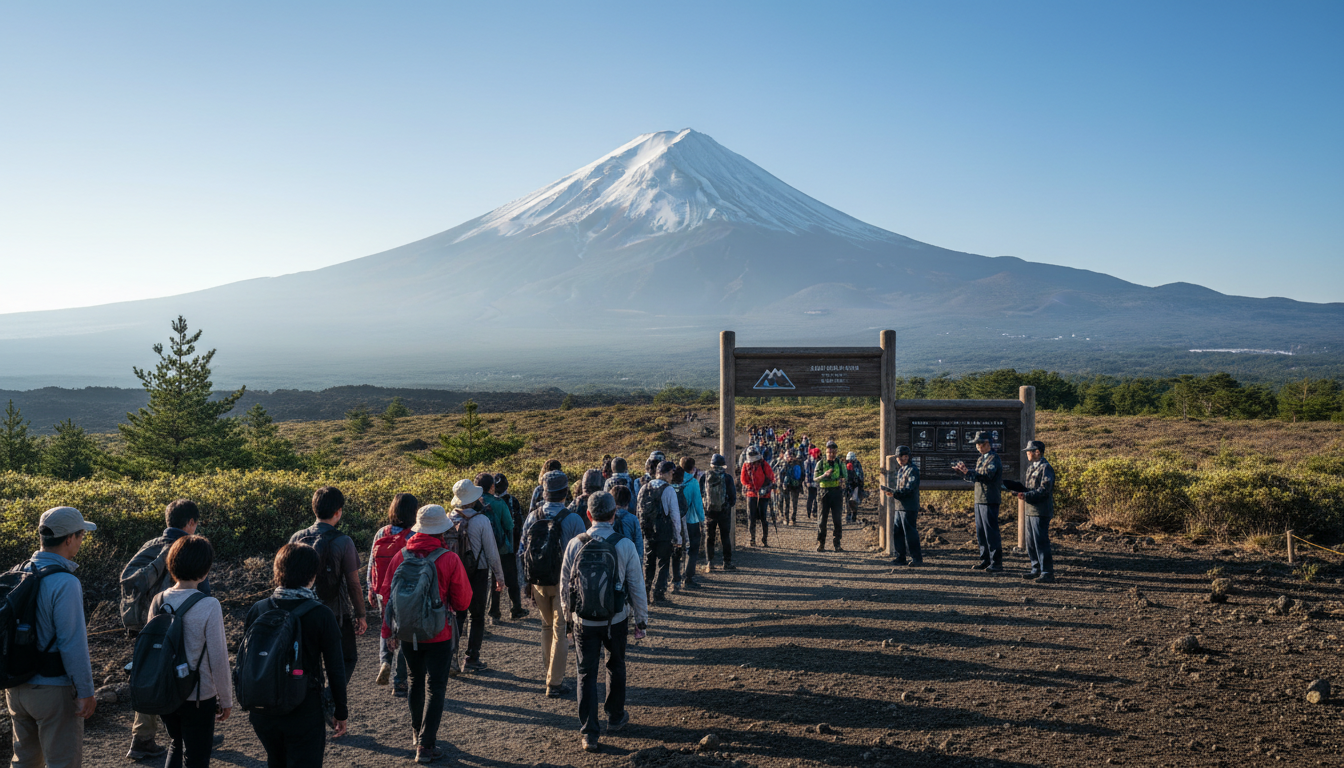
Mount Fuji rules for 2026: fees, reservations and caps reshape summer climbs
Mount Fuji rules for 2026 require a ¥4,000 trail fee, timed gate access, and new reservation systems for all four official routes; these measures affect planning for summer ascents.
Summer 2026 schedule and access rules
The official climbing season for Mount Fuji in 2026 will follow staggered opening dates: the Yoshida and Subashiri routes open on July 1, while the Fujinomiya and Gotemba routes on the Shizuoka side open on July 10, with all trails scheduled to close in early September. These dates reflect the annual window designed to limit hazardous off-season climbs and to concentrate trail management resources. (fujisan-climb.jp)
Authorities have reinforced timed gate access across the mountain to discourage late daytime ascents and so-called “bullet climbs” aimed at summiting and descending in a single push. Gates at the fifth stations will be closed daily from mid-afternoon into the pre-dawn hours, and entry during the closure is permitted only for those holding mountain-hut reservations. (fujisan-climb.jp)
Prefectural offices emphasize that these access rules are operational: if you plan to enter a trail after the posted gate-closing time you must carry documentary proof of an approved hut reservation or an authorized permit. The goal is to reduce emergency rescues and on-trail congestion that endanger climbers and burden local services. (fujisan-climb.jp)
Yoshida Trail fee, gates and booking process
The most-visited route, the Yoshida Trail on the Yamanashi side, will require climbers who pass above the fifth station gate to pay a mandatory ¥4,000 trail fee for the 2026 season. The fee is collected to fund trail maintenance, emergency services and conservation efforts along the busiest sections of the mountain. (fujisan-climb.jp)
Yamanashi Prefecture has implemented on-site gates and an online booking system for the Yoshida route; climbers can prepay and secure a booking via the official Mt. Fuji climbing portal. Prefectural information released ahead of the season also set a clear expectation that gear inspections will be conducted at entry, and that hikers must demonstrate appropriate footwear, rain and cold-weather clothing. (fujisan-climb.jp)
Reservation windows for the Yoshida Trail opened in late April 2026 and bookings are subject to daily quotas that fill quickly on weekends and holidays. Walk-up entry without a pre-booked slot will be refused once the daily quota is reached, although mountain-hut reservations allow access during restricted hours. Climbers are advised to reserve as early as possible. (stripes.com)
Daily caps and timed entry on the Yoshida route
To reduce overcrowding at the summit and along key bottleneck sections, the Yoshida Trail carries a hard daily cap on non–hut-reservation climbers set at 4,000 people. The cap does not apply to hikers holding confirmed mountain-hut reservations, but it does limit the number of casual or last-minute climbers who can pass through the gate. (fujisan-climb.jp)
The gate policy is intended to change climber behavior by curtailing late-afternoon ascents that aim for summit sunrise without a planned overnight stay. Officials say managing flow on the Yoshida Trail reduces the likelihood of altitude-related incidents and prevents dangerous queues on steep sections. The measure complements ongoing investments in first-aid points and staffed checkpoints. (fujisan-climb.jp)
Local enforcement teams at the fifth station are authorized to verify bookings and to turn back hikers who lack correct documentation or adequate equipment. Climbers should prepare to show QR codes, reservation confirmations and proof of prepayment at gate checkpoints. (fujisan-climb.jp)
Shizuoka-side pre-registration and permit QR codes
On the Shizuoka Prefecture side — the Subashiri, Gotemba and Fujinomiya trails — prefectural authorities require pre-registration through the FUJI NAVI system and issuance of a digital climbing permit (QR code) before entry. Pre-registration for Shizuoka trails opened in early May 2026 and is mandatory for anyone planning to use those routes. (fujisan-climb.jp)
A ¥4,000 climbing fee applies to Shizuoka-side registrants as well, and the online process includes a short mandatory learning module on safety, etiquette and environmental stewardship. The module is designed to ensure climbers are aware of the mountain’s risks and the expectations for waste management and trail behavior. (fujisan-climb.jp)
Unlike the Yoshida route, Shizuoka Prefecture did not impose a numerical cap on total daily entries for 2026, but it enforces strict time-based entry rules. Anyone entering a trail between the afternoon gate closure and the early-morning reopening must hold a verified mountain-hut booking or face denial of entry at the trailhead. (fujisan-climb.jp)
Mountain-hut reservations, inspections and ranger enforcement
Mountain huts remain independent services and their fees are separate from the trail access charge; reservations for huts must be made directly with the lodging operators and should be confirmed well in advance of your climb. Hut reservations grant access during gate closure hours but do not replace the need to complete online registration or to carry the trail permit where required. (fujisan-climb.jp)
Both prefectures have increased ranger patrols and deployed teams tasked with safety inspections and enforcement on all four routes. Rangers and inspection staff are empowered to intervene when climbers lack essential gear, display unsafe behavior, or refuse lawful instructions meant to protect the climber and others on the trail. Officials have urged visitors to cooperate promptly with staff requests. (fujisan-climb.jp)
The on-site checks include basic gear verification—sturdy boots, waterproof outer layers, and warm clothing—because hypothermia and altitude sickness remain the leading causes of mountain rescue incidents. Climbers who plan a pre-dawn summit attempt without an overnight stay should be aware that the inspections are stricter than in previous years. (stripes.com)
Background: crowding, conservation and official statistics
The 2026 measures build on changes initiated in 2024 and reflect longstanding concerns about overtourism, trail degradation and public safety on a site that is both a cultural icon and a UNESCO-listed landscape. Officials have cited frequent reports of littering, bonfires, and risky “bullet climbs” as drivers of the new regulatory framework. (fujisan-climb.jp)
Official data show the scale of the challenge: in 2025 roughly 205,100 people climbed Mount Fuji across all routes, with about 121,068 using the popular Yoshida Trail. Those figures underline why prefectures introduced caps, gates and mandatory fees to support trail maintenance and emergency capacity. (env.go.jp)
Government statements accompanying the 2024 and 2025 reforms framed the policy as a life-safety and conservation measure rather than a revenue exercise. Local leaders have said the additional funds will be directed to maintenance, ranger staffing and facilities aimed at reducing environmental impact. (fujisan-climb.jp)
How climbers should plan for a 2026 ascent
Secure bookings early: make trail and hut reservations well ahead of your intended climb and complete any required online registration or permit acquisition as soon as the booking windows open. Weekend and holiday slots fill fastest, and digital quotas can be exhausted days in advance. (fujisan-climb.jp)
Pack for inspection: bring verified, high-quality hiking boots, full rainproof layers, warm clothing suitable for near-summit temperatures, and a backup headlamp. Officials will check gear at entry gates, and inadequate equipment increases the likelihood of being denied passage. (stripes.com)
Understand fees and receipts: the ¥4,000 trail fee is separate from any mountain-hut charges and must be paid in the manner specified on the official booking portals. Keep confirmation emails or QR codes accessible on your phone and printed copies where possible, since mobile reception can be unreliable near trailheads and at higher elevations. (fujisan-climb.jp)
Plan arrival times: aim to pass the fifth-station gates well before the afternoon closure to avoid complications, and if you intend an overnight hut stay, bring the confirmed hut reservation to expedite gate processing. Night climbs without confirmed lodgings are strongly discouraged and could be blocked by officials. (fujisan-climb.jp)
Final paragraph without title:
The 2026 Mount Fuji rules reshape how summer ascents are organized, prioritizing climber safety and environmental protection while requiring more planning from visitors; for anyone intending to climb this season, the practical takeaway is clear—book early, carry proper gear, complete required online registrations, and expect on-site checks as part of a sustained effort to preserve Japan’s most famous peak. (fujisan-climb.jp)

