
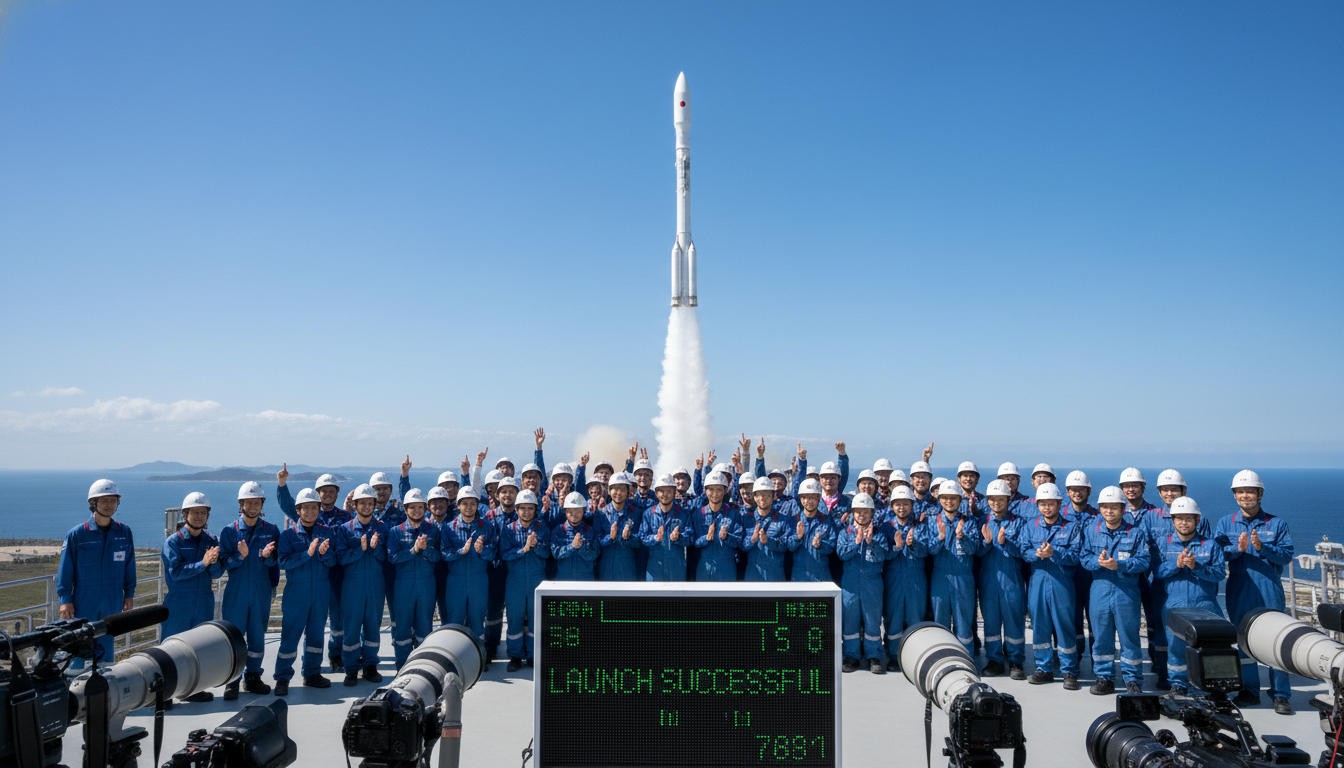
H3 rocket 6th flight succeeds from Tanegashima, marking boosterless debut and recovery after December 2025 failure
H3 rocket 6th flight succeeds from Tanegashima on June 12, 2026, marking first boosterless configuration and a recovery after a December 2025 failure for Japan.
The H3 rocket No.6 lifted off successfully from the Tanegashima Space Center in Kagoshima Prefecture at 9:54 a.m. on June 12, 2026, completing its planned ascent and initial mission milestones. The launch represented the first operational flight of a new, boosterless configuration and was explicitly framed as a test of changes made after a failed mission six months earlier. Government and industry officials described the ascent as an important step in restoring confidence in the domestic flagship launcher and in validating technical fixes implemented since December 2025.
Launch details and trajectory
The vehicle cleared the launch pad on schedule and passed through its primary flight phases without immediate anomaly, sources at the launch site reported. Telemetry indicated that the first-stage engine and upper-stage separation occurred according to plan, and engineers confirmed stable guidance throughout the critical early minutes of flight.
Mission controllers monitored a suite of onboard instruments aimed at evaluating structural loads, engine performance, and stage separation dynamics under the new configuration. Ground teams received a continuous stream of data that will be analyzed in detail over the coming days to confirm the long-term viability of the modifications.
New configuration without auxiliary boosters
This mission tested an H3 variant that omitted the auxiliary strap-on boosters used in previous flights, shifting key performance demands onto the core stage. Engineers redesigned thrust profiles and structural interfaces to compensate, a change intended to simplify operations and lower long-term costs if validated.
Officials said the boosterless design reduces complexity and could improve manufacturing throughput, but it also demanded rigorous verification because it changes aerodynamic and vibrational environments. The June 12 flight therefore served both as a technical demonstration and as a performance proof for a revised production baseline.
Follow-up on the December 2025 failure
The June launch carried the explicit remit of testing corrective measures taken after a failure in December 2025 that grounded the vehicle series. Investigators had traced the earlier incident to a small number of component and procedural issues, prompting a concentrated review and a rapid overhaul of inspection and assembly protocols.
Since then, teams conducted a series of ground tests and incremental hardware changes, with particular attention to engine plumbing and separation mechanisms. The success of the No.6 flight will not, by itself, close the investigation, but it does provide the first in-flight confirmation that several targeted fixes function as intended.
Official reactions and industry response
Cabinet officials and space-sector executives issued cautious praise for the outcome, emphasizing the flight’s role in rebuilding reliability and investor confidence. Statements highlighted the coordinated effort across government agencies, research institutions, and private manufacturers that made the reflight possible within a six-month window.
Market observers and defense planners noted the broader implications for Japan’s access to space and for regional launch competitiveness. A reliable H3 program is seen as key to meeting growing demand for satellite deployments tied to communications, earth observation, and national security requirements.
Technical assessments and next steps
Engineers will now conduct an exhaustive post-flight review, examining high-rate telemetry and recovered telemetry records to validate margins and identify any residual anomalies. Component inspections and stage recovery data, where available, will feed into revised certification criteria for future missions.
The program’s schedule calls for a stepped return to routine launches contingent on the outcomes of these analyses, with particular emphasis on repeating the boosterless configuration under different payload and trajectory profiles. That approach is designed to confirm operational flexibility before fully committing the configuration to commercial or national missions.
The successful No.6 flight marks a milestone, but officials stress that firm conclusions require time and repeated demonstration. The engineering teams have outlined a phased verification plan and expect to publish a detailed technical summary once initial assessments are complete.

