
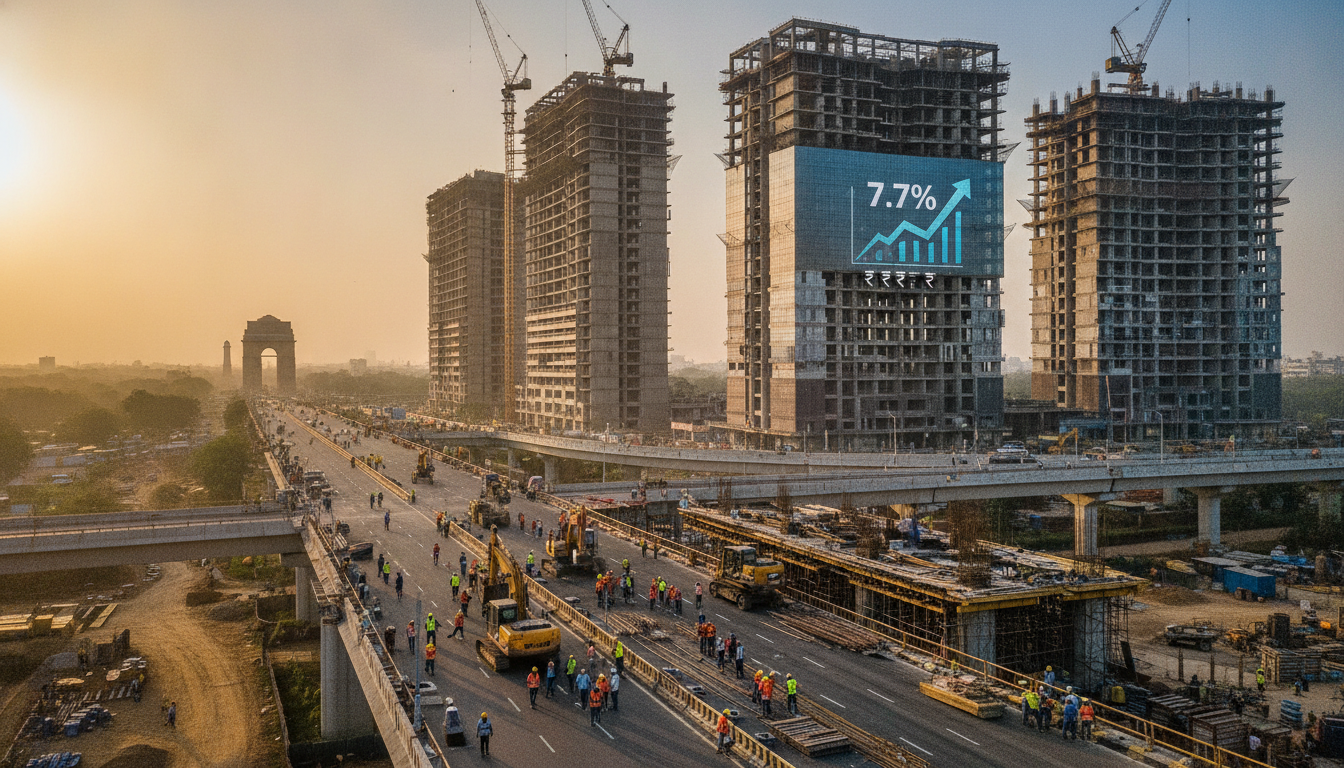
India public works spending drives 7.7% growth, powers highways, high-speed rail and chip plants
India public works spending on highways, high-speed rail and chip plants helped lift real GDP to 7.7% growth in fiscal 2025 amid rising domestic consumption.
India public works spending has been credited with a sharp lift to the country’s real economy, as large-scale outlays on highways, high-speed rail and semiconductor factories coincided with robust household spending to produce a 7.7% growth rate in fiscal 2025. Government planners accelerated capital expenditure to plug infrastructure gaps and attract manufacturing investment, producing visible construction activity across major states. Policymakers say the mix of public investment and private consumption has helped sustain growth even as global headwinds persist.
Government ramps up infrastructure outlays
The central government has significantly increased budgeted capital expenditure, directing resources to transport corridors, urban transit and industrial parks. These allocations reflect a strategic shift toward projects that can boost productivity and reduce logistics costs for exporters and domestic manufacturers. Officials contend that higher public works spending accelerates private-sector investment by improving connectivity and lowering long-term operational barriers.
High-speed rail and highways move to the front of the agenda
Major transport projects, including a high-speed rail corridor and expanded national highways, have entered advanced stages of planning and, in some cases, construction. The Mumbai high-speed rail station under construction is one of several high-profile sites where activity is measurable and employment intensive. Improvements to road and rail networks are expected to shorten travel times and ease freight bottlenecks that have long constrained interregional commerce.
Semiconductor plants and the industrial push
Alongside transport projects, the government has prioritized semiconductor and electronics manufacturing, offering incentives and land allocations to attract global chipmakers. Investment in chip fabrication plants aims to develop a domestic value chain and reduce reliance on imports for critical components. Observers note that semiconductor projects tend to be capital-intensive and have long lead times, but they can deliver high-skilled jobs and ancillary supplier networks when implemented effectively.
Consumption remains a central growth pillar
Private consumption continued to underpin the broader expansion, with households sustaining demand for goods and services that in turn support manufacturing and retail sectors. Wage growth and improving employment figures in urban areas have helped maintain spending momentum. Analysts say the simultaneous rise in public capital projects and healthy consumption forms a complementary growth dynamic, with government works providing immediate demand while enhancing supply-side capacity.
Financing the push and fiscal trade-offs
The surge in public works spending has prompted scrutiny of financing methods, including borrowing, reprioritization of existing budgets and public-private partnerships. Authorities emphasize that many projects are financed through targeted capital budgets rather than recurrent spending, limiting immediate pressure on day-to-day fiscal balances. Still, watchdogs and investors are watching closely for cost overruns, project delays and the long-term implications for public debt if investment does not translate into higher revenue growth.
Implementation challenges and delivery risks
Despite the policy emphasis, implementation hurdles remain substantial. Land acquisition, environmental clearances, supply-chain bottlenecks and contractor capacity can delay timelines and inflate costs. Moreover, complex projects like semiconductor fabs require sustained policy consistency and stable power and water supplies to be viable. The degree to which state governments coordinate with the centre will also influence project outcomes and the equitable distribution of benefits.
A range of regional impacts is already visible: construction activity has boosted employment in project corridors, and ancillary industries—from steel to logistics—are recording higher orders. However, the benefits are uneven, with urban centers drawing a disproportionate share of large infrastructure investments.
Looking ahead, officials say the blend of public works spending and household demand should support continued expansion, but they acknowledge that sustaining a near-8% growth rate will require steady progress on completing large projects and improving private investment sentiment. Close monitoring of project execution, transparent procurement and disciplined fiscal management will be essential to convert spending into durable economic gains.
Sustained attention to implementation and financing will determine whether the current surge in infrastructure and industrial outlays translates into long-term productivity gains and broader economic resilience.

