
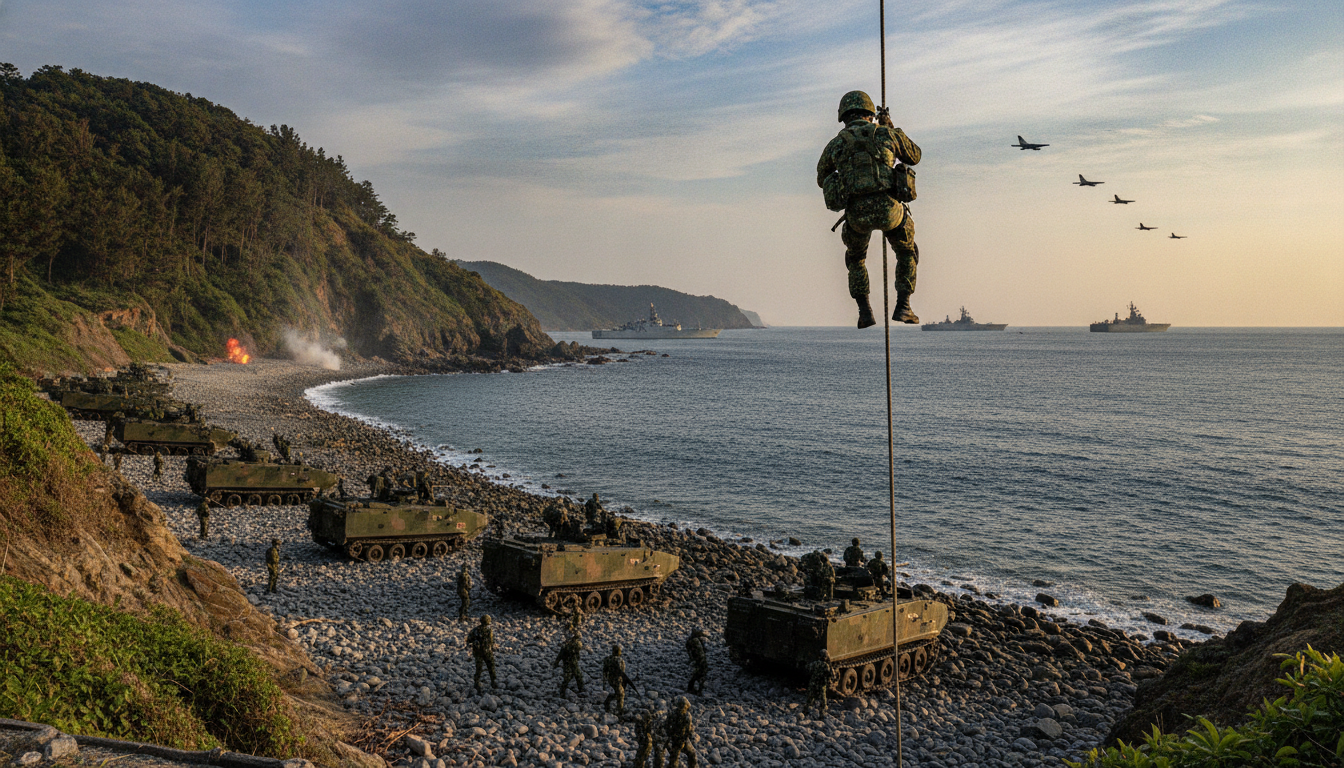
Taiwan combat readiness exercise shifts to unscripted rapid-deployment drills amid Chinese activity
Taiwan holds a five-day combat readiness exercise, using unscripted rapid deployment drills to speed transition to wartime posture amid Chinese activity.
Taiwan’s military launched a five-day combat readiness exercise this week in Kaohsiung aimed at practicing unscripted, rapid-deployment responses to a crisis. The exercise, described by defence officials as a move toward more realistic training, is intended to shorten the time needed to move from peacetime routines to a wartime posture. Officials framed the drills as part of a broader push to ensure forces can react quickly and flexibly if tensions escalate across the Taiwan Strait.
Five-day exercise underway in Kaohsiung
The exercise centers on a sequence of live drills and command-post evaluations conducted around Kaohsiung and nearby training areas. Military units are rehearsing mobilization procedures, communications handovers and rapid movement of troops and equipment under simulated threat conditions. Defence spokespeople emphasized the compressed timeline of the training, with multiple scenarios run in quick succession to replicate the operational tempo expected in a real contingency.
Participation includes elements from different branches of Taiwan’s armed forces operating in concert to test joint coordination. Commanders said the goal is to validate decision-making chains and logistics flows that would be critical in an abrupt crisis. The format intentionally reduces scripted cues so that commanders and units must adapt to changing conditions in real time.
Shift to unscripted, realistic drills
This exercise marks a deliberate shift away from rehearsals that follow prearranged scripts toward more chaotic, realistic scenarios. Officials said unscripted training forces personnel to confront unpredictability, including degraded communications, surprise movements and simulated electronic interference. That realism is intended to reveal weaknesses in procedures that scripted drills can obscure, allowing the military to correct them before a genuine emergency.
Training designers said they are emphasizing initiative at lower command levels so front-line units can act without waiting for detailed direction. This decentralised approach aims to preserve tempo if higher headquarters are disrupted. The emphasis on improvisation also tests how well reserve forces and civilian-military interfaces can be integrated quickly.
Focus on rapid deployment and wartime transition
A central objective of the Taiwan combat readiness exercise is to reduce the time required to transition from normal operations to sustained combat posture. Officials pointed to bottlenecks in mobilization, equipment readiness and transportation networks as priorities for improvement. Exercises have included rapid loading of vehicles, expedited arming procedures and accelerated air and sea lift drills to move forces to forward positions.
Planners are also assessing command-and-control handoffs that occur when civilian authorities transfer crisis responsibilities to military leaders. Faster, clearer protocols for that transfer were highlighted as essential to preventing paralysis in the early, decisive hours of any confrontation. The drills measure not only speed but the reliability of those rapid transitions under pressure.
Units and assets being tested
The five-day programme brings together ground, naval and air components, along with electronic-warfare and logistics units, in multi-domain exercises. Armoured and amphibious units practiced rapid embarkation, while air squadrons conducted short-notice sorties to validate scramble procedures. Support elements carried out sustained resupply missions to determine how quickly sustainment can be scaled up during an extended crisis.
Exercises also incorporated simulated missile defense and counter-fire measures, reflecting the priority Taiwan places on protecting population centers and critical infrastructure. Reserve units — increasingly important to Taiwan’s defence planning — were activated to test call-up procedures and integration with active-duty formations.
Regional context and Chinese military activity
The drills come amid continued concern in Taipei about heightened Chinese military activity near Taiwan, including increased patrols, sorties and naval demonstrations. Taiwanese officials have linked the shift to unscripted training to a need to operate under conditions where adversary actions create uncertainty and disruption. Analysts say Beijing’s expanded military footprint in the region has prompted Taipei to prioritise agility and resilience in planning.
Foreign diplomats and regional security observers have noted that Taipei’s focus on rapid transition is consistent with broader efforts across the Asia-Pacific to harden defence postures without crossing thresholds that could provoke escalation. The exercise therefore serves a dual purpose: improving operational readiness while signaling intent to deter potential coercion.
Implications for Taiwan’s defence posture
Military planners view the exercise as part of a continuous reform of Taiwan’s defence posture that stresses distributed forces, reserve integration and rapid escalation management. The move toward unscripted, rapid-deployment drills could accelerate reforms in procurement, training doctrine and civil-military coordination. Officials say lessons from the exercise will inform subsequent training cycles and equipment priorities.
Observers caution that while exercises can expose and fix operational gaps, they do not replace long-term investments in platforms, logistics and personnel depth. Taiwan’s leadership has suggested a sustained programme of realism-focused training will be necessary to maintain credible deterrence as regional dynamics evolve.
The exercise also has domestic resonance: leaders have framed rapid-deployment capability as a safeguard for civilian safety and continuity. Public communications around the drills aim to reassure citizens about preparedness while avoiding unnecessary alarm.
Taiwan’s defence authorities said they will publish after-action assessments in the coming weeks and adjust training plans based on the findings. They emphasized that exercises like this five-day combat readiness exercise are intended to keep forces sharp and adaptable in an increasingly uncertain security environment.

