
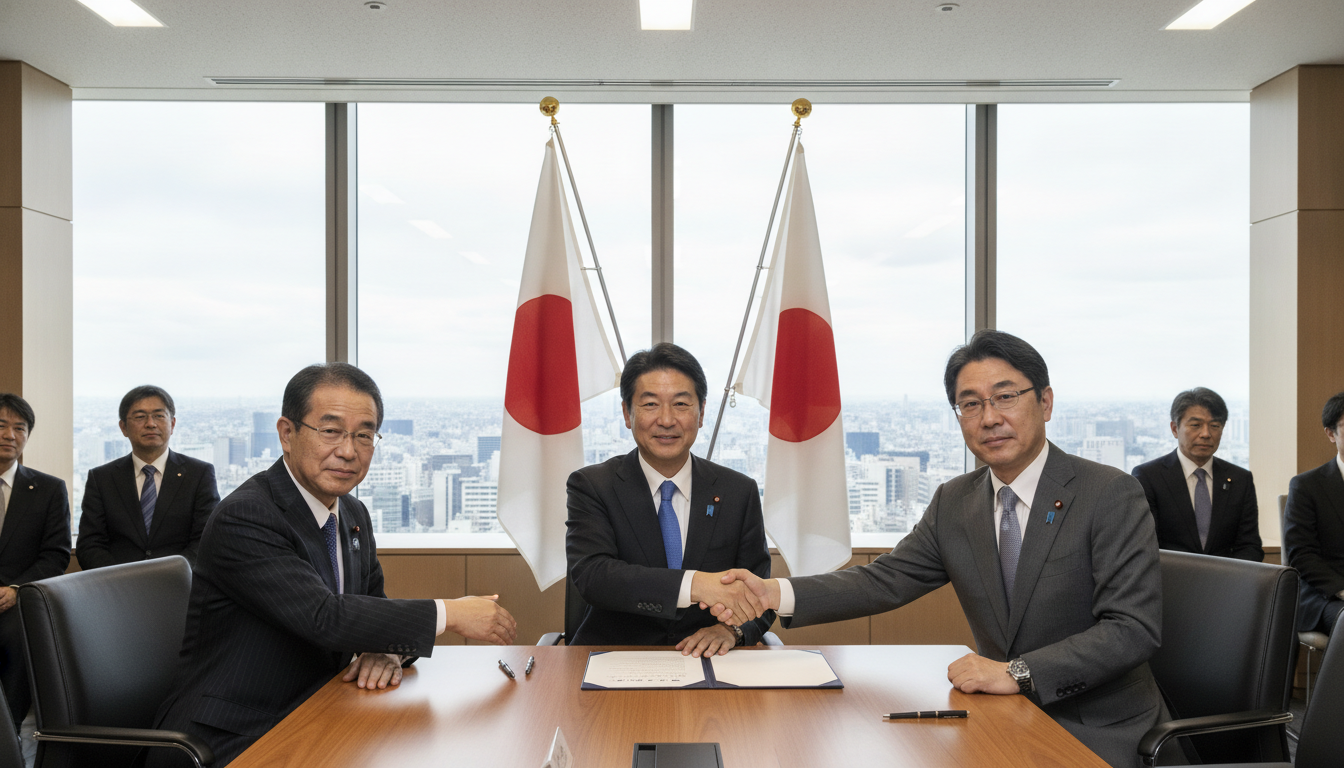
Three-party talks set up council to explore centrist merger
Leaders of the Centrist Reform Union, Constitutional Democratic Party and Komeito agreed on June 26, 2026 to establish a consultative council to explore a centrist merger.
The leaders of the Centrist Reform Union, the Constitutional Democratic Party and Komeito met at the Diet on June 26, 2026 and formally agreed to create a consultative body, marking a new phase in Japan’s opposition realignment. The three-party talks will initially focus on organizational arrangements, election strategy and key policy issues, with party secretaries-general charged to begin concrete discussions next week. While the initiative signals a push toward a unified centrist alternative to the current government, party officials warn that substantive progress is not guaranteed before the Diet session ends on July 17, 2026.
Leaders agree to establish consultative council
At the June 26 meeting Junya Ogawa, leader of the Centrist Reform Union, proposed formation of what he styled a “Three-Party Organizational Issues Council” to coordinate possible merger options. Shunichi Mizuoka of the Constitutional Democratic Party and Toshiko Takeya of Komeito expressed formal acceptance of the proposal and conveyed their intention to participate. The three leaders agreed the council would be empowered to convene relevant committee chairs and secretariats as discussions require.
Ogawa framed the effort as a response to what he described as a need for “a credible alternative” to the current administration, urging cooperation among centrist and liberal forces. He said the council’s work would proceed under a broad political rationale aimed at creating a dependable political force. The meeting produced a compact mandate: to begin by focusing on organizational, electoral and policy coordination.
Scope of talks: organization, elections and policy
Party officials confirmed the council will take up three core areas—party organization, election strategy and policy platforms—rather than immediate structural merger mechanics. Officials said organizational questions would include membership, local branches and the roles of party officers in a joint framework. Election talks are expected to examine candidate selection, district strategies and coordination to avoid vote-splitting.
Policy discussions will aim to identify common ground on priority issues that could unite the three parties ahead of any formal realignment. Sources close to the talks indicated that working-level meetings will include policy chairs and committee heads, enabling substantive debate on platform convergence. The council’s remit, they added, is to prepare options rather than to deliver a binding merger blueprint immediately.
Proposed structure and participants
Ogawa proposed a flexible participation model in which party policy chiefs, election strategy chiefs and organizational leaders join sessions as topics dictate. The three parties agreed that secretaries-general would take the lead in early-stage coordination and set the agenda for subsequent meetings. This structure is intended to balance political leadership with technical, operational planning from each party’s apparatus.
Officials said ad hoc working groups could be formed beneath the council to handle discreet tasks such as legal reviews, local branch integration and communications. Those groups would report back to the secretaries-general and to the leaders when policy or structural decisions were required. The arrangement is designed to preserve each party’s autonomy while allowing pragmatic collaboration.
Timeline and hurdles before Diet recess
The parties plan to begin concrete discussions as early as next week, but several factors complicate any rapid timeline. The current Diet session is scheduled to conclude on July 17, 2026, leaving a narrow window for detailed negotiations and agreement on contentious items. Party insiders cautioned that procedural work, internal approvals and local-level consultations will take time and could delay major decisions beyond the session’s end.
Practical obstacles include reconciling differing organizational rules, negotiating candidate placements ahead of electoral calendars, and aligning policy stances on sensitive issues. Each step requires approval processes within the respective parties, and any proposals will be subject to debate among rank-and-file members. Observers say that while the start of talks is significant, progress should be judged on outcomes rather than initial intent.
Diverging positions among the three parties
Despite the joint announcement, differences in approach and appetite for a full merger emerged immediately after the meeting. Komeito, historically cautious about abrupt shifts given its own organizational ties and voter base, signaled a preference for measured, issue-by-issue coordination rather than an immediate structural union. Officials close to the party stressed maintaining policy identity while exploring practical cooperation.
The Constitutional Democratic Party displayed a mixed posture, with some factions open to deeper integration and others urging careful scrutiny of electoral ramifications. The Centrist Reform Union, led by Ogawa, has taken the most proactive stance in pushing for consolidation as a means to present a unified alternative. These internal contrasts underline the political calculation each party must make ahead of potential electoral tests.
Implications for opposition alignment and next steps
Political analysts say the creation of the consultative council could reshape opposition dynamics if it leads to meaningful coordination in electoral districts and policy messaging. A successful alignment would aim to reduce vote fragmentation and offer voters a clearer centrist-liberal option against the incumbent administration. The degree to which the council can translate meetings into concrete electoral strategy will be pivotal in the coming months.
Next steps include scheduling working-level sessions led by the secretaries-general, forming topic-specific teams and holding internal consultations within each party. Leaders agreed to reconvene expected progress reports as discussions unfold, but left open the timeline for any legal or formal merger procedures. For now, the three-party talks remain a preparatory step that observers will watch closely for signs of deeper realignment.
The parties’ immediate timetable and the limited window before the Diet recess mean the council’s initial role is likely to be one of coordination and option-setting rather than rapid transformation. The coming weeks will test whether differences among the Centrist Reform Union, the Constitutional Democratic Party and Komeito can be bridged into a durable, electorally viable collaboration.

