
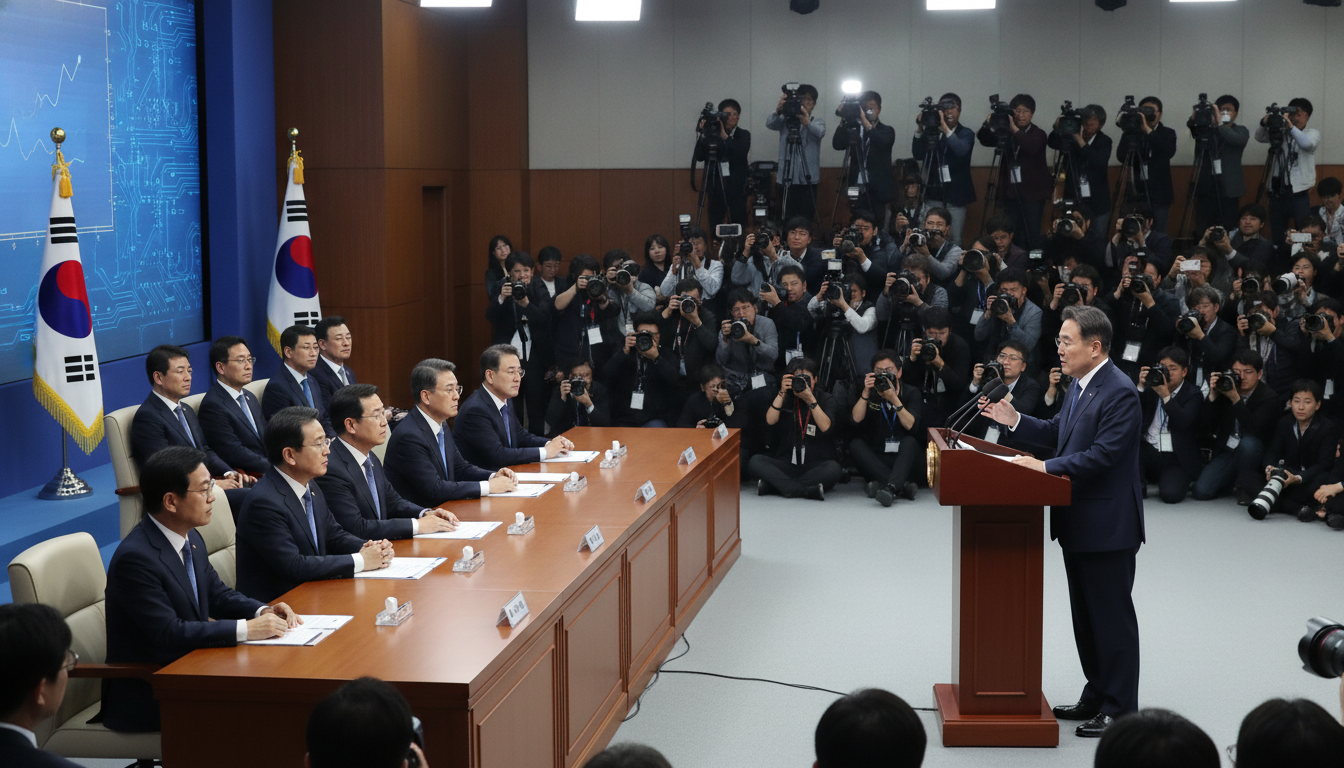
South Korea Announces Unprecedented 800 Trillion Won Semiconductor Investment with Samsung and SK Hynix
South Korea semiconductor investment: President Lee Jae‑myung unveiled an 800 trillion won plan with Samsung and SK Hynix to expand chipmaking capacity and secure an edge in the global AI economy.
South Korea’s government on Monday announced a landmark 800 trillion won (about $520 billion) semiconductor investment package with Samsung Electronics and SK Hynix aimed at rapidly expanding domestic chipmaking capacity. President Lee Jae‑myung described the move as occurring at a “decisive moment” as artificial intelligence reshapes global markets, and said the plan is intended to preserve the country’s technological leadership and manufacturing base. The agreement signals a large-scale public‑private effort to accelerate production of advanced semiconductors tied to AI applications.
Government and industry outline scope of the investment
The presidential office said the program will combine state support with commitments from the two largest South Korean memory-chip makers, Samsung and SK Hynix, to scale up fabrication facilities and related infrastructure. Officials framed the arrangement as a partnership: the state will provide financial incentives and policy support while companies commit capital and project timelines. Sources close to the discussions described the package as unusually large for peacetime industrial coordination, reflecting heightened urgency around AI-related chips.
Observers note the announcement focuses on expanding capacity across multiple fabrication nodes and increasing production of chips used in AI servers and data centers. While specific project timetables and funding breakdowns were not detailed in the initial statement, officials said the investment spans supply‑chain elements, research and development, and workforce training. The government emphasized the goal of reducing reliance on foreign production bottlenecks and boosting long‑term export competitiveness.
Strategic motives tied to the AI-driven economy
President Lee framed the investment as a response to structural changes driven by artificial intelligence, saying the nation must act now to secure its place in a reconfigured global economy. Policymakers argue that AI will concentrate demand on advanced semiconductors, creating both opportunities for producers and risks for economies without ample fabrication capacity. The Korean plan aims to position domestic firms to supply AI server chips and memory components at scale, tapping strong global demand.
Analysts say the move also reflects geopolitical considerations as countries seek secure, diversified chip supplies amid trade tensions and export controls. By boosting local production, South Korea hopes to insulate critical sectors from supply disruptions while strengthening bargaining power with foreign customers and partners. The initiative is therefore both economic and strategic, designed to align industry capabilities with broader national security and industrial policy objectives.
Industry commitments and likely areas of expansion
Samsung Electronics and SK Hynix have pledged to accelerate investments in new fabrication plants and advanced process technologies, according to government briefings. Both companies already operate some of the world’s most advanced memory fabs, and the new plan is expected to expand capacity for DRAM and NAND memory as well as exploration into logic and AI accelerator chips. The collaboration could include joint research programs, co‑funded pilot lines and coordinated procurement to lower the cost and risk of capacity expansion.
Experts caution, however, that scaling up advanced chip production requires sustained capital expenditure, skilled personnel and complex supply-chain coordination. Building new fabs and upgrading processes can take several years, and governments typically complement corporate spending with tax incentives, grants, and support for utilities and land development. South Korea’s package appears designed to reduce those barriers and accelerate projects that would otherwise face long lead times.
Economic and labor implications within South Korea
If realized at scale, the investment could have significant economic impact through job creation, supplier growth and increased exports. Fabrication plants support large local ecosystems, from equipment makers to materials suppliers and facilities services, and expanded chipmaking could boost manufacturing employment and regional development. Officials have highlighted plans for workforce training initiatives to meet specialized labor demands in semiconductor manufacturing and R&D.
Still, economists note that the multiplier effects depend on efficient deployment of funds and the ability of domestic suppliers to scale. The competitiveness of production will hinge on productivity, energy costs, and the pace of technological innovation relative to competitors in Taiwan, the United States and elsewhere. The government will likely face pressure to ensure transparent procurement and effective oversight as public resources are mobilized alongside private capital.
International reactions and competitive dynamics
Global technology and policy observers will closely monitor how this South Korea semiconductor investment affects market dynamics, particularly among leading chip-producing nations. Competitors may respond with their own subsidy programs, incentives or strategic alliances to capture portions of the rapidly growing AI chip market. Buyers of semiconductors — including cloud providers and hardware makers — will also watch for changes in supply availability and pricing as capacity expands.
The announcement may trigger discussions in trade and diplomatic channels about state support for strategic industries and the rules governing such interventions. For countries dependent on Korean chips, any acceleration of production could offer short-term relief from bottlenecks, while long-term competition could intensify across multiple technology fronts.
This plan marks a substantial escalation in South Korea’s industrial policy aimed at preserving technological leadership in semiconductors and ensuring the country’s firms are competitive in an AI-dominated market.

