
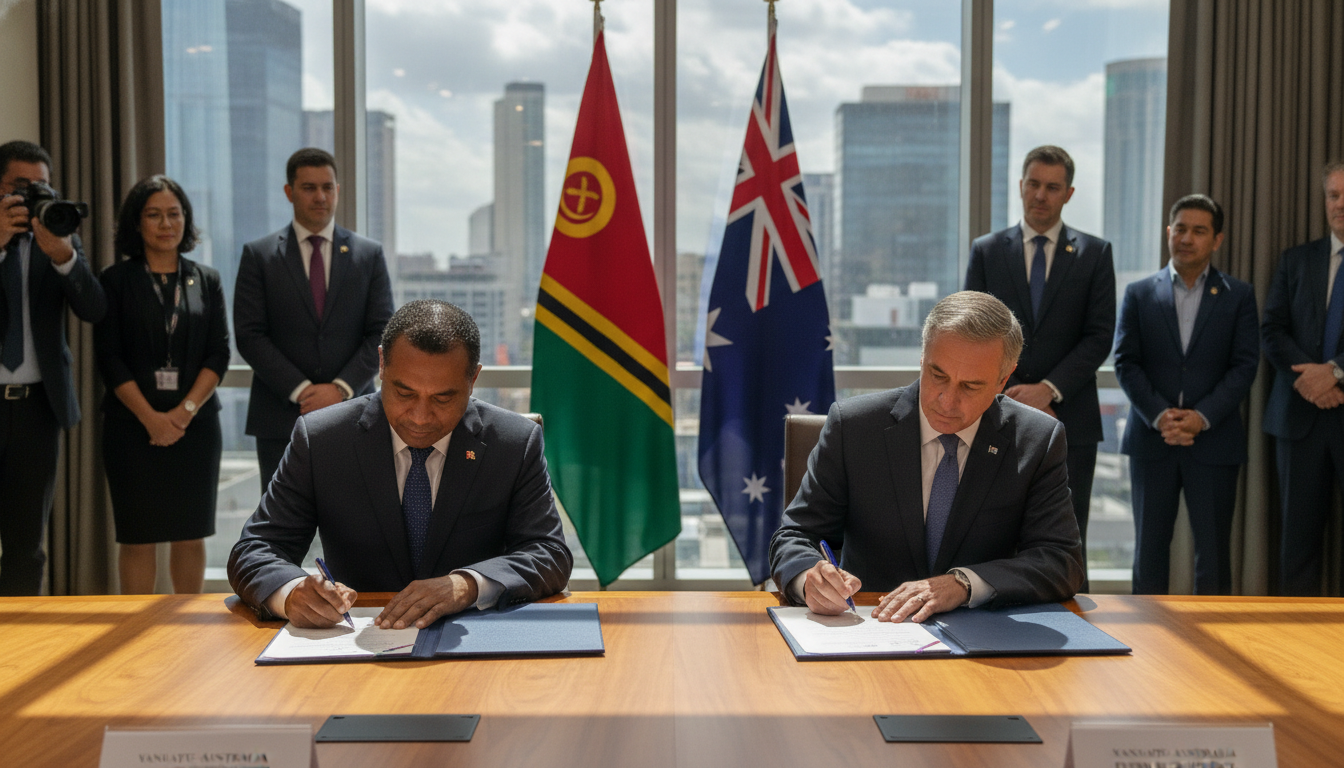
Australia and Vanuatu sign Nakamal Agreement, barring foreign military bases
Australia and Vanuatu signed the Nakamal Agreement in Canberra on June 29, 2026, a bilateral treaty that formally commits Vanuatu to prohibit foreign military bases and keeps the island nation’s critical infrastructure free from militarisation. The pact, signed by Australian Prime Minister Anthony Albanese and Vanuatu Prime Minister Jotham Napat at Parliament House, was presented as a framework for deeper security, economic and disaster-response cooperation. (foreignminister.gov.au)
Provisions ban foreign military bases and protect infrastructure
The Nakamal Agreement explicitly states that Vanuatu will not permit the establishment of foreign military bases or military infrastructure on its territory, and it affirms protections for critical infrastructure against militarisation or unauthorised access. The text also sets out commitments to keep key facilities and services free from foreign interference as part of a broader security understanding between the two countries. (apnews.com)
Consultation mechanism on third‑party projects, without a veto
Under the pact, Vanuatu agreed to consult Australia when considering third‑party engagement in critical infrastructure projects, but the arrangement falls short of granting Canberra a veto over those investments. Negotiators described the clause as a procedural consultation requirement intended to manage strategic risk while preserving Vanuatu’s sovereign right to pursue development partnerships. Australian and Vanuatuan officials stressed that the compromise was a central factor in reaching an agreement acceptable to Port Vila. (whbl.com)
A strategic response amid growing China competition
The Nakamal Agreement comes amid an intensified contest for influence in the South Pacific, where Beijing has sought closer ties with island states through loans, infrastructure projects and a separate proposed pact with Vanuatu known as the Namele Agreement. Canberra has framed the Nakamal deal as part of a wider Australian effort to hedge against the possibility of a permanent foreign military footprint in the region, while Vanuatu has maintained it will continue to pursue economic cooperation with multiple partners. (abc.net.au)
Economic commitments, disaster response and funding timetable
Earlier drafts of the Nakamal framework envisaged A$500 million in Australian support spread over a decade for climate resilience, infrastructure and capacity building; the final agreement confirmed economic and disaster‑response cooperation but left some funding details to be finalised. Canberra said it would publish costings by December 2026, and officials said the deal included specific provisions for prioritised emergency response pathways with Australia, New Zealand and France. The economic package is intended to underpin long‑term resilience measures in a country that remains heavily exposed to cyclones and climate shocks. (dfat.gov.au)
Vanuatu’s domestic politics and diplomatic balancing act
Vanuatu’s leadership navigated months of fraught negotiations at home, balancing the desire for development finance with concerns that a security pact might restrict the country’s options. Prime Minister Jotham Napat’s government secured assurances that the Nakamal Agreement would respect Vanuatu’s sovereignty and allow space for other development relationships, including a separate and as‑yet unsigned Namele Agreement with China that Port Vila describes as a development cooperation pact. Domestic debate in Vanuatu reflected those tensions, with the cabinet approving a revised text before today’s signing in Canberra. (abc.net.au)
Regional reactions and diplomatic signals
Pacific capitals and regional partners welcomed the deal as a reinforcement of existing security partnerships and disaster cooperation mechanisms, though some analysts cautioned it could further crystallise strategic competition between Canberra and Beijing in Melanesia. Australian officials framed the agreement as reinforcing long‑standing ties and practical support, while Beijing’s representatives in the region have emphasised that their projects are focused on infrastructure and capacity building and have sought to rebut characterisations that imply a military dimension to their engagement. (euronews.com)
The Nakamal Agreement marks a pragmatic compromise for both Canberra and Port Vila: Australia sought to secure assurances that Vanuatu would not become a locus for foreign military activity, while Vanuatu secured guarantees that preserved its ability to attract investment and maintain sovereign decision‑making. As Pacific leaders prepare for a period of closer scrutiny over infrastructure and security partnerships, the practical steps for implementation—funding timelines, consultation processes and transparency arrangements—will determine whether the deal strengthens resilience and stability in the islands or deepens diplomatic friction in the region.

