
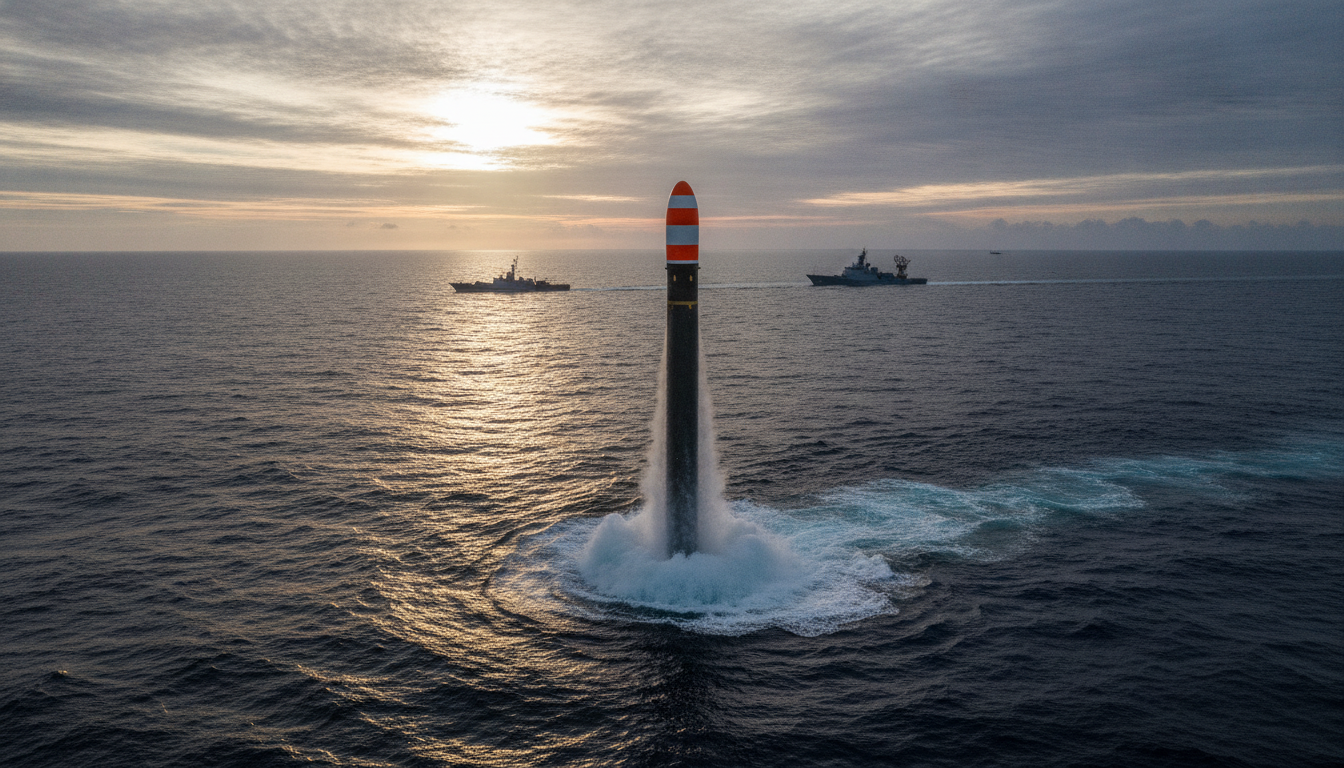
China SLBM test fires one strategic missile into Pacific, Beijing says
China SLBM test: Xinhua reports a Chinese strategic submarine launched one submarine‑launched ballistic missile into the Pacific on July 6, 2026, with a mock warhead, striking its planned target area. (150 characters)
China reported that a strategic submarine launched one submarine‑launched ballistic missile into the Pacific on July 6, 2026, saying the mock‑warhead shot struck a planned impact area. Xinhua cited the Chinese Navy’s announcement that the launch occurred at 12:01 p.m. local time (1:01 p.m. Japan time) and was part of routine annual training. The statement emphasized that the exercise had been notified to relevant countries in advance and, according to Beijing, complied with international law and practice. Chinese officials also said the firing was not directed at any specific country or target.
Launch Details
The Chinese Navy, as reported by Xinhua, said the missile was fired from a strategic nuclear submarine on July 6, 2026, at 12:01 p.m. local time and landed in the designated sea area. The statement described the missile as carrying a mock warhead intended for training purposes rather than live ordnance. Beijing indicated the operation took place in international waters of the Pacific and was planned as part of a scheduled military exercise. There was no immediate independent confirmation from foreign naval authorities in the region at the time of the announcement.
Official Chinese Statement
Xinhua quoted naval authorities saying the launch conformed to annual training plans and followed established procedures for safety and notification. Chinese officials stressed the action aligned with international law and customary practice, framing the test as routine and non‑provocative. The announcement explicitly stated the missile did not target any specific country or objective, a line Beijing has used previously to characterize such tests. The language in the statement sought to reassure outside observers while affirming China’s continued development of strategic capabilities.
Notification to Other States
According to the Chinese release, relevant nations were informed in advance of the exercise through established channels, and navigational warnings were issued for the planned impact area. Beijing’s assertion of prior notification is intended to reduce the risk of miscalculation and maritime accidents during weapons tests conducted in international waters. Verification of those notifications and their recipients remains a matter for the notified states and international monitoring bodies. Independent confirmation of the content and timing of any diplomatic notices was not provided in the Xinhua dispatch.
Technical and Strategic Context
Submarine‑launched ballistic missiles form a core leg of modern nuclear deterrents by providing an undersea, survivable launch platform for strategic forces. China has in recent years invested in enhancing the range, accuracy, and deployment of its submarine fleet and missile systems, developments that analysts say aim to strengthen second‑strike capabilities. A single reported test like this underscores Beijing’s focus on maintaining and validating strategic readiness through scheduled drills. While the Chinese account focuses on routine training, such launches also serve as operational practice for forces and a signal of capability to regional and global audiences.
Regional Security Implications
The reported SLBM test is likely to draw scrutiny from neighboring states and defense watchers concerned about shifts in maritime strategic balance in the Indo‑Pacific. Even when presented as routine, strategic missile tests can prompt calls for transparency and risk reduction measures from nearby capitals and international organizations. Governments in the region routinely monitor missile activity and issue assessments; responses may range from formal diplomatic inquiries to adjustments in surveillance posture. The degree of political or military reaction will depend on confirmation from independent tracking sources and the cumulative pattern of similar tests over time.
Monitoring and Verification
Independent verification of ballistic missile launches typically relies on national satellite, radar, and ocean surveillance assets operated by multiple states and commercial providers. Publicly available confirmation can lag behind state media reports, leaving initial accounts to be cross‑checked as more data becomes available. Analysts and open‑source monitoring groups often compare launch telemetry, debris or splashpoint data, and naval notices to corroborate official statements. Until such corroboration is publicly released, assessments of the launch will rest primarily on Beijing’s account and subsequent reporting by other governments and monitoring organizations.
China says the launch was a preplanned training exercise conducted in international waters, with a mock warhead onboard and prior notifications to relevant states, and that it was not aimed at any specific country. The event adds to a series of strategic activities that will be examined by regional capitals and independent observers as they assess China’s force posture and routine training patterns.

