
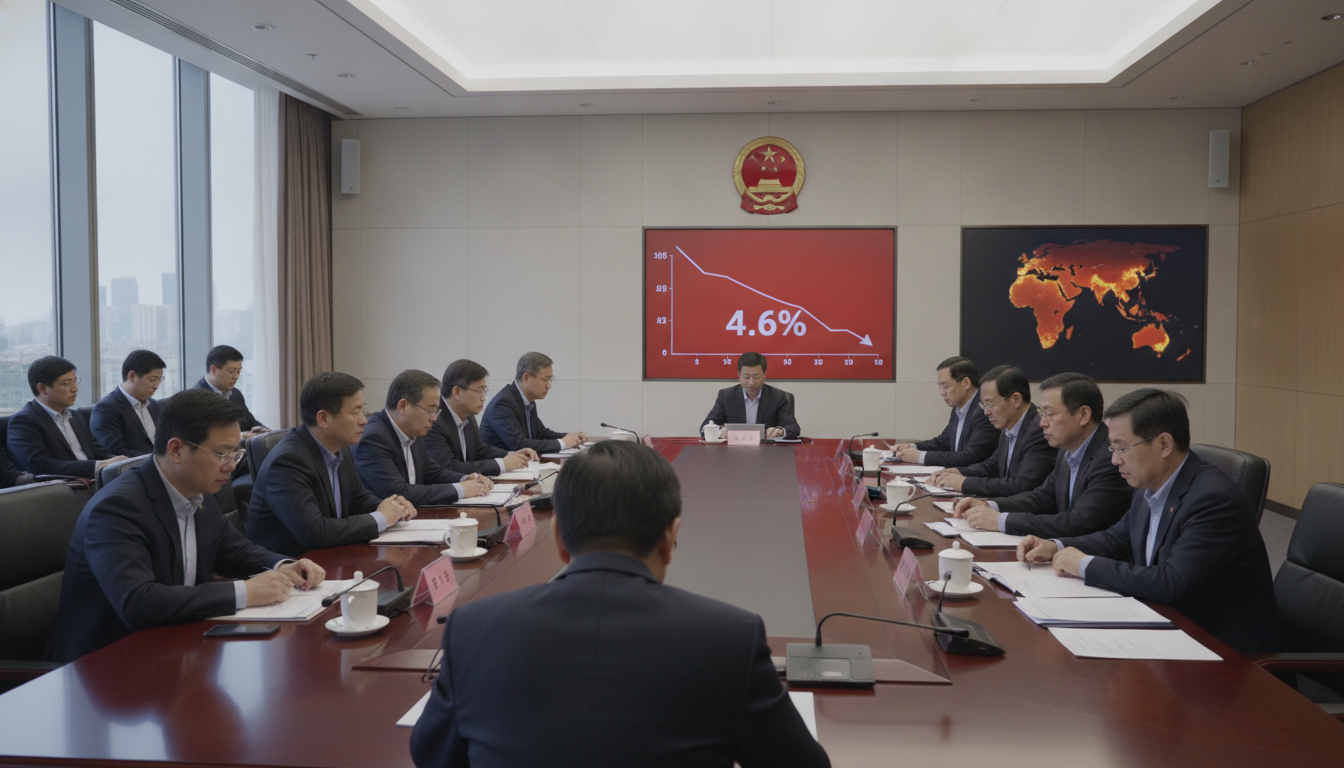
China Q2 growth seen slowing to 4.6% as property slump and energy shocks weigh
Surveyed economists expect China Q2 growth to decelerate to about 4.6% from 5% in Q1, hit by a weak property sector, soft domestic demand and energy risks tied to Middle East tensions.
China Q2 growth likely slowed in April–June, according to a recent survey of economists who pointed to weak consumer spending and a continuing real estate downturn. The survey respondents warned that rising global energy prices and uncertainty stemming from the Middle East conflict have added to downside pressures. Business investment showed limited momentum, and policymakers face a narrow window to shore up demand without reversing financial stability gains. Markets and trading partners will be watching Beijing’s policy choices closely in coming weeks.
Economists’ survey signals Q2 slowdown
A cross-section of economists polled in late June and early July converged around a Q2 growth estimate near 4.6%, down from roughly 5.0% in the January–March quarter. Respondents cited softer retail sales, slowing industrial output growth in select sectors and weaker fixed-asset investment as principal drivers. Many analysts stressed uncertainty over external demand and the timing of any significant policy easing as factors that could push growth lower.
Property sector weakness drags consumption and investment
The ailing property market continues to be a central drag on the economy, with home sales, new construction starts and developer financing remaining subdued. Weakness in housing has transmitted to household wealth effects, curbing consumer spending on discretionary items and services. Local governments, which rely heavily on land-sale revenues, face tighter budgets that have restrained infrastructure projects in some regions. Together, these dynamics have complicated efforts to generate a synchronized recovery in consumption and investment.
Middle East conflict raises energy costs and external risks
Analysts in the survey flagged the ongoing Middle East conflict as a fresh source of risk for China’s growth trajectory through higher oil and gas prices. For an economy that imports the bulk of its energy needs, even short-lived price spikes can raise production costs and reduce corporate margins. The conflict has also heightened volatility in global financial markets, which can dampen exports and complicate corporate planning. Several economists warned that a sustained rise in energy costs would erode real incomes and widen trade imbalances for the remainder of the year.
Monetary and fiscal policy face trade-offs
Policymakers in Beijing have limited room to manoeuvre without reigniting financial imbalances, according to survey participants. Monetary authorities may opt for targeted liquidity measures and modest rate adjustments rather than broad-based easing to support credit flow to healthy firms. Fiscal policy is likely to focus on infrastructure projects and selective homeowner support, but large-scale stimulus could strain debt metrics at the local-government level. Economists urged a calibrated combination of measures that support demand while guarding against renewed leverage growth.
Employment and household confidence under pressure
Slower growth has immediate implications for the labour market and household sentiment, the economists noted. Youth unemployment and underemployment in smaller cities have remained stubbornly high, undermining confidence and spending among younger cohorts. Weak wage growth and rising living costs, especially if energy prices rise, could further constrain consumption. Restoring household confidence, the respondents said, will require visible policy support and progress on stabilising the housing market.
Global spillovers and supply-chain implications
A softer China Q2 growth outcome would have measurable effects on its major trading partners and global commodity markets. Reduced Chinese demand for industrial commodities and intermediate goods could weigh on exporters across Asia and beyond. Some manufacturers have already reported softer orders for capital goods destined for China, underscoring potential supply-chain knock-on effects. Financial markets may react to any downward revision in growth expectations with increased volatility in currency and equity markets.
The path ahead, economists argued, hinges on three elements: whether domestic demand can be revived without compromising financial stability; whether energy price shocks prove transitory; and whether global trade conditions stabilise. A carefully calibrated policy response, stronger execution on housing market reforms and progress in diversifying energy sources would all help sustain a moderate recovery.
If China Q2 growth does settle near the survey’s midpoint, the economy will likely remain on a slower, more uneven expansion path through the rest of 2026. The coming weeks of policy signals and economic releases will be critical for markets and businesses gauging the scale of any policy response and the durability of the recovery.

