
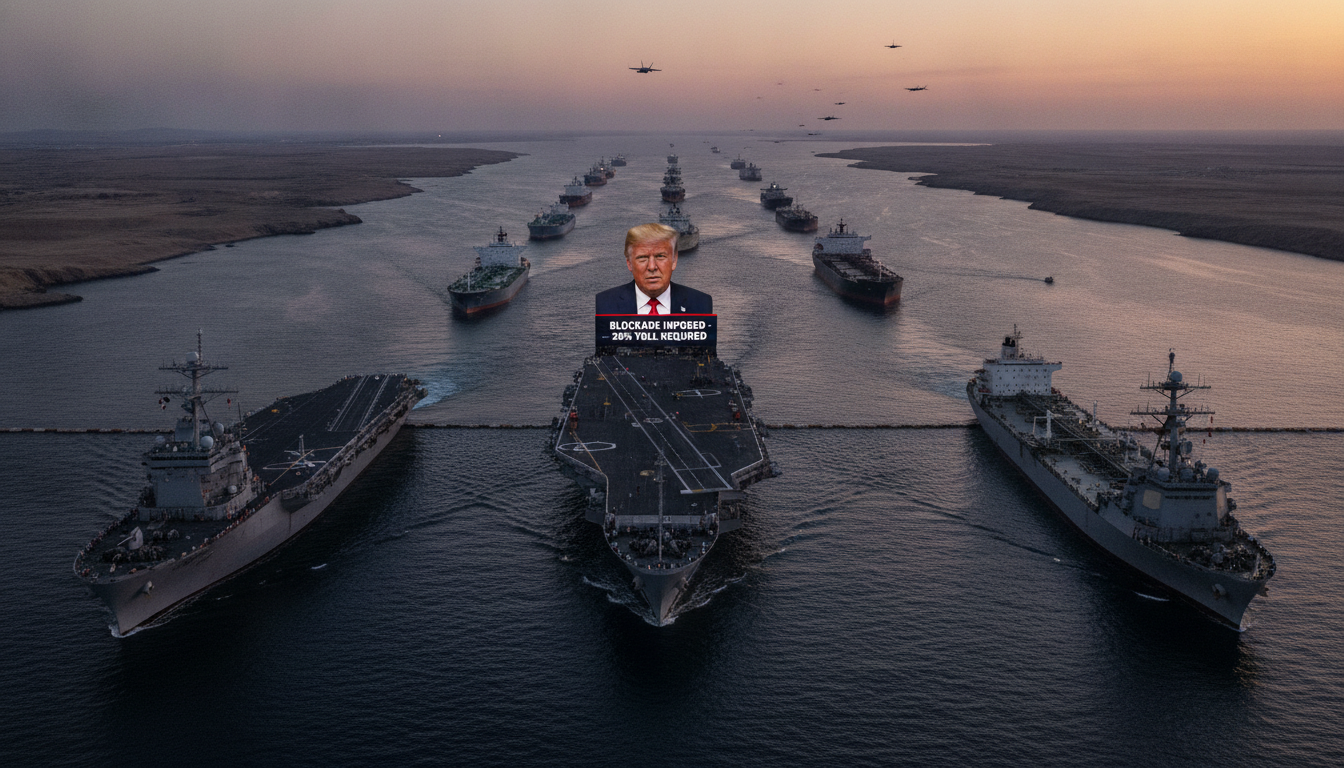
Trump demands 20% fee from ships as U.S. reimposes maritime blockade on Iran
U.S. President Donald Trump announced a reinstated maritime blockade on Iran and said the United States will charge a 20% fee on cargo transiting the Strait of Hormuz, escalating tensions in the region. The move, unveiled on July 13, 2026, set off immediate diplomatic and commercial alarm as governments and shipping firms sought clarity on enforcement and legality. (apnews.com)
Trump’s announcement and policy terms
President Trump declared on July 13 that the United States would act as “the guardian of the Hormuz Strait” and seek reimbursement at a 20% rate on cargo transiting the waterway, while asserting that Iranian vessels would be denied passage under the renewed blockade. His statement, posted on social media and restated in press comments, did not include full operational details or an implementation timetable. (cbsnews.com)
The White House framed the move as a security measure intended to ensure “fair and open use” of the chokepoint, but it also signalled a direct reversal of recent diplomatic concessions that had left Iran with some leverage over passage. Officials acknowledged the proposal would raise complex questions about which cargoes would be subject to the fee and how refunds, exemptions or disputes would be handled. (washingtonpost.com)
U.S. enforcement plans and military posture
U.S. military statements accompanying the announcement indicated forces would enforce restrictions on Iranian-flagged vessels and step up patrols to secure nominated transit lanes, though commanders offered few specifics on rules of engagement. Pentagon briefings suggested the enforcement regime would rely on naval assets already operating in the region, supplemented by allied surveillance and maritime interdiction teams. (axios.com)
Analysts noted that practical enforcement of a blockade across the busy Strait of Hormuz — through which an estimated one-fifth of seaborne oil passes — would require sustained presence and coordination with regional partners. Military planners also face the operational challenge of separating Iranian merchant traffic from Iranian Revolutionary Guard Corps (IRGC) vessels and ensuring commercial ships can identify authorized escort or oversight units. (apnews.com)
Regional reactions and Iran’s response
Tehran reacted predictably with anger and rhetorical countermeasures, with Iranian officials insisting the strait remains under Iranian sovereignty and arguing they, not the United States, have the right to levy fees on passage. Iranian foreign ministry statements and state media used the U.S. announcement to justify their own previous claims over control, and Tehran warned of reciprocal steps. (cnn.co.jp)
Gulf states voiced mixed responses, balancing security concerns with economic realities. Some regional governments immediately sought clarification from Washington about the blockade’s scope and whether neutral and allied-flagged commercial shipping would be affected, while others privately signalled apprehension that further escalation could destabilize a fragile diplomatic opening achieved only weeks earlier. (axios.com)
Impact on shipping, trade and energy markets
Global shipping operators and insurers reacted swiftly, with several carriers rerouting vessels away from the Strait of Hormuz or delaying transits until operational rules were clarified. Market data showed a rapid contraction in ship traffic through canonical transit points and spikes in freight and insurance premiums as underwriters reassessed risk exposure in the Gulf. (worldoil.com)
Oil markets responded with a sharp price rise on fears that the blockade and any retaliatory strikes could choke supply through the key chokepoint. Traders priced in the possibility of extended disruption, prompting strategic stock release discussions among consumer countries and heightened coordination among energy companies monitoring supply chains that rely on Gulf crude. (worldoil.com)
Legal, diplomatic and institutional questions
International law experts and multilateral bodies immediately questioned the legality of charging transit fees and imposing a unilateral blockade on an international strait. The International Maritime Organization — and several states — noted that unilateral tolling of passage rights would clash with established norms governing transit passage and maritime freedom unless justified under narrow security exceptions. (apnews.com)
Diplomats in Europe, Asia and the United Nations signalled urgency in seeking clarification and urged de-escalation. Several capitals called for consultations through established fora to examine whether the U.S. action is compatible with prior agreements and customary law, and to explore diplomatic measures that could prevent further military confrontation in the Gulf. (washingtonpost.com)
Commercial and strategic aftermath to monitor
Shipping firms, insurers and port operators are preparing contingency plans while traders and industrial buyers review supply alternatives and contract terms. The prospect of a sustained or intermittently enforced blockade is expected to reshape short-term logistics strategies and could accelerate longer-term diversification of energy routes. (worldoil.com)
For governments and international institutions, the immediate tasks are to seek operational clarity from Washington, to press for channels that reduce the risk of miscalculation, and to prepare legal and diplomatic responses if unilateral tolling proceeds. Observers say the coming days will be critical in determining whether the announcement becomes an enduring policy or a short-lived escalation. (washingtonpost.com)
The United States’ decision to demand a 20% fee for passage through the Strait of Hormuz marks a dramatic escalation in a conflict that has already seen repeated strikes and counterstrikes, and it raises urgent questions about maritime law, regional stability and the cost of global trade security.

