
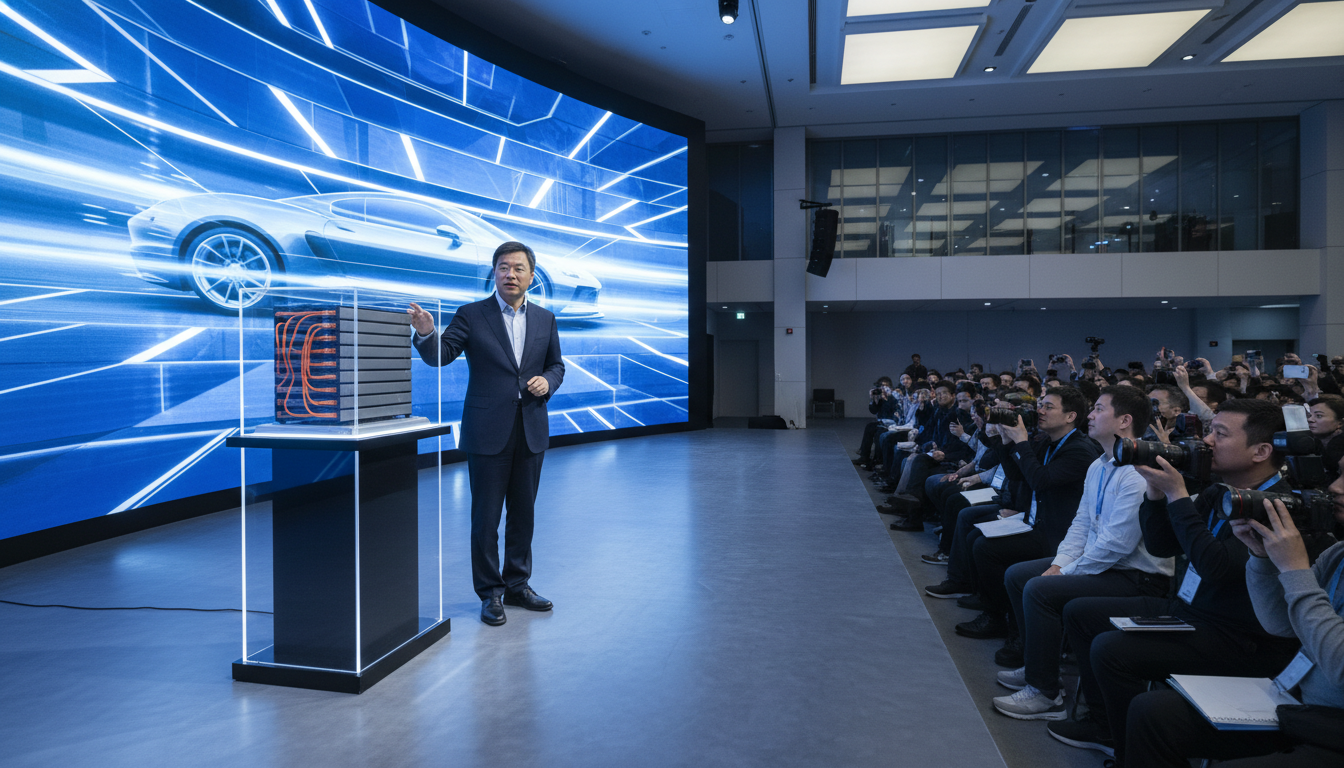
CATL Unveils 6-Minute Charging Breakthrough with New Shenxing Battery Ahead of Auto China
CATL unveils Shenxing battery claiming a 6-minute charging breakthrough on April 21 ahead of Auto China — market moves, technical claims and implications.
Contemporary Amperex Technology Co. Ltd. (CATL) on April 21 unveiled the latest iteration of its flagship Shenxing battery, touting a 6-minute charging breakthrough and gains in driving range ahead of the Auto China motor show in Beijing. The company said the development marks a significant leap in charging speed, a claim that drew immediate attention from automakers and investors. Shares in CATL opened little changed in Shenzhen and fell 2.17% in Hong Kong as markets weighed the announcement against technical, commercial and regulatory questions.
Market reaction in Shenzhen and Hong Kong
CATL’s stock movement reflected a mixed investor response to the announcement, with Shenzhen trading flat while the Hong Kong listing declined by 2.17 percent on the day following the reveal. Market analysts described the share action as a reflection of cautious optimism: investors welcomed potential technological progress but remained uncertain about timelines for commercial rollout and verification of the company’s claims. Short-term volatility underscored how announcements of disruptive battery advances can produce immediate trading swings even before independent testing or partner confirmations.
Company claims on Shenxing’s charging and range
CATL framed the upgraded Shenxing cell as a significant evolution of its flagship chemistry, emphasizing dramatic reductions in charging time alongside improved effective driving range. The company described the six-minute charging capability as a breakthrough that could substantially shorten typical EV charging sessions, while also highlighting enhancements to energy density and thermal management. CATL’s statements focused on the potential user benefits — faster turnaround, greater convenience and fewer range anxieties — but stopped short of providing detailed third-party validation data in the initial release.
Technical hurdles and verification needs
Independent validation will be central to converting CATL’s claims into commercial credibility, with engineers and testing bodies likely to probe charging profiles, state-of-charge thresholds and battery longevity under rapid fill cycles. Achieving a usable charge in six minutes typically requires sustained high-power input, sophisticated cell chemistry and robust thermal control systems to avoid degradation or safety risks. Industry experts caution that lab demonstrations and prototype performance do not always translate to durable, mass-producible solutions, and they note that cycle life, cost per kilowatt-hour and real-world operating conditions will determine success.
Implications for charging infrastructure and grid demand
If the 6-minute charging capability scales reliably, it would reshape demand for charging infrastructure by increasing the attractiveness of ultra-fast charging stations while concentrating high-power draws into shorter windows. Such a shift would place pressure on local distribution networks and require significant upgrades to power delivery at busy stations, including higher-capacity transformers, advanced cooling and smart load management systems. Grid operators, charging network providers and policymakers will need to balance the benefits of rapid turnaround for drivers against the costs and technical challenges of delivering repeated high-power charging events at scale.
Potential responses from automakers and suppliers
Automakers attending Auto China are likely to evaluate the Shenxing battery for future vehicle architectures, particularly for models targeting long-range performance and fast recharging convenience. Vehicle makers considering adoption would need to integrate battery management systems and cooling solutions compatible with higher charge rates, and they may seek co-development agreements to validate durability and safety. Battery system suppliers and tier-one contractors will also be watching closely, since widespread adoption could shift engineering priorities and accelerate investment in components designed for high-power, high-throughput charging environments.
Competitive and supply-chain considerations
CATL’s announcement intensifies competition among major battery manufacturers and could influence supply-chain dynamics for critical raw materials such as lithium, nickel and cobalt, as well as for components like advanced separators and cooling hardware. Rivals and partners in Asia, Europe and North America will likely accelerate their own R&D programs or seek alliances to avoid ceding market share in a landscape where charging speed becomes a selling point. At the same time, questions about manufacturing costs, yield rates and resource availability will shape how quickly a breakthrough moves from demonstration to mass production.
Independent testing, regulatory review and partner commitments will determine whether CATL’s 6-minute charging claim translates into a practical advantage for drivers and automakers. The upcoming Auto China show will provide a platform for further demonstrations and for potential announcements of collaborations with carmakers, charging network operators or government agencies. Observers noted that while the announcement highlights rapid progress in battery innovation, the path to mainstream adoption involves technical validation, infrastructure investment and alignment across a complex industrial ecosystem.
For now, CATL’s unveiling has refocused attention on how much faster charging technology can change the EV ownership experience, but analysts urge caution until outside laboratories and vehicle partners confirm consistent performance under real-world conditions.

