
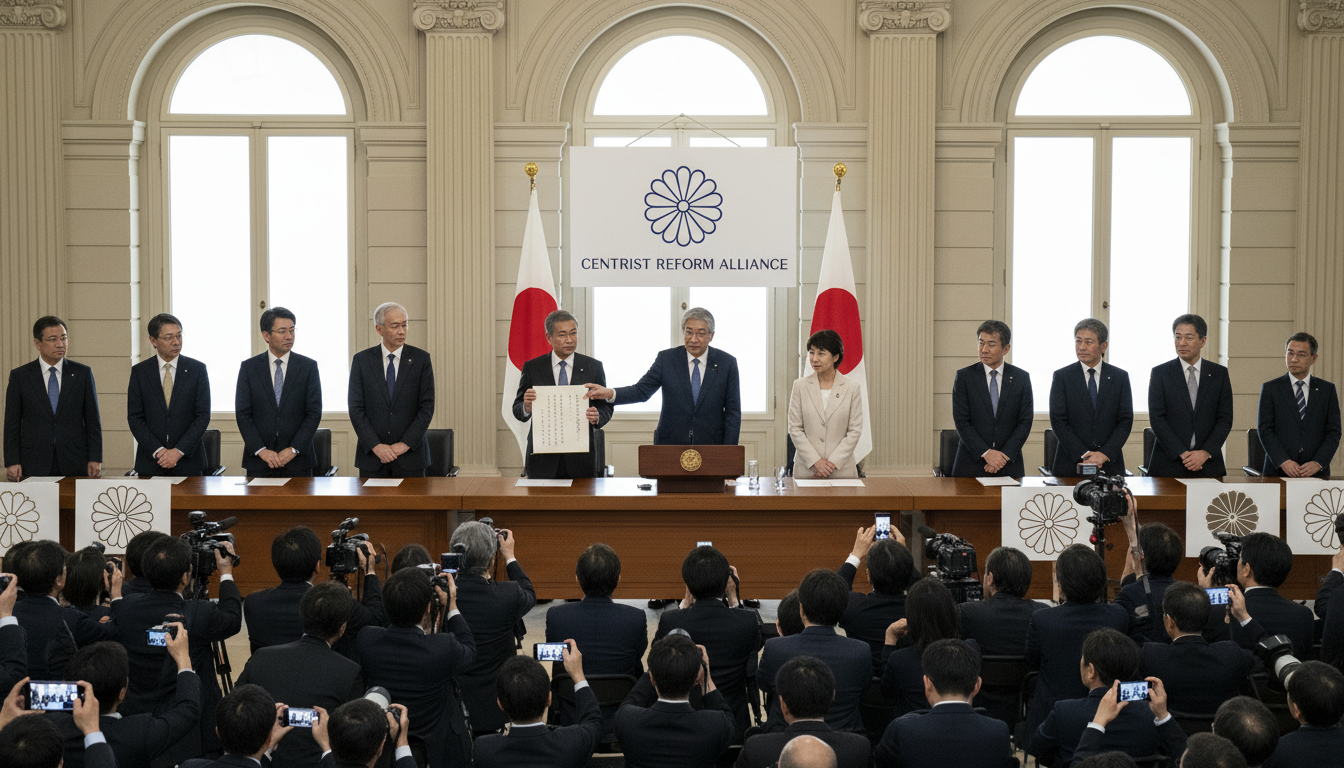
Centrist Reform Union Signals Support for Adopting Male-Line Heirs into Imperial Family
Centrist Reform Union backs adopting male-line heirs from former imperial branches and women keeping imperial status after marriage; formal decision set for May 12, 2026.
The Centrist Reform Union on May 7, 2026 moved toward accepting the idea of adopting male-line heirs from former imperial branches as a means to bolster the number of imperial family members.
The party also reaffirmed its prior support for allowing women of the imperial family to retain their imperial status after marriage, signaling alignment with key proposals to secure stable succession.
Party officials said a formal party position will be adopted at a meeting scheduled for May 12, 2026, after internal adjustments are completed.
Party meeting and the proposal package
The decision emerged from a session of the party’s “Study Group on Stable Imperial Succession,” chaired by Hiroshi Kasa, who presented an outline of the measures under consideration.
Kasa told reporters after the meeting that the proposals, including adopting male-line heirs into the imperial household, were “generally understood” by participants.
The study group framed the package as a dual approach: retaining female imperial status after marriage and supplementing the imperial lineage by recognizing male-line males from former branches through formal adoption.
Details of the adoption and marital-status proposals
Under the centrist plan, adopting male-line heirs would allow men descended through the male line of former imperial family branches to be brought into the imperial household as imperial family members.
The proposal aims to expand the pool of eligible male successors within the traditional male-line framework while avoiding more radical changes to succession rules.
On the separate issue of women who leave the imperial family through marriage, the party reiterated its support for legislation that would allow them to keep imperial status, a step it has already endorsed internally.
Unresolved questions on spouses and children
The Centrist Reform Union declined to take an explicit position on granting imperial status to spouses or children of women who retain imperial standing, saying those matters should be resolved "in accordance with the consensus of the legislature."
By leaving the spouses-and-children question open, the party signaled a willingness to defer to broader Diet negotiations and to avoid preempting cross-party compromise.
Officials indicated that the party expects detailed decisions on these peripheral but politically sensitive issues to follow further consultations and legal review.
Implications for ruling-opposition talks
The ruling coalition has already backed both allowing women to retain imperial status after marriage and adopting male-line heirs from former branches, meaning the centrist shift could accelerate inter-party negotiations.
With three major groups now aligned broadly on similar remedies, lawmakers may move more quickly toward drafting amendments to the Imperial Household Law or related legislation.
Nonetheless, technical disagreements and public sentiment could still complicate final compromises, particularly where adoption procedures and criteria for recognition are concerned.
Legal and constitutional considerations
Implementing a scheme to adopt male-line heirs into the imperial household would require careful legal drafting to reconcile existing statutes governing the imperial family.
Experts say changes of this nature typically involve modifications to the Imperial Household Law and would need to pass through both houses of the Diet.
Beyond statutory changes, proponents will need to address procedural questions—such as eligibility criteria, adoption formalities, and the timing of status transfers—to ensure any reform is legally robust and politically defensible.
Political fallout and public debate ahead
The centrist shift is likely to intensify public discussion about the balance between tradition and practical governance of the imperial institution.
Supporters argue that adopting male-line heirs preserves the male-line principle while stabilizing the monarchy’s succession prospects, whereas critics may view adoption as a stopgap or contend it raises succession legitimacy questions.
Opposition parties, conservative groups, and members of the public are expected to weigh in as the debate moves from internal party deliberations to formal legislative talks.
The Centrist Reform Union plans to formalize its position on May 12, 2026, after party leaders complete internal consultations, setting the stage for expedited Diet negotiations.
If finalized, the party’s stance could narrow the options under active consideration and shape the legislative timetable for measures intended to secure stable imperial succession.
Lawmakers and palace advisers will monitor ensuing discussions closely as both legal detail and public acceptance will determine whether the proposals can become law.

