
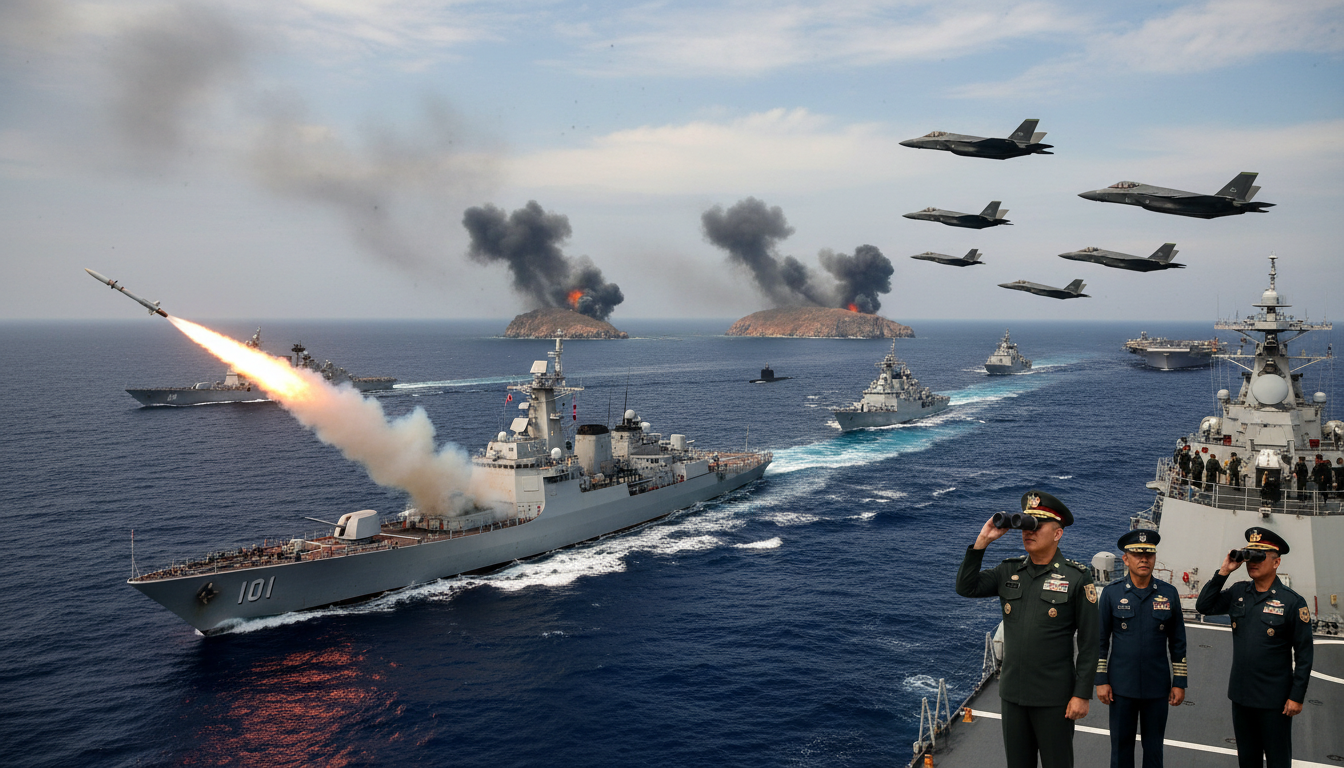
China military drills east of Luzon coincide with Balikatan exercises
China military drills east of Luzon as live-fire training was carried out near waters off the Philippines’ Luzon Island while U.S.-Philippine Balikatan exercises, joined by Japan, were underway.
Chinese Navy conducts live-fire exercises east of Luzon
The Chinese Southern Theater Command said its Naval Task Group 107 carried out live-fire shooting, sea‑air coordination, rapid maneuvers and maritime replenishments in waters east of the Philippines’ Luzon Island.
The statement described the activities as a test of integrated joint combat capabilities and emphasized the use of both surface and air units in coordinated scenarios.
The location of the exercises lies close to sea lanes and areas of overlapping claims in the South China Sea, where maritime and territorial disputes have long heightened regional vigilance.
Details of the Southern Theater Command operations
According to the Southern Theater Command, the drills focused on realistic combat training designed to verify logistics and command interoperability under contested conditions.
The reported tasks included live weapons firing, complex maneuvering between ships and aircraft, and at-sea replenishment that simulated sustained operational tempos.
Military analysts note such combined operations are intended to improve readiness for multi-domain contingencies and to demonstrate force projection capabilities in proximate waters.
Balikatan exercises expand as Japan sends combat troops
At the same time, over 17,000 troops from the United States, the Philippines and allied partners began their annual Balikatan exercises, which Manila and Washington organize each year to enhance interoperability.
This iteration marked the first time combat troops from Japan joined the U.S.-Philippine maneuvers, underscoring Tokyo’s growing willingness to operate alongside regional partners amid strained ties with Beijing.
Balikatan activities typically include amphibious drills, live-fire events, airborne operations and humanitarian response training, and this year’s scope was extended toward areas contested in the South China Sea.
Operational overlap raises risks near disputed waters
The near-simultaneous presence of large-scale exercises by China and the Balikatan participants increases the likelihood of close encounters at sea and in the air, which can raise the risk of miscalculation.
Navies and air forces operating in proximate maritime zones must coordinate deconfliction measures to prevent incidents that could escalate into broader confrontations.
Regional security officials have in past instances urged transparency and communication when major drills take place near contested areas to reduce the chance of unintended clashes.
Tactical emphasis and logistical maneuvers reported
China’s emphasis on sea‑air coordination and maritime replenishment signals a doctrinal focus on sustaining operations beyond littoral zones, according to observers following the maneuvers.
Such logistics training—conducted under live-fire conditions—tests the ability to maintain continuous task-group operations and to integrate aerial assets with surface vessels.
Balikatan participants, for their part, have been conducting combined amphibious and air-land exercises designed to sharpen rapid response and coalition interoperability in complex maritime environments.
Diplomatic responses and calls for restraint
Manila and Washington have historically framed Balikatan as routine, defensive and focused on disaster response, while also underscoring the value of interoperability among allies.
Beijing’s public description of its own drills emphasized preparedness and capability testing rather than direct confrontation, yet the timing and proximity to Balikatan prompted concern among nearby states.
Diplomats and security experts in the region routinely call for channels of communication to remain open during overlapping military activities to reduce the risk of escalation.
The concurrent drills underscore the persistent strategic friction in and around the South China Sea, where overlapping claims and great‑power competition shape military postures.
Observers say clear rules of engagement, timely notifications and professional conduct at sea will be essential in preventing incidents as China conducts live-fire operations and allied forces carry out large-scale joint exercises in neighboring waters.

