
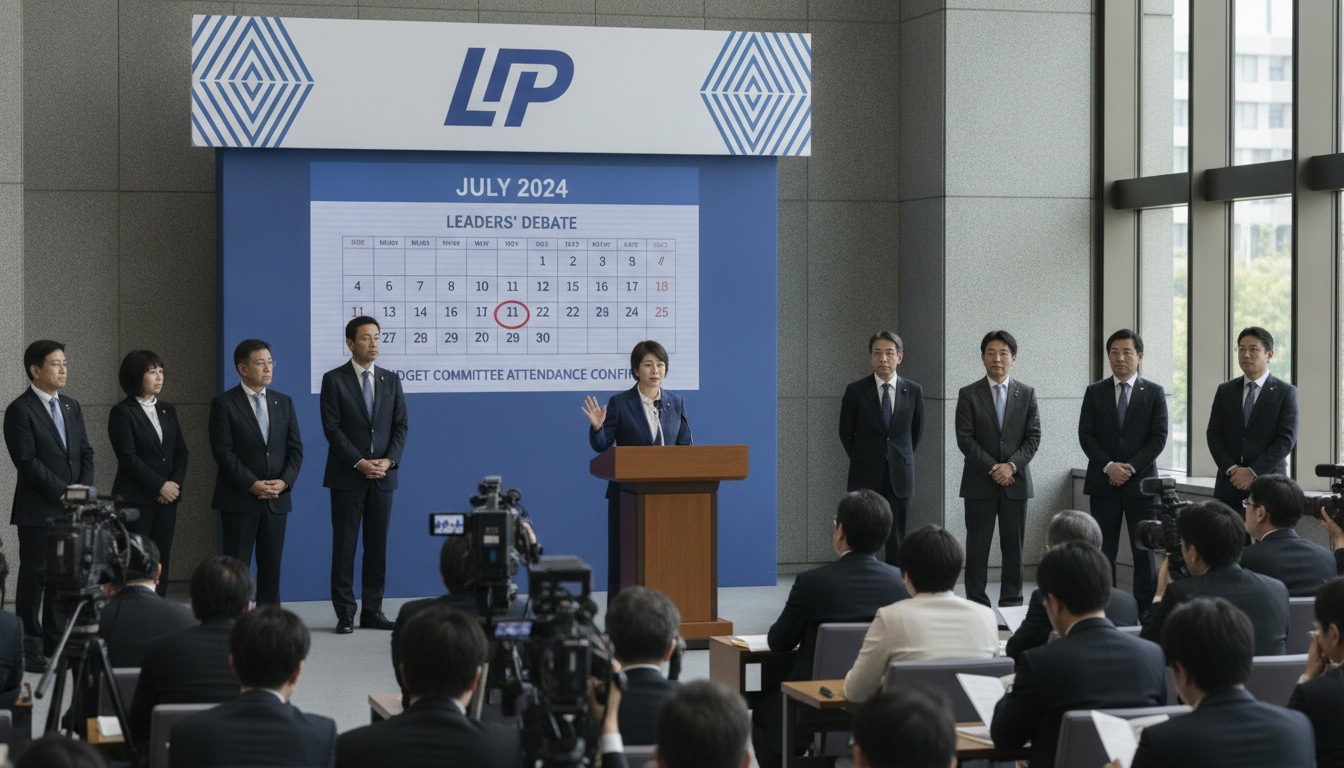
Prime Minister Takaichi to Attend Budget Committee and July Leaders’ Debate, LDP Says
LDP and opposition agree to schedule concentrated Budget Committee deliberation with Prime Minister Takaichi present and a party leaders’ debate in July, sources say.
Prime Minister Takaichi Sanae will attend an intensive session of the Diet’s Budget Committee and face a televised party leaders’ debate, the Liberal Democratic Party (LDP) told opposition negotiators on July 6, 2026. The announcement followed a meeting in the Diet between LDP Upper House Diet Affairs Chair Isogaki Hitohiko and Constitutional Democratic Party (CDP) Diet Affairs Chair Saito Yoshitaka. Opposition leaders signaled they would return to plenary deliberations if parties formally agree to the schedule.
Agreement Reached in Diet Talks
Isogaki informed Saito on July 6, 2026, that the ruling coalition intends to hold concentrated questioning in the Budget Committee with Prime Minister Takaichi present. He also conveyed the government’s plan to hold a party leaders’ debate during July. The meeting took place inside the Diet building and was described by both sides as an effort to defuse a recent standoff that had stalled deliberations.
Saito told reporters that opposition parties would consider resuming parliamentary business if collective consent is secured, indicating that formal confirmation from the opposition caucuses remains a prerequisite. The two negotiators did not set firm dates immediately but outlined a framework intended to restore a timetable for major policy and budget debates.
Dates and Possibility of Diet Session Extension
The LDP representative said the party leaders’ debate would be held “in July,” while the concentrated Budget Committee deliberation was to occur “within this Diet session.” The current ordinary Diet session is scheduled to run through July 17, 2026, raising the possibility that the government may seek an extension of the session to accommodate detailed questioning. Any extension would require Diet approval, prompting continued negotiation between ruling and opposition camps.
Officials close to negotiations said the ruling parties are weighing whether to pursue a formal extension or to compress the schedule into the remaining days before July 17, 2026. Both options carry strategic and procedural implications for how thoroughly lawmakers can examine the government’s fiscal plans and policy priorities.
Imperial Household Law Amendment to Be Debated in Special Committee
On the sensitive issue of the Imperial Household Law amendment, Isogaki indicated the government will move deliberations to a newly established special committee. The ruling bloc had earlier argued for consideration in the Diet’s Steering Committee, but opposition parties had pressed for a special committee that would include smaller parties and permit wider participation. Establishing a special committee could broaden input but may also prolong deliberations.
Lawmakers from across the spectrum have underscored the constitutional and social dimensions of the proposed amendment, which has drawn public attention and party scrutiny. By proposing a special committee, the ruling parties aim to balance calls for inclusivity with the need to advance legislative timelines.
Opposition Conditions and Political Calculations
Saito emphasized that opposition cooperation hinges on securing agreement among minority parties and receiving guarantees on procedural fairness. Opposition lawmakers have repeatedly demanded clear rules for questioning and full participation for minor caucuses before consenting to resume major sessions. Their stance underscores the leverage held by non-government groups when margins in the Diet are tight.
Political strategists said the opposition’s conditional acceptance reflects both a demand for substantive engagement on policy and a tactical effort to extract concessions on committee procedures. The negotiations also come amid heightened public scrutiny of how the government manages parliamentary oversight when its legislative majority is decisive.
Context: Takaichi’s Premiership and Recent Parliamentary Tensions
Prime Minister Takaichi assumed office after a snap general election earlier this year and has faced sustained criticism from opposition parties over her handling of parliamentary schedules. Critics say the government’s past use of majority votes to rapidly advance bills contributed to an impasse in late June and early July 2026. The LDP insists that arranging a public leaders’ debate and concentrated Budget Committee session demonstrates a willingness to engage directly with opposition scrutiny.
Observers note that leaders’ debates and direct questioning of the prime minister are high-stakes political events that can shape public perceptions ahead of municipal and policy battles later in the year. For the government, Prime Minister Takaichi’s direct participation offers an opportunity to explain fiscal priorities and defend recent policy choices.
The negotiators said further talks will be scheduled to fix precise dates and formats, including the length of questioning and participant lineups. Both sides acknowledged the need to finalize arrangements quickly to prevent further disruption to Diet business.
As discussions continue, parties on both sides will monitor public reaction and the potential impact of any Diet extension on legislative momentum and domestic policy agendas. The outcome of the talks will determine whether the Diet can resume substantive scrutiny of the government’s budget and legal proposals in the weeks ahead.

