
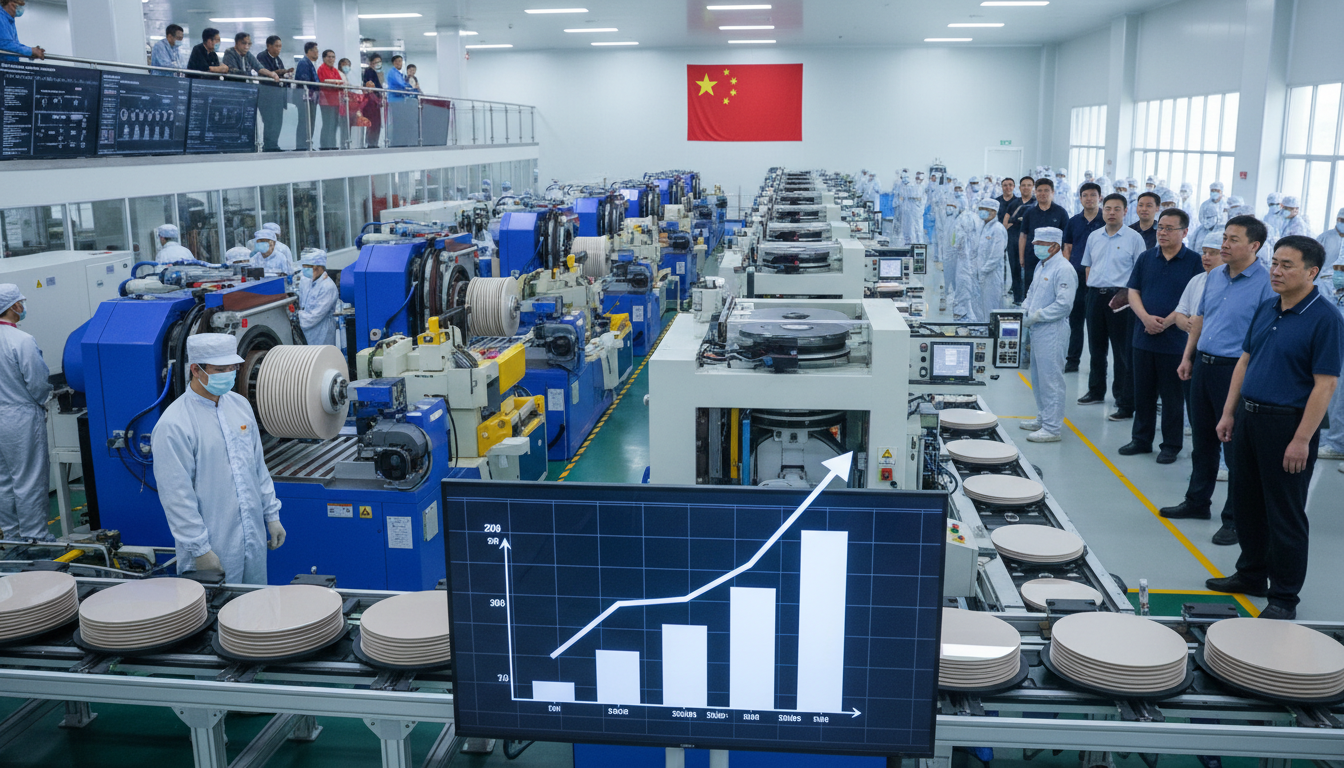
China Pursues 70% Domestic Production of Silicon Wafers Led by Eswin Expansion
China accelerates silicon wafers self-sufficiency drive, aiming for over 70% domestic supply this year through rapid factory builds and local government support.
Immediate Target and National Goal
China has set an aggressive target to have more than 70% of the silicon wafers used by its chipmakers produced domestically by the end of the year, a push designed to reduce reliance on foreign suppliers. The government and provincial leaders are coordinating incentives and permits to speed the construction of new wafer fabrication capacity. Industry sources say private firms, notably Eswin, are expanding rapidly to meet the target and capture demand from local foundries.
The emphasis on silicon wafers is part of a broader strategy to localize critical steps of the semiconductor supply chain. Officials view wafer self-sufficiency as a milestone that will underpin resilience for chip design and assembly sectors across the country.
Eswin’s Expansion and Capacity Gains
Eswin has emerged as a central player in the drive to increase domestic wafer output, announcing multiple new facilities and capacity upgrades in recent months. The company’s projects include large-scale crystal growing and wafer slicing operations intended to supply both mainstream and specialty wafer sizes. Eswin’s move reflects growing investor confidence in wafer manufacturing as a strategic industry.
Local governments have supported these investments with land allocations, tax breaks and infrastructure assistance. The combination of private capital and fiscal incentives has shortened project timelines and attracted ancillary suppliers to cluster around wafer plants.
Local Governments Push Permits and Financing
Provincial and municipal authorities are playing an active role by accelerating environmental approvals and offering low-cost financing for wafer projects. Regional development plans now often list wafer fabrication as a priority sector, unlocking preferential land-use and utility arrangements. These measures aim to reduce the lead time between project announcement and commercial production.
Municipal officials also coordinate with national agencies to channel subsidies and development funds to firms that commit to expanding wafer capacity. Observers note this alignment has been crucial in converting policy targets into concrete factory starts.
Supply Chain Constraints and Technical Hurdles
Despite rapid expansion, wafer self-sufficiency faces technical and supply-chain challenges that could slow progress. Advanced wafer production requires specialized equipment, high-purity materials and process know-how that remain concentrated among a few overseas suppliers. Producing larger-diameter wafers and ultra-flat surfaces for the most advanced chips poses particular difficulty.
Domestic firms are working to close these gaps, but analysts caution that certain upstream inputs—such as some specialty chemicals and precision tools—may remain dependent on foreign vendors for the near term. That reliance could limit how quickly wafer content can be increased across all nodes of the chip industry.
Impact on Chinese Chipmakers and Foundries
For China’s foundries and assembly plants, greater domestic wafer supply could lower procurement risks and lead times while supporting scale-up plans for local chip design firms. Domestic wafers are expected to first serve mature and mid-node processes where requirements are less exacting, before gradually moving into more advanced segments as capabilities improve.
Producers of memory, power semiconductors and discrete components, which use a broad range of wafer specifications, stand to benefit quickly from nearby capacity. Semiconductor firms say having a reliable domestic wafer pipeline will strengthen production planning and reduce exposure to export controls and geopolitical disruptions.
Global Industry and Trade Implications
China’s push for wafer self-sufficiency may reshape regional trade flows for semiconductor substrates and related equipment. Increased domestic output could reduce imports of standard wafers while prompting foreign suppliers to seek new partnerships or shift strategy in response to changing demand. Observers also expect intensified competition in downstream markets as localized wafer supply lowers costs for Chinese fabs.
At the same time, the technical gap in high-end wafer production could preserve a role for international suppliers, maintaining interdependence even as China expands its internal ecosystem. The evolving balance between self-reliance and global collaboration will be watched closely by industry stakeholders.
Projected Timeline and Risks
Officials and industry participants point to the current calendar year as the decisive period for meeting the 70% wafer localization target, with multiple factories scheduled to begin output within months. Achieving the goal will require sustained investment, timely equipment deliveries and successful scale-up of production yields. Any delays in machinery, staff training or regulatory processes could push back the timeline.
Analysts warn that while headline capacity figures may rise quickly, the share of wafers that meet the stringent quality standards of advanced chipmakers will likely increase more gradually. The distinction between installed capacity and qualified output will be a key metric to monitor in coming quarters.
China’s campaign to produce the majority of its silicon wafers domestically represents one of the most concrete steps yet in its semiconductor self-sufficiency drive. If successful, the effort will alter supply dynamics for chipmakers at home and abroad while testing how quickly domestic industry can master complex manufacturing inputs and high-precision processes.
The year’s progress will be measured not only by new factories and tonnage but by wafer quality, yield consistency and the ability of Chinese producers to supply the full range of specifications demanded by modern chips.

