
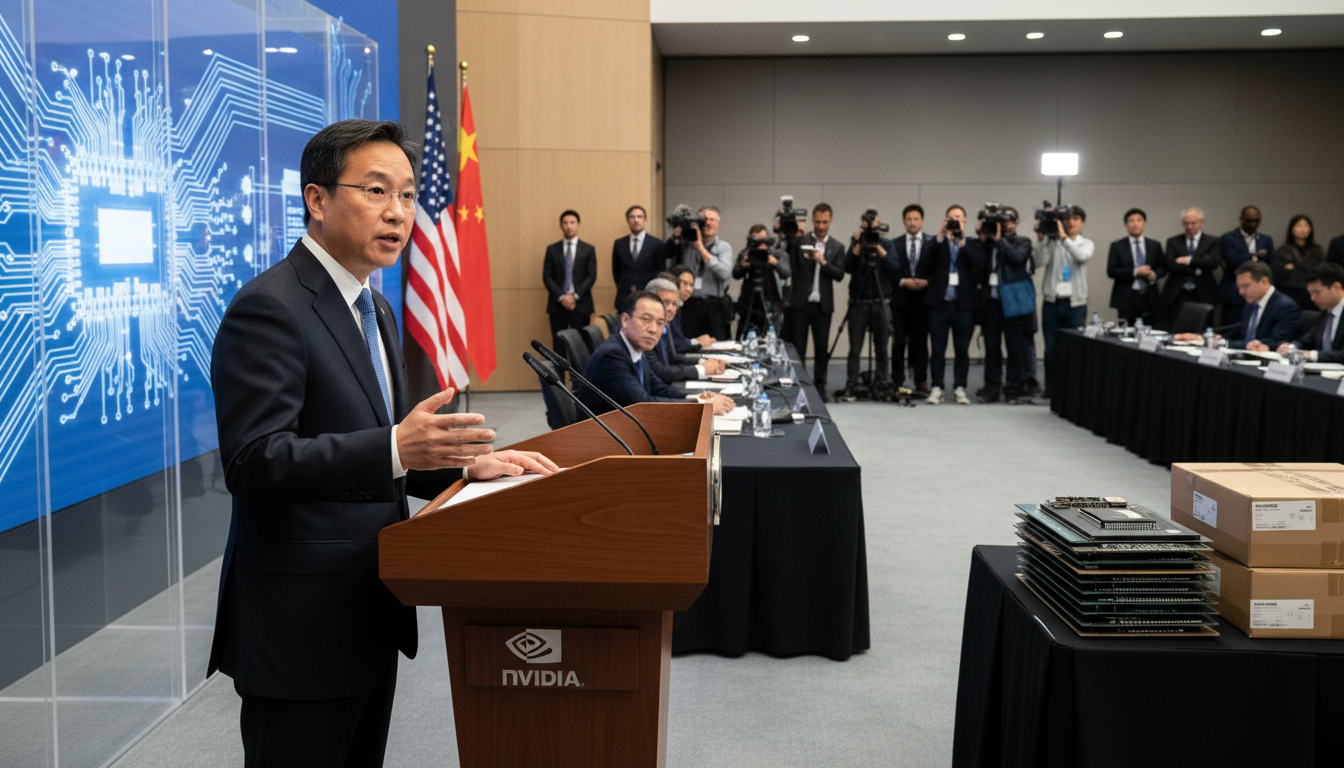
Nvidia chip sales in China: Huang urges U.S. to allow older GPUs while backing American AI lead
Nvidia CEO Jensen Huang says China should not receive the most advanced semiconductors but urges Washington to permit Nvidia chip sales in China of older GPUs to preserve competition and supply chains.
Nvidia CEO Jensen Huang said in Los Angeles that China should not be supplied with the most advanced chips, while stressing that U.S. firms must still be allowed to compete globally. He used the phrase "latest and greatest" in describing the class of semiconductors he believes should be restricted from export, and he pressed Washington to allow sales of mature-generation GPUs to Chinese customers. The comments tie directly into the debate over U.S. export controls and the future of Nvidia chip sales in China.
Huang’s Los Angeles remarks
Nvidia’s chief executive delivered the remarks during a public appearance in Los Angeles, framing the issue as a balance between national security and commercial competition. He affirmed U.S. leadership in artificial intelligence but drew a clear line against providing China with the most cutting-edge processors used for advanced AI tasks. At the same time, he argued that limiting sales of older GPU models would harm competition and innovation across global markets.
The CEO’s stance highlights a growing industry tension: how to protect sensitive capabilities while preserving open markets for less-capable but commercially important hardware. His appeal to policymakers centers on keeping mature-product channels open so companies can compete on price and access without enabling the most sensitive military or AI applications.
Export controls and policy context
U.S. export controls introduced in recent years have targeted the world’s most advanced chips, manufacturing equipment and associated software to curb the transfer of high-end AI capabilities. Policymakers cite national security risks and strategic competition with China as primary drivers for these measures. The controls aim to prevent the rapid spread of cutting-edge AI training tools while allowing non-sensitive commercial trade to continue where possible.
Industry leaders and trade groups have repeatedly warned that overly broad restrictions can fragment supply chains and disadvantage U.S. firms in global markets. Huang’s comments echo those concerns, emphasizing that a narrow, targeted approach to export policy would better balance security objectives with commercial realities.
Implications for Nvidia’s China business
China remains a significant market for Nvidia’s older GPUs, which serve gaming, cloud services and many enterprise customers. Restricting sales of those mature chips would reduce revenue streams and could accelerate efforts by Chinese firms to develop domestic alternatives. Huang’s push to keep mature-product channels open reflects both commercial interest and a strategic calculation to maintain market presence and influence.
A curtailment of Nvidia chip sales in China for even mid-generation products could also prompt customers to seek substitute suppliers or invest faster in local designs. That shift would alter demand patterns and potentially speed technology substitution in sectors that currently rely on imported GPUs.
Supply-chain and industry-wide effects
Permitting the sale of older GPUs while blocking the latest processors would create a two-tier global market for semiconductors, with differing rules for advanced and mature nodes. That structure could preserve some export markets for U.S. companies while still containing the spread of the most advanced AI-enabling hardware. However, it also risks complicating logistics, compliance and product development planning for global manufacturers and their suppliers.
Manufacturers of chips, assembly plants, and equipment vendors would need to adapt to segmented demand, creating administrative burdens and potential inefficiencies. For allied countries and foundries that supply components, the policy environment will determine investment flows and future capacity decisions.
Balancing security and commercial competition
Huang framed his appeal as a request for nuanced policymaking: he supports limiting access to the very top-tier chips but warns against broadly cutting off commercial engagement. His remarks underscore the difficulty regulators face in threading the needle between safeguarding strategic advantage and sustaining competitive markets for established technology. The CEO’s position is likely to resonate with companies that export mature technology while aligning with officials intent on slowing an adversary’s access to frontier AI hardware.
As Washington reviews its export rules, industry voices will press for carve-outs that preserve routine commerce without undermining security goals. That debate will shape not only Nvidia chip sales in China but also how global semiconductor diplomacy and supply-chain resilience evolve in the coming years.
The outcome will also influence how quickly Chinese firms can field domestic AI systems that rival Western capabilities and how U.S. companies maintain market share abroad. Policymakers will need to weigh short-term commercial impacts against long-term strategic imperatives.
Nvidia’s comments add a high-profile corporate perspective to an already intense policy conversation, signaling that while senior executives accept limits on the most advanced hardware, they seek predictable rules that allow continued trade in less-sensitive technologies.

