
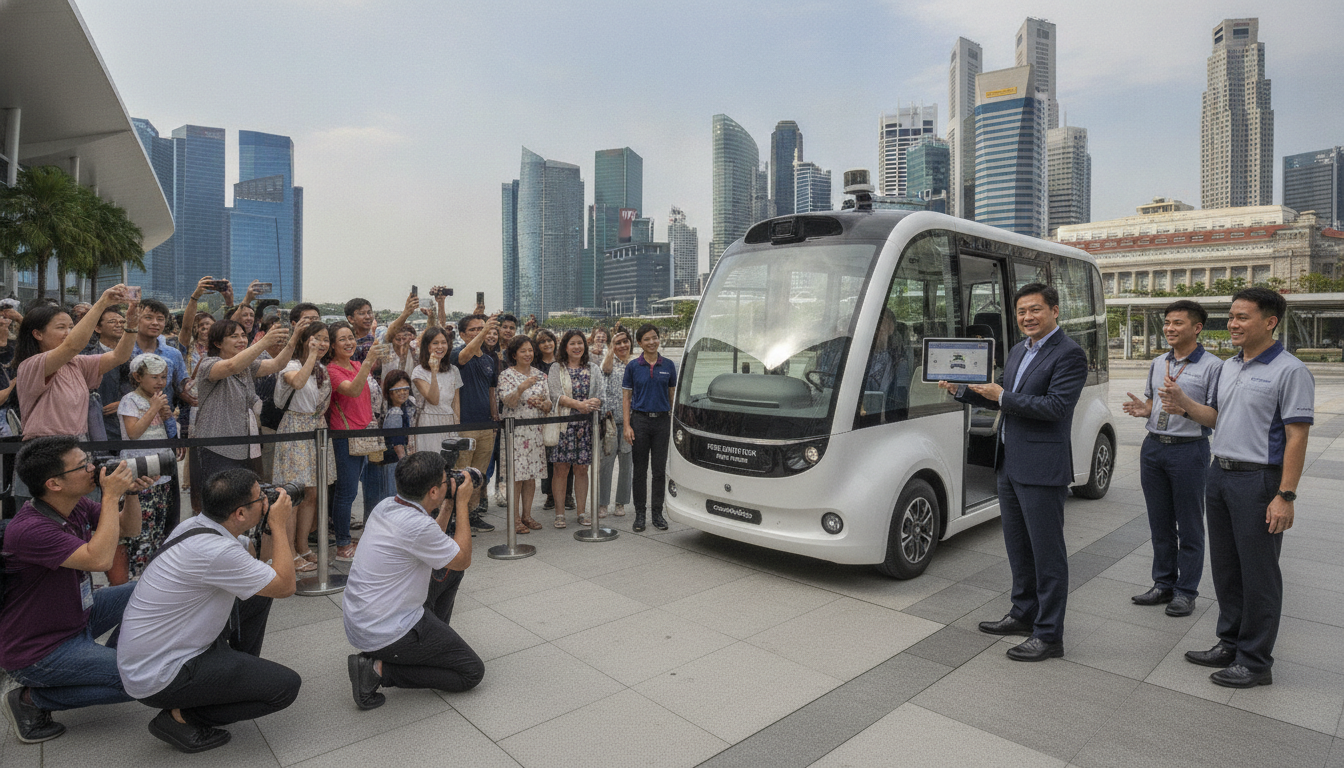
ComfortDelGro autonomous shuttle starts free app-based trials in Singapore’s Punggol
ComfortDelGro autonomous shuttle begins free app-booked trials in Singapore’s Punggol on June 22, 2026, marking a major step toward driverless urban transport.
SINGAPORE — ComfortDelGro autonomous shuttle began free, app-booked passenger trials in the Punggol district on June 22, 2026, as part of a wider move by mobility firms to expand autonomous taxis on public roads. The launch marks an early public test of ComfortDelGro’s vehicle and booking platform, offering local commuters a chance to ride without fares while operators monitor performance. The trial is timed amid growing industry efforts across the city-state to validate driverless systems in daily transport.
Free trial launched in Punggol
The free shuttle service opened to public bookings through a dedicated smartphone app and began picking up passengers along designated routes in Punggol. ComfortDelGro described the initiative as a trial phase aimed at collecting operational data and passenger feedback prior to any commercial rollout. Organisers have emphasised the limited, monitored nature of the service and that rides are complimentary throughout the initial testing period.
Initial deployments are concentrated in managed corridors where traffic conditions and pedestrian flows are easier to control. That approach is intended to reduce variables while engineers and safety teams observe vehicle behaviour in urban settings. Local residents were invited to register through the app to secure space on scheduled runs and to report any ride issues directly to the operator.
How the app-based service works
Passengers must download the operator’s app to reserve journeys on the ComfortDelGro autonomous shuttle, with booking windows and pickup points shown on an interactive map. The app handles real-time availability and sends notifications when a vehicle is approaching, mirroring the experience of standard ride-hailing services while integrating additional safety prompts. Operators are using the data stream to refine routing, wait-time predictions, and user interface elements.
ComfortDelGro said the app also facilitates incident reporting and post-ride surveys, enabling rapid feedback from commuters on ride comfort and operational reliability. Company technicians and a control team monitor the shuttles remotely, logging sensor data and video feeds for analysis after each trip. The digital-first approach allows the operator to iterate on both the vehicle software and passenger experience without charging fares during the trial.
Vehicle technology and on-road performance
The shuttles deployed in Punggol are equipped with a suite of sensors, including lidar, cameras and radar, designed to detect obstacles and navigate in mixed traffic. Software that fuses these sensor inputs governs steering, speed regulation and emergency braking responses. According to company statements accompanying the launch, operators are prioritising conservative driving profiles and heightened scan ranges while the vehicles operate in public areas.
Engineers have staged the trials to evaluate how the autonomous systems react to common urban conditions such as cyclists, delivery vehicles and school-zone congestion. Trials also test the shuttles’ ability to handle drop-off and pickup maneuvers in curbside settings and to interact safely with pedestrians. All data gathered during the trial will inform software updates and possible adjustments to sensor configurations.
Regulatory oversight and safety measures
Singapore’s push to trial autonomous taxis on public roads has been supported by regulators that favour controlled, incremental testing to balance innovation and safety. The trial in Punggol follows earlier experiments and limited deployments by industry players aimed at validating technology in a live environment. Authorities maintain a permitting and monitoring framework that sets conditions on routes, operating hours, and required safety personnel.
ComfortDelGro has stated that its trial adheres to existing regulatory requirements and that safety officers are present during runs to intervene if necessary. The company and regulators will review incident logs, system performance reports and passenger feedback before considering any expansion beyond the trial parameters. Observers note that such oversight is central to public acceptance for any future commercial operation carrying paying passengers.
Industry momentum and competitive landscape
ComfortDelGro’s trial adds to mounting activity by mobility companies worldwide to introduce autonomous taxi services, blending software, hardware and digital booking platforms. Industry analysts say these pilot programs are essential to demonstrate reliability, build public trust and refine the business model for driverless urban transport. Investors and transit planners are watching closely for evidence that trials can deliver consistent service while meeting safety benchmarks.
In Singapore specifically, a concentration of public trials reflects the city-state’s strategy to be an early adopter of transport innovation. The data and lessons from Punggol are expected to inform not only ComfortDelGro’s plans but also wider policy and infrastructure considerations, such as curb management, digital mapping standards and integration with existing transit networks. Competing firms are likely to accelerate their own pilots as regulators and communities assess outcomes.
ComfortDelGro officials have framed the Punggol trials as a measured step toward a future in which autonomous shuttles complement conventional buses and taxis. For now, the free app-based service offers residents a first-hand look at the technology while giving engineers the live conditions they need to improve safety and performance.
The trial’s progress over the coming weeks will determine whether ComfortDelGro expands routes or transitions toward a paid service model, and it will contribute to ongoing debates about timelines for broader driverless deployment in urban environments.

