
U.S. and EU Sign Critical Minerals Partnership to Diversify Supply Chains
U.S. and EU sign a critical minerals partnership on April 24, 2026, unveiling an action plan with coordinated trade measures to diversify supply chains now.
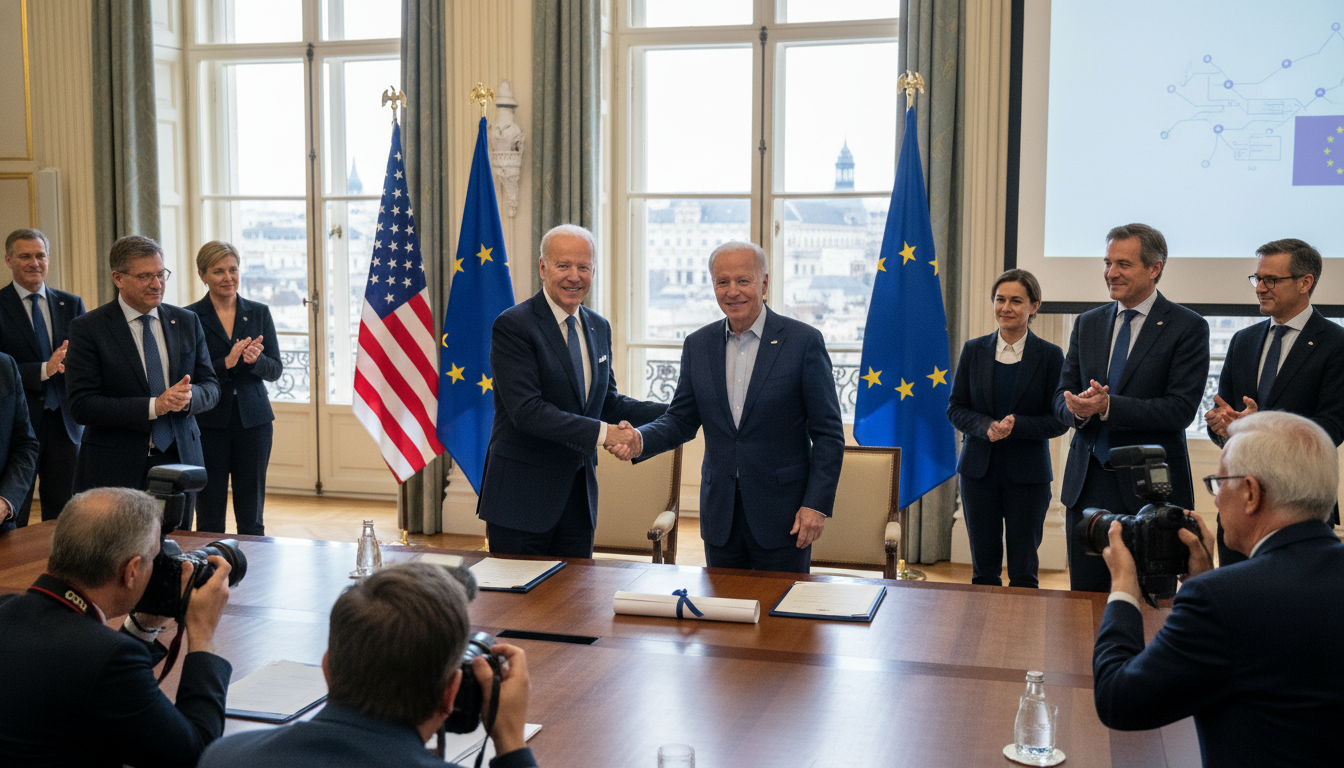
The United States and the European Union on April 24, 2026, formalized a memorandum aimed at securing critical minerals vital to advanced manufacturing and defence. The agreement, signed in Washington by U.S. Secretary of State Marco Rubio and EU Trade Commissioner Maros Sefcovic, includes a companion action plan on trade measures. The move is part of a wider Western effort to reduce dependence on concentrated processors of key raw materials.
U.S. and EU Sign Critical Minerals Memorandum
The memorandum of understanding establishes a framework for cooperation on producing, processing and trading selected critical minerals used in semiconductors, electric vehicles and defence systems. Officials described the pact as an initial step to coordinate policy, investment and regulatory work between Washington and Brussels.
Secretary Rubio framed the agreement as a response to supply‑chain risk, saying the heavy concentration of processing capacity is “an unacceptable risk” and arguing for greater diversification. Commissioner Sefcovic said the pact should accelerate joint projects and bring private sector operators into concrete initiatives.
Action Plan Targets Supply‑Chain Vulnerabilities
Alongside the MOU, the United States Trade Representative and EU trade officials released an action plan that seeks to address “non‑market policies and practices” that have distorted critical minerals supply chains. The plan calls for cooperative measures to shield market‑oriented economies from disruptions, including mechanisms to counter economic coercion and sudden export restrictions.
The document signals a longer‑term goal of building a plurilateral initiative with like‑minded partners to bolster resilience across the full mineral value chain. Washington and Brussels said they will consider coordinated responses that span mining, processing, recycling and rapid crisis response.
Trade Tools under Consideration, Including Price Floors
The action plan highlights several trade tools under study, including border‑adjusted price floors tied to reference prices, standards‑based market approaches, price gap subsidies and offtake agreements. Officials said these measures are intended to level the playing field for domestic producers and downstream manufacturers facing distorted international competition.
U.S. Trade Representative Jamieson Greer emphasized that trade instruments will be examined for their potential to strengthen nascent domestic industries and support competitiveness in downstream sectors. The approach is cautious: officials plan to weigh legal, economic and practical implications before deploying novel mechanisms such as coordinated price floors.
Pilot Projects and Expected Timeline
Brussels and Washington signaled an appetite for testing specific mechanisms through pilot projects, with Mr. Sefcovic expressing hope that initial pilots could begin before the end of 2026. The pilots are expected to trial price‑support arrangements and standards that could later be scaled if successful.
Officials stressed that signing agreements is only the first phase and that execution will determine impact. Both sides identified the need for technical cooperation, investment promotion, and regulatory alignment to translate commitments into operational supply‑chain solutions.
Broader Western Coordination and Prior Agreements
The U.S. and EU initiative builds on earlier U.S. efforts to align partners, following similar action plans Washington has developed with Japan and Mexico. U.S. policymakers, including a February announcement by the administration, have been seeking preferential arrangements and coordinated measures among allies for critical minerals.
Analysts say bringing multiple market‑oriented economies into a common framework could reduce the leverage held by dominant processors and create alternative, diversified sources for key inputs. The strategy underscores a shift from bilateral procurement toward integrated, allied supply‑chain management.
Industry and Geopolitical Implications
For manufacturers of semiconductors, batteries and defence equipment, the proposal offers potential stability through predictable pricing and coordinated procurement, but it also poses transition challenges. Implementing border‑adjusted price mechanisms or subsidies would require careful design to avoid trade disputes and to meet domestic legal constraints.
Geopolitically, the pact signals deeper transatlantic alignment on industrial policy for strategically important materials. By explicitly targeting distortions in global markets, Washington and Brussels are seeking to combine trade policy, standards and investment screening to bolster resilience without severing commercial links.
The memorandum and action plan mark a notable step in allied efforts to secure supplies of critical minerals, but officials acknowledge that turning strategy into supply‑chain alternatives will take time, capital and technical cooperation. The coming months will test whether pilot projects and coordinated trade measures can produce tangible diversification for industries that increasingly rely on these materials.

