
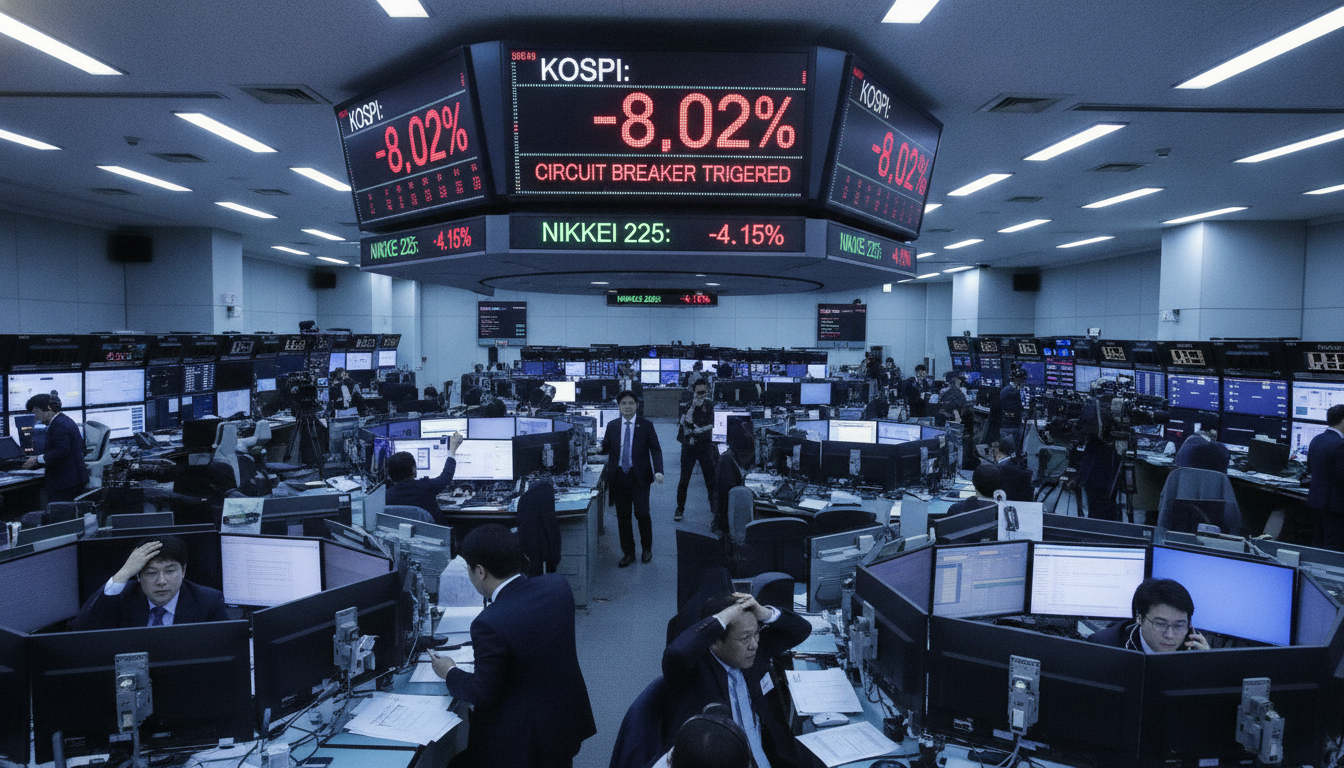
KOSPI Falls 8% on June 8, 2026, Triggering Circuit Breakers as Nikkei Slides
KOSPI falls 8% on June 8, 2026, activating circuit breakers as U.S. rate-hike expectations and Middle East tensions send Asian markets sharply lower today.
TOKYO — KOSPI falls sharply in early trading on Monday, June 8, 2026, plunging about 8 percent and prompting automatic trading halts that temporarily suspended activity on South Korea’s main bourse. The move came as investors reassessed the likelihood of further U.S. interest-rate increases and reacted to renewed tensions in the Middle East, driving a broad sell-off across Asia.
The initial shock in Seoul rippled to Tokyo, where the Nikkei Stock Average fell roughly 4 percent in morning trade, led by technology and export-focused names. Market participants described a rapid shift into defensive positions, with declines concentrated in high-valuation tech stocks and cyclicals sensitive to global demand.
KOSPI plunges 8% as circuit breakers activate
South Korea’s benchmark index moved into the circuit-breaker band shortly after markets opened, halting trading as price declines accelerated. Exchange rules designed to calm volatility were invoked when the index met pre-set thresholds, forcing temporary suspensions intended to give participants time to reassess orders.
Traders on the floor and electronic platforms reported rapid selling pressure as stop-loss orders and algorithmic flows compounded the downturn. The shutdowns highlighted fragile liquidity conditions and underscored how closely regional markets now track global risk sentiment.
Tokyo’s Nikkei down as tech shares lead losses
In Tokyo, technology manufacturers and chip-related firms recorded some of the largest drops, reflecting sensitivity to both interest-rate moves and demand concerns. Export-oriented electronics groups also fell as investors priced in a slower global tech cycle and a stronger dollar that could weigh on overseas earnings.
Financials and smaller-cap domestic names were mixed, with some defensive sectors outperforming amid the rush to safety. Market breadth remained weak, and trading volumes spiked as institutional and retail investors adjusted exposures.
Rate-hike expectations and bond yields push equities lower
Fresh market pricing that increases the probability of further U.S. Federal Reserve tightening put pressure on growth-focused equities across the region. Rising U.S. Treasury yields reduce the present value of future earnings, a dynamic that disproportionately affects high-multiple technology companies.
Currency moves compounded the effect, with the dollar appreciating against many Asian currencies and adding to concerns about profit margins for exporters. Analysts said the confluence of tighter global policy expectations and elevated yields made risk assets more vulnerable to abrupt re-pricing.
Middle East tensions amplify risk-off sentiment
News of renewed tensions in the Middle East intensified the risk-off mood, prompting investors to favor safer assets and reducing appetite for equities tied to global trade. Geopolitical shocks can raise the prospect of energy supply disruptions and heighten uncertainty for multinational companies, factors that weigh on regional stock markets.
Commodity and currency markets responded alongside equities, with safe-haven flows into government bonds and the yen at times strengthening on intra-session moves. Market participants emphasized that even limited geopolitical flare-ups can act as an accelerant when financial conditions are already tightening.
Trading halts, liquidity and investor behavior
Circuit breakers and trading halts served their intended role by pausing frantic selling, but they also underscored liquidity challenges in stressed conditions. When automated trading, margin calls and concentrated order flow converge, brief interruptions can help restore order but may not prevent subsequent volatility once trading resumes.
Institutional desks reported a surge in inquiries from clients and an increase in stop-loss activity that amplified price moves. Risk managers said they were monitoring margin requirements and counterparty exposures as volatility rose across equity and derivative markets.
Outlook for Asian markets and policy watch
Investors are set to monitor upcoming economic releases and central bank speeches for signals on the path of monetary policy and growth. Market strategists noted that any firm indication of further tightening from major central banks would likely keep pressure on risk assets and could extend the period of elevated volatility.
Regional policymakers and exchanges will also be watched for measures to support orderly markets if stress persists. Analysts urged investors to focus on fundamentals while remaining prepared for near-term swings driven by macro and geopolitical developments.
Markets will be closely watched when trading resumes fully, with attention on whether volatility stabilizes or if further pressure prompts extended declines.

