
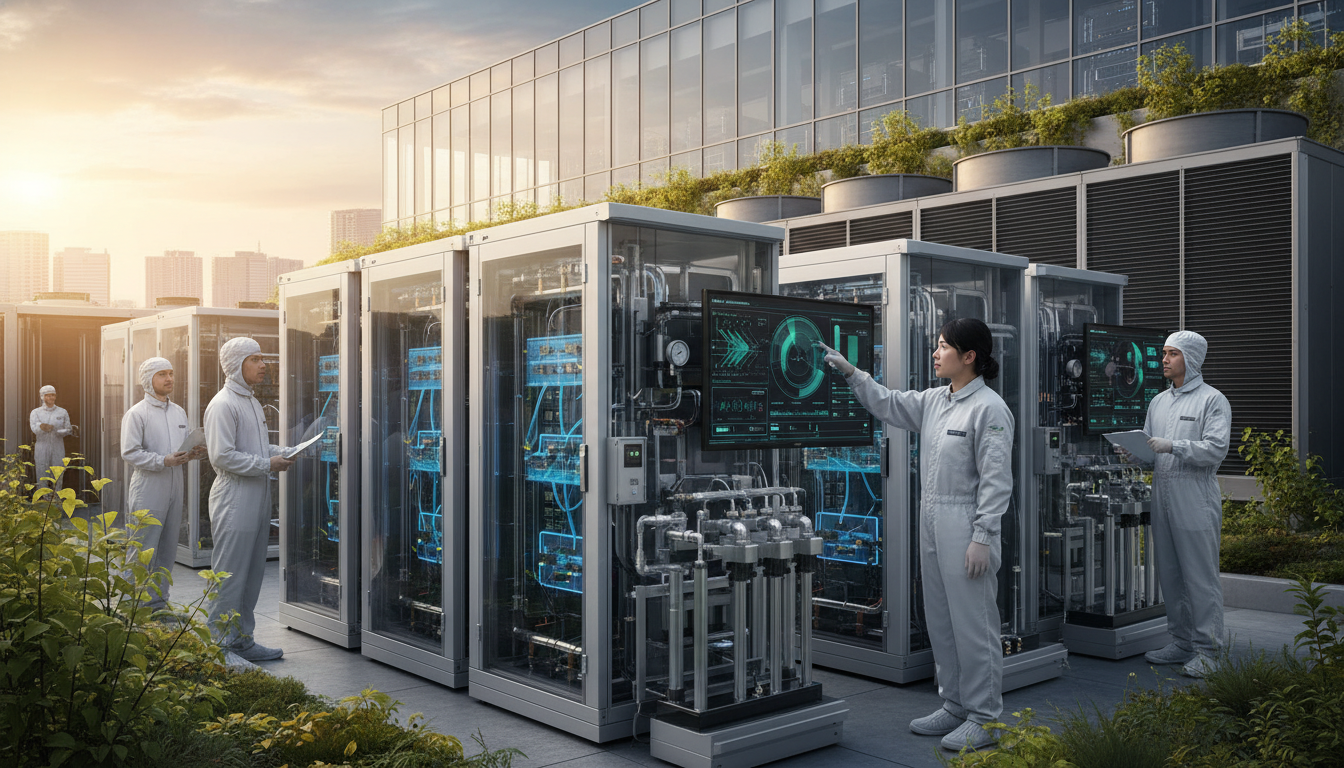
Liquid cooling adoption surges in Japan as data centers race to cut energy use
Japan’s data centers turn to liquid cooling to curb rising power demands from AI workloads, with firms and utilities accelerating pilots and technology development.
Liquid cooling is gaining rapid traction in Japan as operators seek more efficient ways to cool data centers that run artificial intelligence models, industry sources say. The shift reflects mounting concern over the steep energy consumption of AI training and inference, and it is prompting hardware makers, system integrators and utilities to expand pilots and production plans for liquid-based cooling systems. Policymakers and grid operators are watching closely as the technology promises lower energy use and greater rack density, but also raises questions about costs, standards and waste heat reuse.
Industry momentum behind liquid cooling
Liquid cooling adoption in Japan has moved beyond laboratory tests into commercial deployments, driven by the need to cool high-density AI servers more efficiently. Several domestic and international cloud and colocation operators have publicly signalled trials or roll-outs, while equipment vendors are announcing compatible server racks and heat-exchange components tailored for the Japanese market.
Analysts note that liquid cooling can reduce power used for cooling systems by a significant margin compared with traditional air-cooling, and that the technology enables higher compute density per rack. That combination makes liquid cooling an attractive option for operators aiming to expand AI capacity without proportionally increasing electricity demand.
Technology development and domestic suppliers
Japanese firms, including established electronics manufacturers and startups, are increasing investment in liquid-cooling hardware and integration services. Vendors are developing immersion cooling fluids, cold-plate designs and modular deployment units compatible with existing data center footprints.
Local system integrators are also building expertise to retrofit older facilities with liquid-cooling loops or to design new-build data centers that use liquid cooling as the primary thermal management approach. The move bolsters a domestic supply chain for components and services, which industry participants say is important for reducing lead times and managing total cost of ownership.
Utility and grid considerations
Power utilities and grid planners in Japan are engaging with data center operators as liquid cooling enables higher power density and can change patterns of electricity demand. Utilities have expressed interest in working with operators to manage peak loads and to explore incentives for energy-efficient cooling systems.
At the same time, grid integration issues remain important, particularly in regions where local transmission capacity is constrained. Some utilities are piloting demand-response schemes and time-of-use pricing to encourage load shifting, while others are examining whether waste heat recovery from liquid-cooled centers could be used to supply district heating or industrial processes.
Environmental impact and waste heat reuse
Proponents argue that liquid cooling offers clear environmental benefits by lowering the electricity consumed for cooling and improving overall data center efficiency. Reduced use of air-conditioning chillers and fans typically translates into lower greenhouse gas emissions, especially when combined with renewable power sources.
Industry groups and local governments are exploring uses for recovered heat from liquid-cooled facilities, ranging from greenhouse heating to municipal buildings. Successful integration of heat reuse would further strengthen the environmental case for liquid cooling, but technical and economic hurdles remain to connect data centers with heat consumers at scale.
Cost, standards and operational challenges
While liquid cooling can yield energy savings over time, upfront costs and operational complexity are significant hurdles for some operators. Retrofitting existing air-cooled facilities can be expensive and require lengthy downtime, and new operational procedures are needed to manage fluids, leak detection and maintenance.
Standards development is another area attracting attention as industry players push for interoperable connectors, fluid specifications and safety protocols. The establishment of common standards could reduce vendor lock-in and lower adoption barriers, but progress will depend on coordination among manufacturers, operators and regulators.
Pilot projects and corporate strategies in Japan
Several Japanese companies have announced or implemented pilot projects that integrate liquid cooling into research and production environments, often focusing on AI training clusters and high-performance computing. These pilots serve both technical validation and business cases, allowing firms to quantify energy savings and performance improvements before wider roll-out.
Corporate strategies vary: some firms are pursuing immersion cooling for specific workloads, while others favor hybrid approaches that use liquid cooling for the hottest nodes and air cooling elsewhere. Executives say this flexibility helps manage cost and operational risk while capturing efficiency gains where they matter most.
As Japan expands its digital infrastructure to support AI, liquid cooling is emerging as a key technology to limit energy demand and enable denser compute deployments. The next phase will test whether technical promise translates into broad adoption, balanced against cost, supply chain readiness and regulatory frameworks.
Industry observers say the pace of deployment will depend on measurable energy savings, clearer standards and successful examples of waste heat reuse that create additional value streams from data center operations.

