
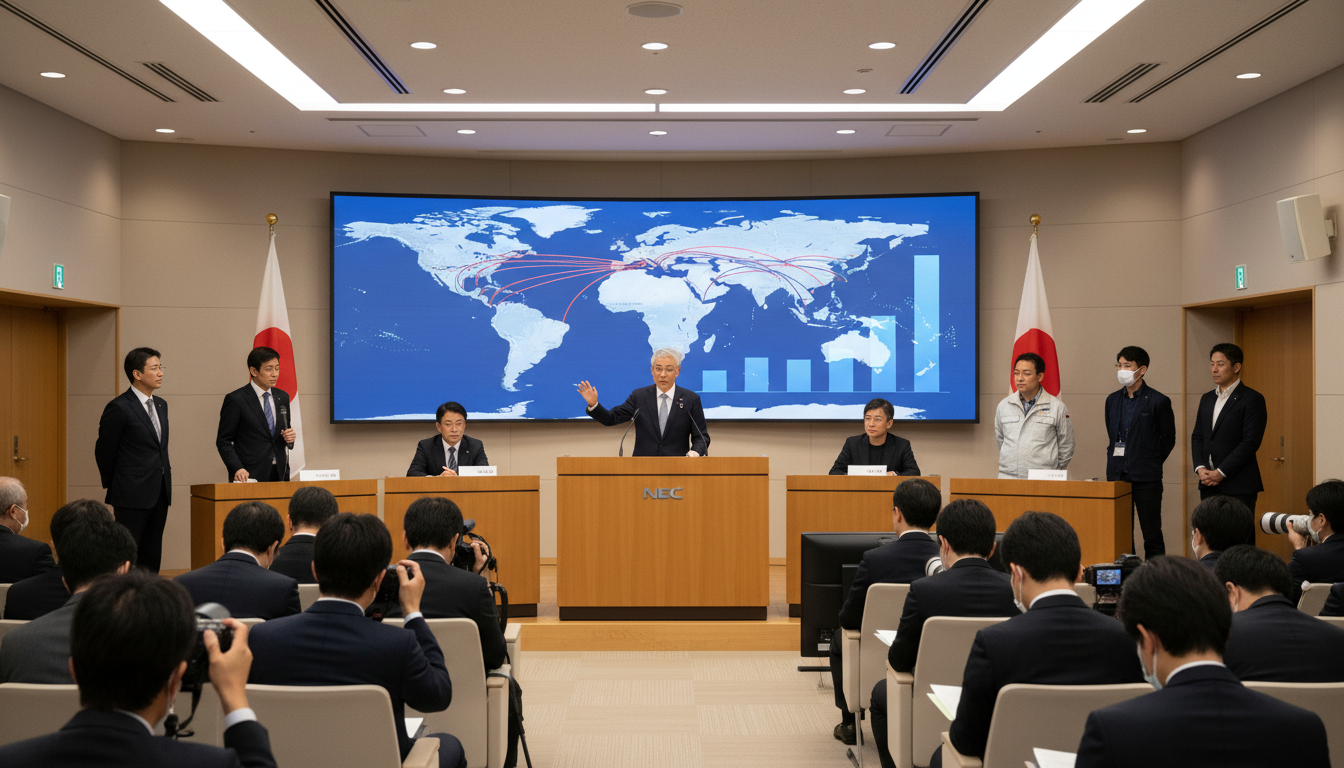
NEC submarine cable push: more than ¥100bn investment to expand undersea capacity
NEC will invest over ¥100bn in submarine cable technology and manufacturing over five years to boost capacity and seize global undersea network demand.
Japan’s NEC said it will bolster its submarine cable business with an investment exceeding ¥100 billion ($636 million) over five years, a strategic push to capture a larger share of the expanding international telecommunications market. The NEC submarine cable initiative targets upgrades in both technology and production, including greater cable-laying capacity and enhanced manufacturing at facilities operated by its OCC subsidiary. Company officials framed the move as a response to rising demand for high-capacity undersea links driven by cloud services, data centre growth and cross-border traffic.
Investment plan and timeline
NEC has committed to a multi-year investment program that will flow into research, manufacturing and deployment capabilities for undersea cables. The company described the funding as aimed at strengthening its competitiveness in a market where lead times and delivery capacity are critical.
The investment is slated to cover five fiscal years and will be directed at both hardware upgrades and operational scaling. NEC executives indicated the sum would fund new equipment, expanded factory output and enhancements to cable-laying vessels and logistics.
Manufacturing and capacity upgrades
NEC’s plan includes bolstering production lines at OCC, the group unit that manufactures submarine cable systems, where cables are wound and prepared for deployment. The company intends to increase output and streamline processes to shorten delivery schedules for large international projects.
Improvements will focus on higher-capacity optical fibres, thicker sheathing for long-haul routes and automated production steps to raise yield and reduce unit costs. NEC also plans investments in auxiliary facilities — storage, testing and spooling yards — to support faster turnarounds for complex, long-distance systems.
Technical focus and product development
A central element of NEC’s strategy is advancing the technologies that underpin submarine links, from repeaters and optical amplifiers to power feed and signal management systems. NEC aims to refine designs that raise per-fibre throughput while extending service life in challenging marine environments.
Engineering efforts will emphasise modular designs that can be tailored to bespoke routes and client needs, alongside software-driven monitoring to improve fault detection and reduce repair times. NEC’s engineers also plan to accelerate testing and certification cycles to align new products with global operator standards.
Market drivers and competitive landscape
Demand for submarine cable capacity remains robust as hyperscale cloud providers and global carriers seek denser, lower-latency paths between continents. NEC’s investment is intended to position the company to win larger slices of this work while responding to tighter capacity windows worldwide.
The market is competitive, featuring established specialist suppliers and new entrants expanding manufacturing capabilities. NEC’s push reflects a broader industry trend of securing production capacity and supply chain resilience after recent bottlenecks and longer project lead times.
Customer pipeline and contract prospects
NEC is pursuing contracts with international carriers, cloud companies and consortiums that fund cross-border systems. The company has signalled its readiness to bid on both greenfield projects and upgrades of existing routes where higher-capacity fibres are required.
Industry sources say customers are increasingly prioritising vendors that can offer end-to-end delivery — from design and subsea repeaters to cable-laying and post-installation maintenance. By expanding its production and operational footprint, NEC aims to present more competitive, integrated proposals to such buyers.
Regulatory, geopolitical and operational risks
Building and operating submarine cables involves regulatory clearances, environmental assessments and coordination with coastal authorities in each landing country. These permitting processes can delay timelines and add cost, and NEC will need to navigate varied legal and environmental regimes across regions.
Geopolitical tensions and export controls affecting high-tech components also pose potential complications for suppliers linking multiple jurisdictions. NEC’s strategy includes working closely with partners and customers to mitigate these risks and to ensure components and deployments meet evolving compliance requirements.
NEC’s investment in the submarine cable sector represents a deliberate effort to scale up where demand for international bandwidth is expanding rapidly. By directing funds into OCC’s manufacturing lines, cable-laying capacity and technical development, the company seeks to shorten delivery schedules and offer higher-capacity systems to a global client base. The move will be watched closely by competitors and customers alike as undersea networks continue to underpin the growth of cloud services and cross-border digital commerce.

