
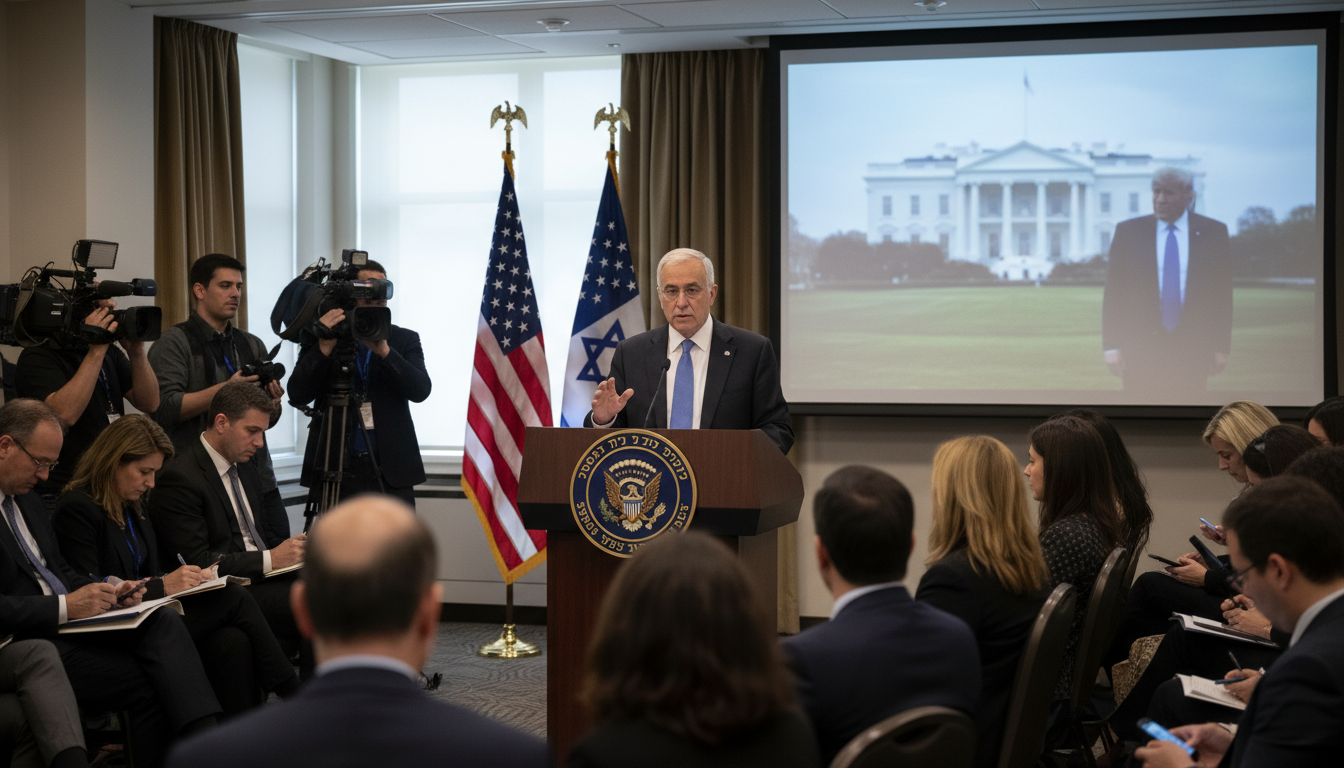
Yoram Hazony, the Philosopher Behind National Conservatism, Says Nation-States Should Resist Globalism
Yoram Hazony presents national conservatism as a defense of nation-states against globalism, saying his ideas influenced Trump-era policy and nationalist movements.
Yoram Hazony, an Israeli political philosopher whose 2018 book outlined a case for nationalism, said in a recent interview that defending the nation-state is a principled response to modern globalism.
He argued that the political movement associated with Trump and other nationalist leaders rests on a coherent philosophical foundation rather than mere populist emotion.
Hazony framed his work as an effort to provide both intellectual reasoning and practical models for political leaders seeking to reassert national sovereignty.
Hazony’s central argument about nationalism
In his writings Hazony contends that modern global integration functions as a form of empire that erodes distinct political communities.
He rejects the view that events such as the 2016 U.S. election or the U.K.’s Brexit were driven solely by irrational sentiment.
Instead, he says these outcomes reflect legitimate political preferences rooted in a desire to preserve national identity, law, and institutional integrity.
Influence on conservative politics in the United States
Hazony described his engagement with policymakers as two-way, combining theoretical work with active dialogue at conferences and meetings.
He said he has sought to present a systematic political theory while also cultivating contacts among elected officials and advisers.
Hazony pointed to recent shifts in U.S. strategy, including language in national security documents, as evidence that a national-conservative worldview has gained traction within parts of the policy establishment.
Distinction between government philosophy and political order philosophy
A core element of Hazony’s thesis is his distinction between what he calls the philosophy of government and the philosophy of political order.
He argued that much modern political thought begins from the assumption that states originate in voluntary agreements among autonomous individuals.
By contrast, Hazony maintained that historical states typically arose from conquest, tribal consolidations, or other power dynamics, and that a political-order perspective better captures how durable communities are formed.
Historical sweep from empires to contemporary globalism
Hazony traces a historical continuum from ancient empires to today’s supranational institutions, which he views as modern iterations of imperial integration.
He warned that attempts to amalgamate multiple tribal or national groups under a single administrative framework tend to erode the cultural and political bonds that sustain self-government.
For Hazony, the nation-state — grounded in shared language, customs, and legal traditions — remains the most viable unit for political loyalty and accountability.
Reception, translation, and controversy
Since its publication, Hazony’s book has been translated into several languages and generated debate among scholars and policymakers.
Supporters praise its challenge to liberal internationalism and its defense of democratic self-determination, while critics contend it risks legitimizing exclusionary politics.
Hazony acknowledged the controversy but said widespread interest in his work reflects deeper public unease about globalization and institutional displacement.
Policy implications and international ramifications
Hazony argues that a national-conservative approach implies a decisive break from liberal internationalist policies in favor of prioritizing domestic autonomy.
He cited changes in strategic documents and rhetoric as signals that some governments are rethinking alliances and global commitments to emphasize national interest.
Observers say such shifts could reshape trade, diplomacy, and security cooperation if adopted more broadly by Western governments.
The debate over Hazony’s ideas underscores a broader contest about the future of the postwar international order, with advocates contending that stronger nation-states will better protect pluralist democracy and skeptics warning of fragmentation and heightened conflict.

