
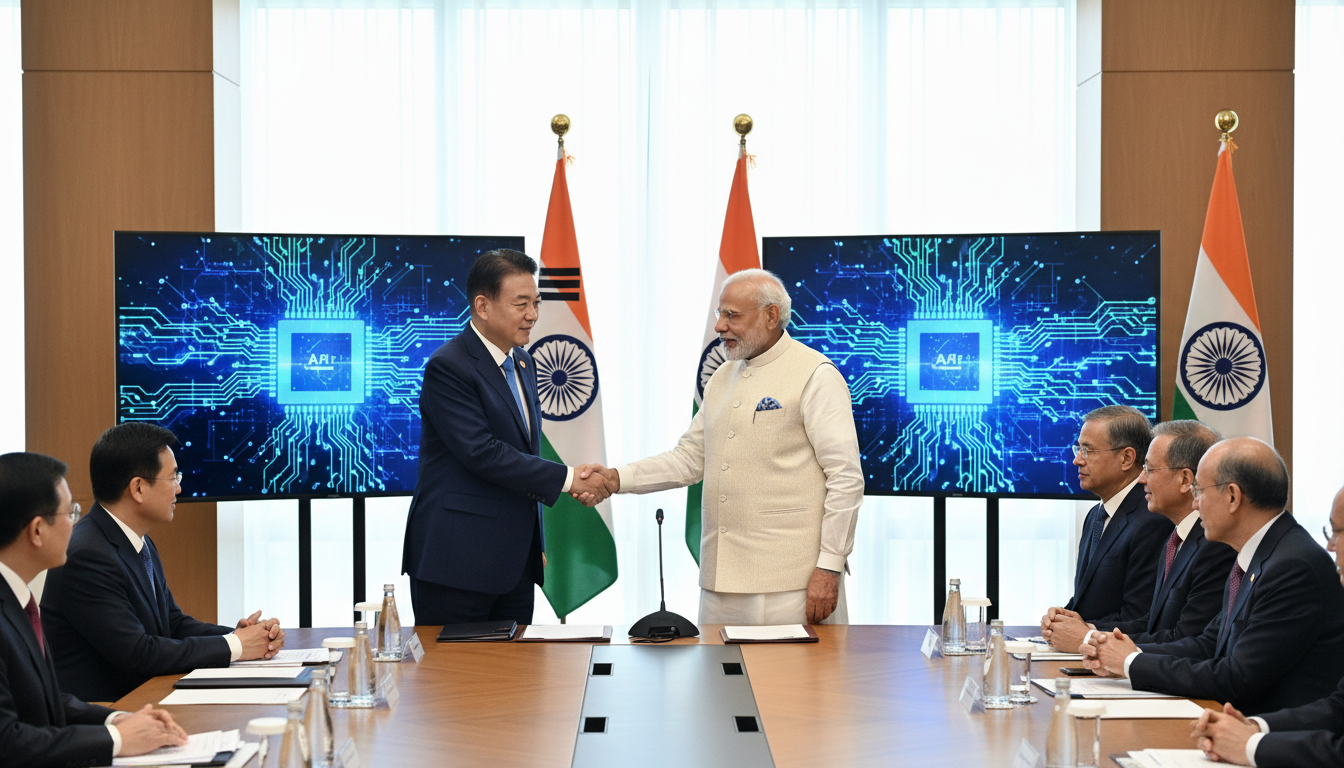
Lee Jae Myung India visit: Presidents Lee and Modi pledge deeper AI, semiconductor and IT cooperation in New Delhi
South Korean President Lee Jae Myung’s India visit saw him hold detailed talks with Prime Minister Narendra Modi on April 20 in New Delhi, with both leaders focusing on expanded cooperation in artificial intelligence, semiconductors and information technology.
Lee and Modi Hold Strategic Talks in New Delhi
President Lee Jae Myung arrived in New Delhi for his first visit to India since taking office and was welcomed at the presidential palace on April 20. The leaders held high-level discussions that covered the full spectrum of bilateral ties, signaling a mutual intent to elevate the partnership.
The meeting emphasized a shared agenda across technology, trade and people-to-people relations, and Modi publicly noted cultural affinities between the two countries. Officials described the talks as broad and forward-looking, aimed at deepening practical cooperation.
Agreements on Artificial Intelligence and Semiconductors
Both governments underscored artificial intelligence as a cornerstone of the new cooperation framework, agreeing to intensify joint research, data sharing and regulatory dialogue. South Korea’s strengths in AI applications and India’s large talent pool were cited as complementary assets for collaborative projects.
Semiconductor cooperation was identified as a priority for supply-chain resilience and industrial policy alignment. The leaders discussed joint initiatives to support chip design, manufacturing partnerships and supply security, reflecting shared concerns about global semiconductor shortages and strategic autonomy.
Economic and Trade Commitments
Economic ministers accompanying the two leaders outlined plans to boost bilateral trade and investment in high-tech sectors, including incentives to attract private sector participation. Both sides spoke of creating an enabling environment for South Korean firms to expand in India’s electronics and digital services markets.
Commerce officials also flagged measures to simplify regulatory pathways and facilitate cross-border investment in research-intensive industries. The emphasis on trade and investment frameworks aims to convert diplomatic intent into concrete commercial projects.
Technology Partnerships and Talent Exchange
Leaders agreed on a roadmap to foster joint technology ventures, including research-and-development hubs and start-up co‑incubation programs. Proposals included academic exchanges, collaborative hackathons and shared incubator spaces to accelerate commercialization of joint innovations.
A parallel focus was placed on people-to-people links that underpin tech partnerships, with plans to scale student exchanges, vocational training and professional secondments. Officials said talent mobility will be crucial to sustaining joint platforms in AI and software engineering.
Defense, Supply Chains and Regional Stability
While the public discussion centered on economic and technological collaboration, officials acknowledged the strategic importance of resilient supply chains in the Indo-Pacific. The talks included dialogue on safeguarding critical technologies and diversifying sourcing to reduce systemic risks.
Both capitals signalled that deeper industrial collaboration would be considered in the context of regional stability and shared security interests. Observers noted that aligning technology policy and industrial planning can have broader implications for economic security across the region.
Cultural Outreach and Soft Power Momentum
The summit also highlighted cultural ties, with Prime Minister Modi mentioning India’s enthusiasm for Korean popular culture and noting President Lee’s appreciation for Indian cinema. Both leaders framed cultural exchange as a catalyst for stronger bilateral relations and expanded tourism and academic links.
Ministries of culture and tourism were directed to develop joint programs to promote language education, film co-productions and festivals that showcase each country’s creative industries. These initiatives are intended to complement the technical and commercial pillars of the relationship.
In the coming months, delegations from both governments will work to translate the leaders’ commitments into memorandums of understanding, pilot projects and business-led investments. The emphasis in New Delhi on AI, semiconductors and IT indicates a shared strategic priority that could reshape the economic architecture of Korea‑India ties.
The Lee Jae Myung India visit marked a concerted push by Seoul and New Delhi to build a technology‑centric partnership driven by trade, talent and cultural exchange, with officials from both sides now tasked with moving agreed frameworks into operational programs.

