
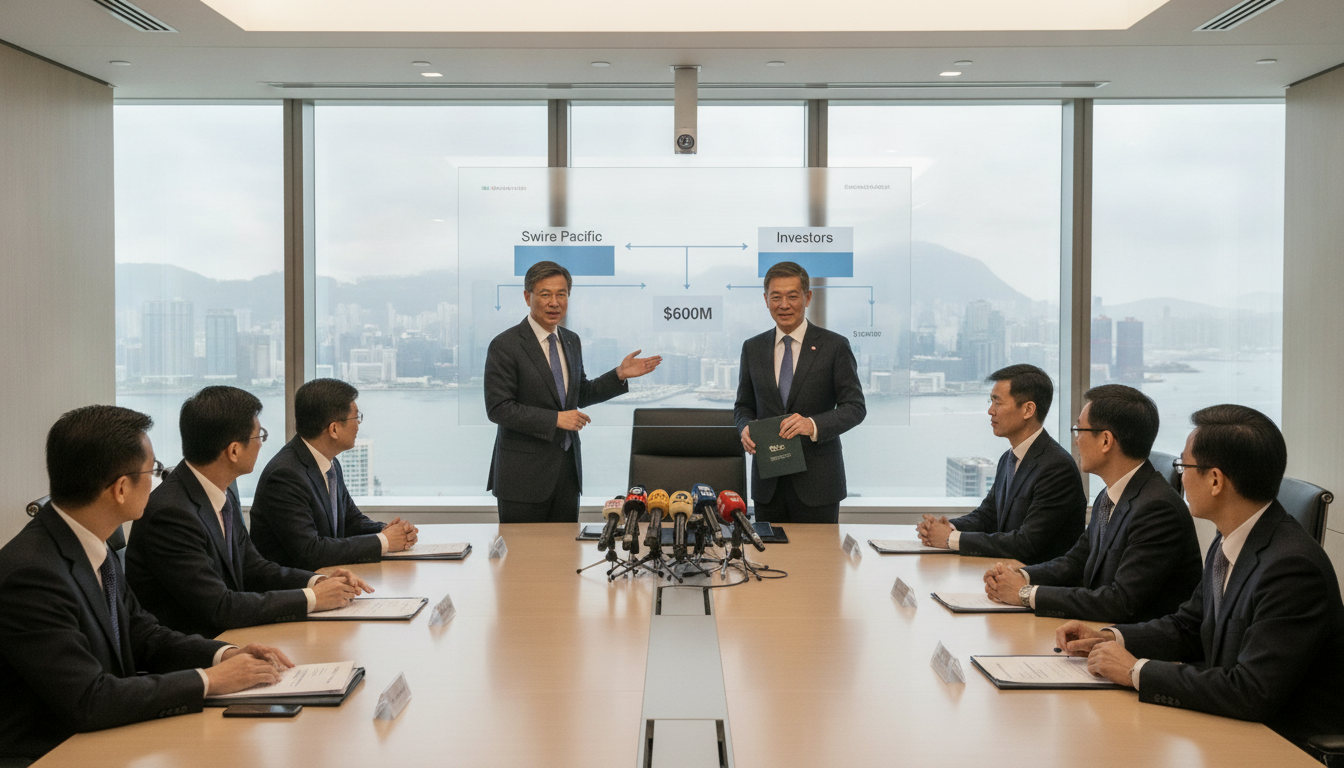
Swire Pacific exchangeable bond raises $600m, could transfer nearly 6% of Cathay Pacific
Swire Pacific issues a $600 million exchangeable bond tied to Cathay Pacific shares; the zero‑interest move may hand bondholders roughly 6% of the airline if converted.
Hong Kong conglomerate Swire Pacific said it will raise around $600 million by issuing an exchangeable bond that can be converted into shares of its listed subsidiary, Cathay Pacific Airways. The Swire Pacific exchangeable bond is structured with no coupon payments, a feature that market participants say will likely result in a transfer of nearly 6% of Cathay Pacific to bondholders if they choose conversion. Swire, the controlling shareholder of Cathay, framed the deal as a liquidity move that leverages its equity holding without an immediate cash dividend.
Deal mechanics and headline terms
The bond is being offered exchangeable into Cathay Pacific shares rather than traditional convertible debt tied to Swire Pacific’s own equity. Under the terms disclosed by Swire, holders will have the option to tender the bonds for Cathay shares at a pre‑set exchange rate on or after specified dates. The zero‑interest, or zero‑coupon, profile reduces ongoing financing costs for Swire but shifts return expectations onto potential equity appreciation at conversion.
Issuing exchangeable bonds allows Swire to monetize part of its stake while deferring any immediate transfer of control until bondholders exercise conversion rights. Market analysts note that the structure effectively offloads upside to bond investors and can lead to significant changes in share ownership if conversions occur en masse.
Expected stake shift and shareholder impact
Swire has signalled that full or partial conversion could result in bondholders owning close to 6% of Cathay Pacific’s outstanding shares. That level of potential transfer would be material for an airline whose ownership structure has implications for governance and strategic direction. While the conversion would not necessarily increase the total number of shares, it would move a meaningful block of economic and voting rights out of Swire’s direct holding and into the hands of bond investors.
Cathay’s minority shareholders may see increased free float and potentially greater trading liquidity if conversion occurs. Conversely, the prospect of a near‑6% shift to bondholders could weigh on sentiment among investors concerned about future selling pressure or changes to the company’s shareholder base.
Zero‑interest rationale and investor appeal
Swire and its financial advisers emphasised the cost advantage of a zero‑interest issuance amid a varied rate environment. By offering no periodic coupon, Swire reduces cash outflows while providing investors with exchange rights that yield upside tied to Cathay’s performance. For investors, the tradeoff combines downside protection from a bond seniority position with upside exposure via the exchange feature.
Institutional buyers that favour equity‑linked instruments may be attracted by the potential to capture Cathay’s recovery in passenger traffic and cargo revenues. However, the absence of coupon income means returns depend heavily on share appreciation or on the bond’s trading dynamics prior to conversion.
Market reaction and trading considerations
Initial market response to the bond announcement was mixed, with analysts noting potential selling pressure on Cathay Pacific shares if conversions are seen as imminent. Equity traders typically factor possible overhang from exchangeable issues into pricing, particularly when the conversion ratio and timing are clearly defined. Liquidity in Cathay stock could increase, but volatility may rise around key conversion windows.
Bond investors will monitor the issuer’s covenant package and any protective clauses that influence conversion economics. Credit investors also assess Swire’s broader balance‑sheet position and alternative financing routes the group could pursue in future capital markets activity.
Governance implications for Cathay Pacific
A move that channels nearly 6% of Cathay into bondholders’ hands raises questions about the airline’s shareholder composition and the influence of Swire as controlling shareholder. While Swire would retain its core stake, a dilution of direct holdings could alter voting dynamics on strategic matters, board appointments, and long‑term planning. Regulatory and stakeholder scrutiny may increase if the new holders are passive financial investors with different priorities from strategic shareholders.
Cathay’s management is likely to stress continuity of operations and strategic priorities, even as ownership composition evolves. The airline’s recovery trajectory, operational performance, and cash generation will determine whether bondholders opt to convert or to hold the bonds through maturity.
Strategic context behind Swire’s fundraising
Swire’s decision to tap equity‑linked financing follows a period in which airlines have balanced rebuilding capacity with managing expensive capital markets conditions. Using an exchangeable bond offers a way to raise sizeable proceeds without immediate share sales that could depress market prices. The approach also allows Swire to retain flexibility over the pace and timing of any final ownership adjustments.
Corporate observers note that similar structures have been used by parent companies globally to unlock value from listed units while limiting short‑term market disruption. The effectiveness of this tactic will depend on investor appetite for zero‑coupon, equity‑linked paper and on Cathay’s operational performance in the months ahead.
The coming weeks will reveal how many investors participate in the offering and how the market prices the embedded exchange option. That response will shape whether the bond ultimately materialises as a temporary financing tool or as a vector for a significant shift in Cathay Pacific’s share registry.

