
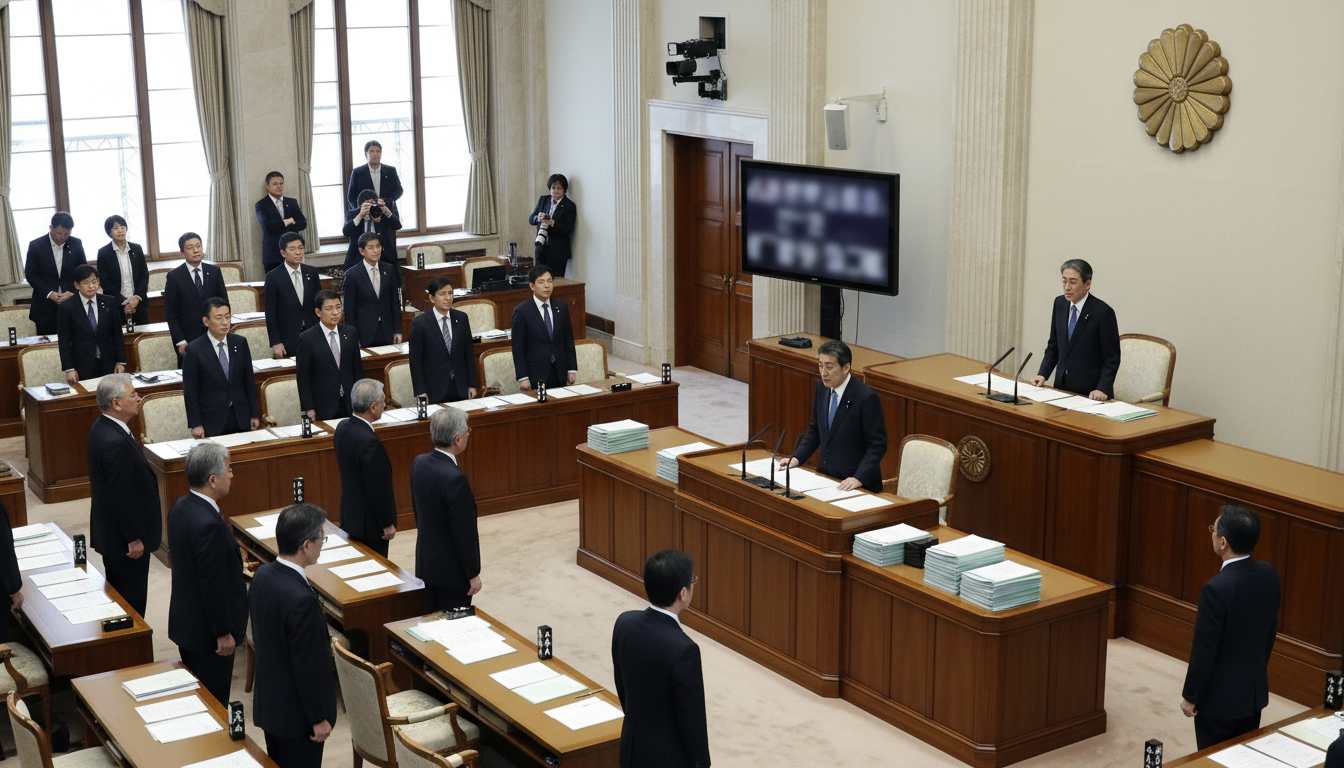
Diet leaders agree “legislative consensus” to begin securing imperial family numbers
Japan’s parliamentary leaders adopted a “legislative consensus” on June 10, 2026, endorsing measures to secure imperial family numbers, including allowing married female royals to remain and admitting male-line descendants from former princely houses. (nippon.com)
Summary of the June 10 decision
On June 10, 2026, the chairs and vice-chairs of both chambers of the Diet convened a full meeting of party representatives and formalized a document described as the “legislative consensus” aimed at securing imperial family numbers. The consensus records that two principal approaches — allowing female imperial family members to retain status after marriage, and bringing male-line descendants of former princely houses into the imperial household by adoption — should proceed to legal consideration. (nippon.com)
The leaders said the move was intended to provide a parliamentary foundation for legislation, and they signaled a request to the prime minister to advance statutory changes as needed. The decision reflects years of debate over stable succession and the shrinking number of imperial family members. (nippon.com)
Origins of the two proposals
Both measures find their origins in a government expert panel report published in December 2021, which recommended that the state proceed with concrete study of options to halt further reductions in imperial family numbers. That report identified maintaining the status of female imperial members after marriage and accepting male-line descendants from the former princely houses as the principal paths for consideration. (cas.go.jp)
Lawmakers have been negotiating those options since May 2024, and the June 10 action codifies an instruction that the Diet’s majority supports moving toward statutory solutions to the demographic challenge facing the imperial household. The consensus does not, however, convert proposals into law; it asks the executive and relevant committees to prepare draft legislation. (cas.go.jp)
What the two measures would change in practice
Under current law, the Imperial Household Law provides that female members of the imperial family lose their status upon marriage to a commoner. The first measure approved in principle would change that rule so that women who marry would retain imperial status. The proposal leaves open questions about whether spouses and children of such women would also become imperial family members. (fnn.jp)
The second measure would create a legal pathway for male-line descendants of the former “eleven princely houses” abolished after World War II to be recognized as members of the imperial household through adoption or another statutory mechanism. Proponents say this would restore a pool of male-line heirs while keeping succession within the male line. (fnn.jp)
Unresolved legal and social questions
Despite agreement on general principles, lawmakers deferred detailed decisions on critical implementation questions, including the status of spouses and descendants, residency and public duties, and financial and administrative arrangements. These unresolved points will determine how the changes affect day-to-day life for those brought into the imperial household. (newsdig.tbs.co.jp)
Opposition and some civil society groups have raised constitutional and equality concerns, while conservative lawmakers have pressed for limits — for example, proposals that would allow women to remain but not confer imperial status on their spouses or children. Those divisions explain why the leaders chose to approve a consensus on principle while postponing the specifics. (newsdig.tbs.co.jp)
Who the former princely houses are and what adoption would mean
The former eleven princely houses refer to branches of the imperial family whose male-line descendants lost imperial status under postwar reforms. Advocates for adoption-based measures say those descendants retain male-line lineage and could, if legally reintegrated, help ensure a larger pool of imperial household members. Critics note practical and historical complexities in tracing lineage and integrating families after decades outside the household. (craj.jp)
Legal experts caution that any plan to restore status will require precise statutory language to address heredity, public roles, and constitutional constraints. The government’s earlier materials flagged questions about how distant male-line kin should be treated and whether restoration would need supplemental rules to address modern family structures. (craj.jp)
Political next steps and timeline
Parliamentary leaders have asked the prime minister and relevant ministries to begin drafting amendments and to prepare for committee-level scrutiny, but they did not set a binding legislative timetable on June 10. The consensus is intended to guide lawmakers, not to short-circuit debate, and party caucuses retain the right to press for changes in committee. (fnn.jp)
Observers expect the measures to move slowly through Diet committees, where detailed legal, fiscal and social impacts will be examined and where political bargaining may produce compromise language. For proponents, the declared consensus is a key step toward legislative action; for opponents, it is the start of a more intensive round of scrutiny. (fnn.jp)
The June 10, 2026 decision establishes a parliamentary framework for securing imperial family numbers while leaving the most consequential policy decisions to follow in draft legislation and committee debate.

