
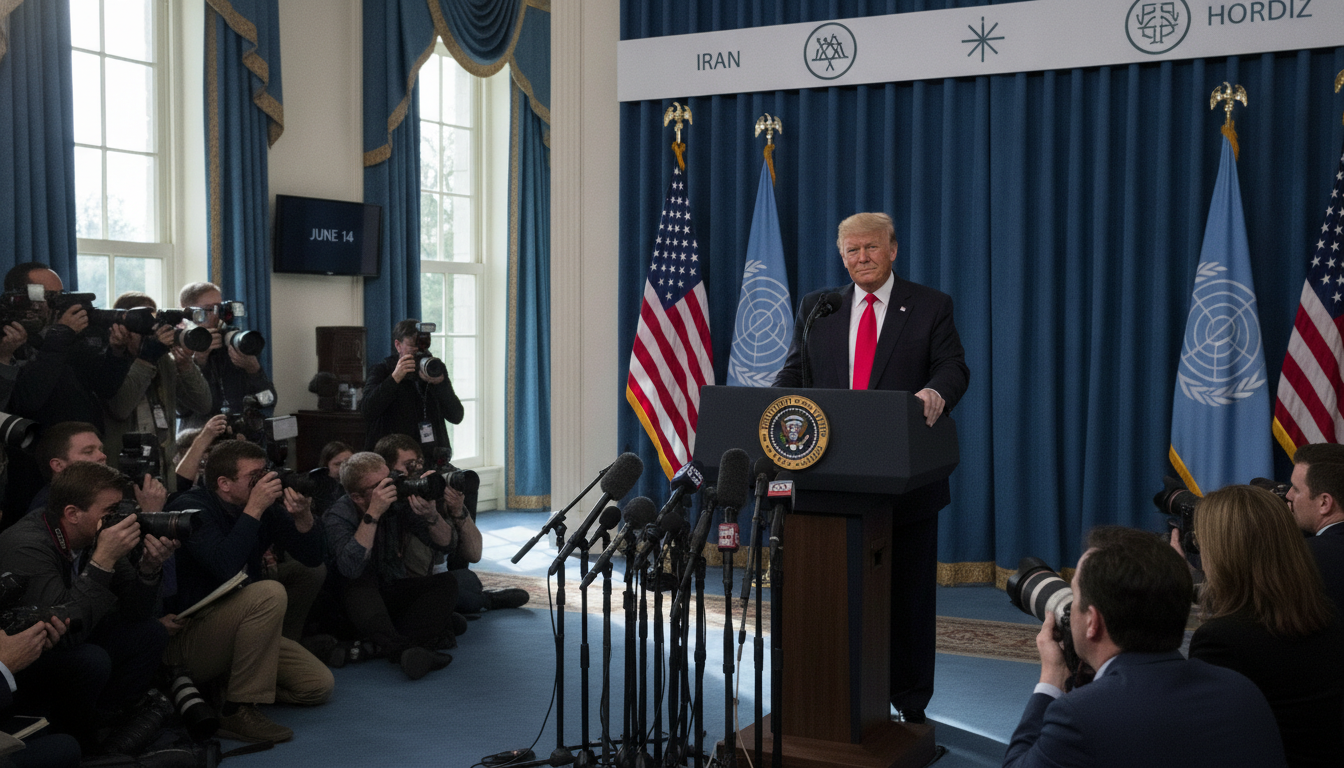
Trump Iran agreement to be signed June 14, President says Hormuz Strait will open immediately
President Trump said on June 13 that a Trump Iran agreement will be signed on June 14 and that the Strait of Hormuz will reopen immediately after signing.
President Trump announced on June 13 via social media that a Trump Iran agreement is scheduled to be signed on June 14 and that the Strait of Hormuz would be opened to all immediately after the ceremony. The president said the agreement would prevent Iran from pursuing nuclear weapons and that no financial payments would be exchanged as part of the deal. U.S and Iranian officials were reported to have indicated on June 12 that a memorandum to end hostilities may be nearing signature, suggesting negotiations are in a closing phase.
Trump Sets June 14 Signing Date
President Trump posted on June 13 that the formal signing is planned for June 14, supplying the specific date in his announcement. He framed the move as a diplomatic breakthrough that would change the tenor of relations between Washington and Tehran. The timeline announced by the president brings negotiations into an intensified final stage with heightened global attention.
Claims on Iran Nuclear Capability
In his statement the president asserted that Iran no longer seeks nuclear weapons and will not possess them under the terms of the Trump Iran agreement. He portrayed the pact as a mechanism to block nuclear weapons development while emphasizing U.S. verification priorities. Independent monitors and foreign governments will likely seek clarity on inspection and verification measures before treating the claims as established.
High Enriched Uranium and Financial Terms
Trump said high enriched uranium in Iran would be collected at an appropriate time, suggesting a phased process for handling sensitive material. He also insisted there would be no financial transfers in connection with the deal, a point that appears aimed at addressing domestic political concerns. Details on custody timelines and who would oversee removal or storage were not provided in the president’s post and remain key questions for experts tracking the agreement.
Strait of Hormuz Reopening and Shipping Impact
The president pledged that the Strait of Hormuz would be reopened to all immediately after the agreement is signed, a claim with major implications for global shipping and energy markets. The strait is a strategic chokepoint for maritime oil transit and any formal commitment to secure passage would be closely watched by traders and navies. Commercial carriers and insurers will likely seek assurance through concrete security protocols before adjusting risk assessments.
Negotiations Reach Closing Phase
U.S and Iranian officials signaled on June 12 that a memorandum aimed at ending hostilities could be signed soon, indicating negotiators are moving to finalize terms. The president’s June 13 social media post appears intended to set expectations for an imminent formalization of those talks. Observers caution that last minute technical and legal language often determines whether such accords are durable and verifiable.
Regional and International Reactions
Allies and regional powers will be watching for confirmation from Tehran and for the full text of any agreement before changing posture or policy. Gulf states in particular will examine security guarantees tied to the Strait of Hormuz and demand clarity about enforcement mechanisms. Global markets and diplomatic capitals typically respond to confirmed text and implementation timetables rather than preliminary public statements.
The announcement sets a tight clock and raises immediate questions about verification, safeguards for sensitive nuclear material, and the international mechanisms that would ensure safe passage through the Strait of Hormuz. If the Trump Iran agreement is formally signed on June 14 as the president announced, attention will quickly turn to the details of inspections, the treatment of high enriched uranium, and responses from regional and global stakeholders.

