
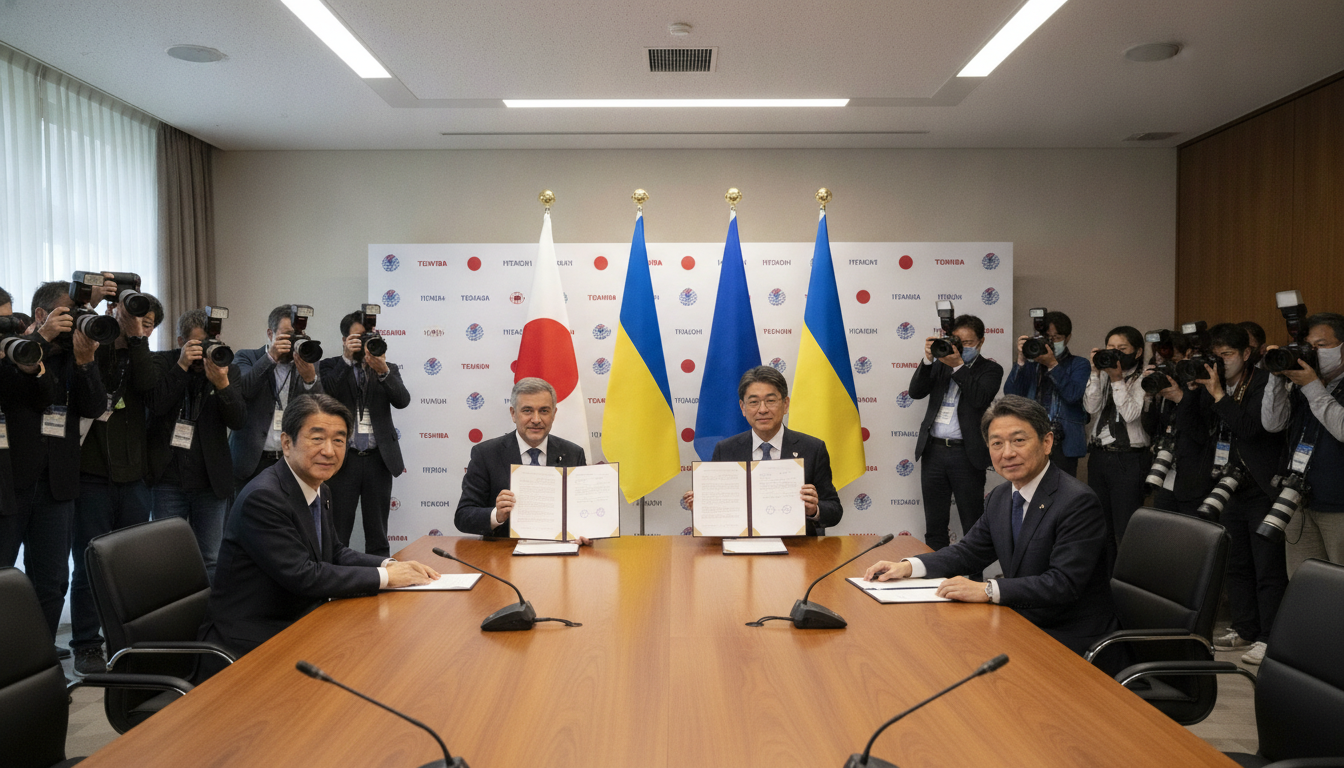
Ukraine-Japan joint fund to mobilize Hitachi and Toshiba for Ukraine’s industrial recovery
Kyiv and Tokyo will set up a Ukraine-Japan joint fund worth tens of millions to buy equipment and rebuild industry, with help from Hitachi and Toshiba.
Ukraine and Japan have agreed to establish a Ukraine-Japan joint fund aimed at accelerating the country’s post-invasion industrial recovery, Ukrainian officials said. The initiative, expected to total tens of millions of dollars, is intended to channel public and private resources into procurement of machinery, infrastructure repairs and industrial revitalization. Ukrainian Economy Minister Oleksii Sobolev confirmed Kyiv has already approached several Japanese firms about cooperation, signaling an early role for major manufacturers. The fund represents a new model of bilateral support that pairs government financing with corporate participation.
Kyiv and Tokyo formalize recovery financing
The two governments are moving to formalize an arrangement that combines Japanese financial backing with Ukrainian reconstruction needs. Officials indicate the structure will be designed to attract corporate partners and to fast-track deliveries of heavy equipment and industrial components. While precise governance arrangements remain under negotiation, both sides have signaled urgency in setting up the vehicle. The fund is intended to bridge immediate procurement needs and longer-term industrial rebuilding.
Planned uses: equipment procurement and infrastructure investment
The primary stated purpose of the fund is the procurement of industrial equipment and targeted infrastructure investment to restore production capacity. Priorities include machinery for energy, transport and manufacturing sectors damaged by conflict, along with components to re-establish supply chains. Kyiv expects the fund to finance both outright purchases and co-investments in priority projects. Officials say rapid delivery of equipment will be crucial to preventing further decline in industrial output.
Role of Hitachi, Toshiba and Japanese manufacturers
Ukrainian representatives have approached established Japanese heavy-industry names, including Hitachi and Toshiba, about supplying machinery and technical expertise. Japanese firms are seen as potential suppliers of turbines, generators, automation systems and other capital goods needed by factories and utilities. Participation by major corporations could also accelerate training, maintenance and after-sales support in Ukraine. Tokyo’s involvement is expected to help underwrite corporate risk and facilitate export procedures.
Requests from Ukrainian industry and government
Economy Minister Oleksii Sobolev told visiting delegations that Ukrainian companies and public agencies have already begun discussions with Japanese counterparts. Those talks reportedly cover specific equipment specifications, delivery timetables and co-investment terms. Kyiv’s approach emphasizes practical, project-level cooperation rather than abstract pledges, with businesses encouraged to identify immediate needs. The government also plans to coordinate requests to ensure allocations match national reconstruction priorities.
Implementation challenges and oversight considerations
Officials caution that moving equipment into Ukraine will face logistical, security and legal hurdles that must be addressed in fund design. Routes for transport, customs facilitation, and guarantees for equipment protection are among the operational issues to be resolved. Donor coordination and independent oversight mechanisms will be necessary to ensure funds are spent on intended projects and to limit diversion. Both sides have suggested a governance board with representatives from Kyiv and Tokyo, as well as independent auditors, to oversee disbursements.
Economic and diplomatic implications for both countries
For Ukraine, the joint fund offers a faster channel to replace lost industrial capacity and to stabilize manufacturing employment in damage-hit regions. For Japan, the arrangement creates new commercial opportunities for manufacturers while reinforcing Tokyo’s political support for Ukrainian sovereignty. The initiative also signals a broader trend of bilateral reconstruction partnerships that combine state financing with private-sector delivery. Analysts say success will depend on speed of implementation and clarity on procurement and security arrangements.
The joint fund marks a concrete step in Kyiv’s efforts to mobilize international industrial support and in Tokyo’s expanding role as a financier of Ukraine’s recovery. If effectively structured, the mechanism could provide timely equipment and investment to revive factories and critical infrastructure while offering Japanese companies a foothold in post-conflict reconstruction.

