
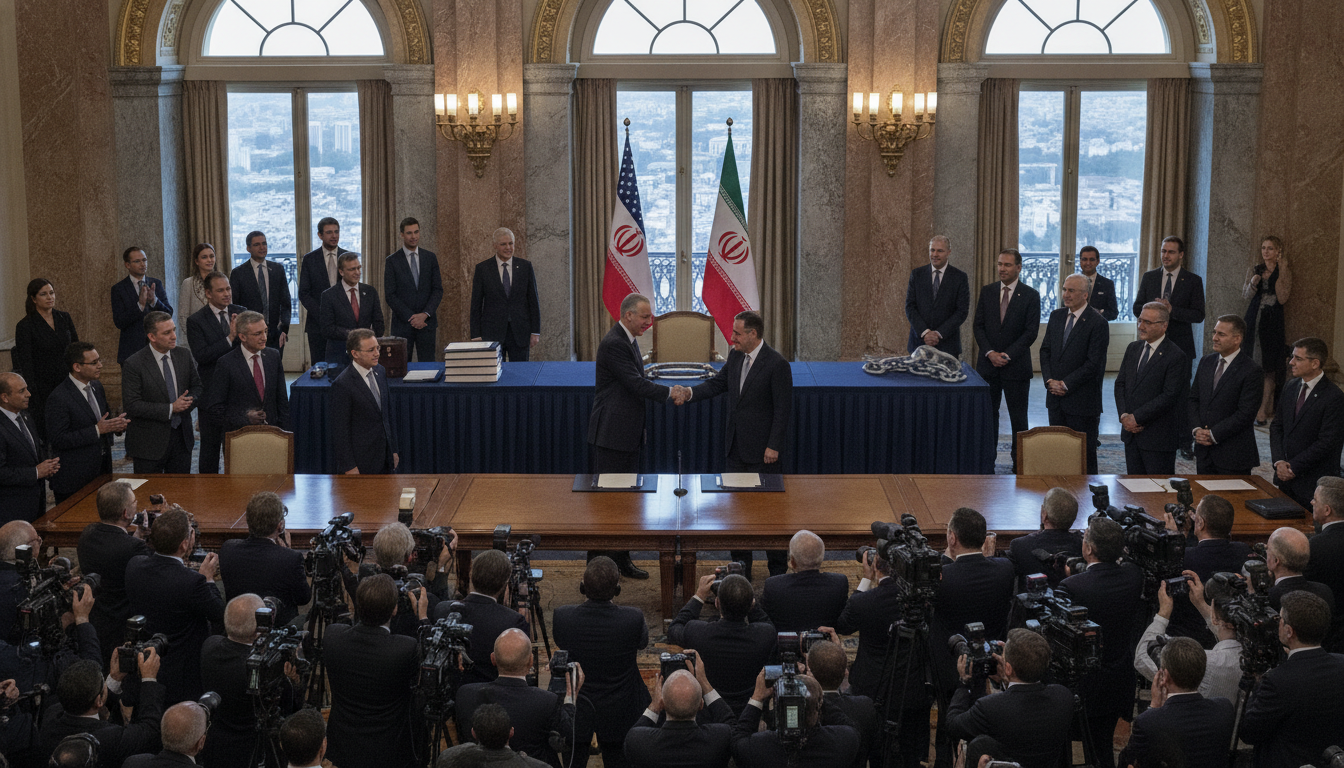
US-Iran peace agreement announced; signing set for June 19 in Switzerland
Pakistan-mediated US-Iran peace agreement announced June 15, with Iran confirming a finalized memorandum and both sides scheduling a formal signing in Switzerland on June 19.
The Pakistan prime minister announced a US-Iran peace agreement early on June 15 Japan time, saying negotiators had reached terms aimed at ending recent hostilities. The declaration was followed by public statements from the U.S. president and a formal confirmation from Iran’s national security apparatus, signaling a coordinated diplomatic push to halt fighting across multiple fronts. Officials said a signing ceremony is planned in Switzerland on June 19, and that the memorandum was finalized on the night of June 14.
Pakistan Prime Minister Announces Agreement
The Pakistani prime minister, identified by his social media post, said he had helped mediate a peace pact between the United States and Iran and declared that negotiators had reached a “peace agreement.” He framed Pakistan’s role as that of a facilitator and set a date for a formal signing ceremony in Switzerland on June 19. The announcement came in the early hours of June 15 Japan time and was released ahead of any public, formal text of the memorandum.
His post emphasized the diplomatic channel that brought the parties together and described the pact as a milestone toward ending exchanges of force. Pakistan’s involvement underscores Islamabad’s renewed engagement in regional diplomacy after playing limited mediating roles in previous crises. Officials in Islamabad have not yet released the full text of the memorandum or a detailed timeline for implementation.
U.S. President Announces Deal and Lifts Maritime Restrictions
The U.S. president quickly posted that a deal had been reached, celebrating the development and announcing immediate changes in maritime policy tied to the agreement. He said the United States would approve free passage through the Strait of Hormuz and would lift what he described as a maritime blockade of Iranian shipping. The president’s message stressed a swift return to commercial navigation and energy shipments, framing the accord as a restoration of normalcy for international shipping.
The statement from Washington suggested rapid operational steps would follow, but it did not specify verification mechanisms or how changes to military posture would be coordinated with allies. U.S. defense and diplomatic officials will likely need to implement technical and security measures to ensure the declared lifting of restrictions is executed safely and verifiably.
Iran Confirms Memorandum and Orders Immediate Cessation of Hostilities
Iran’s Supreme National Security Council said in a statement carried by state media that it had finalized the memorandum with the United States and had decided to end military actions. The council declared that military operations on all fronts, including in Lebanon, would stop immediately under the terms of the agreement. Iranian deputy foreign ministry officials issued similar statements, noting that the finalization of documents occurred late on June 14.
Tehran’s announcement framed the decision as a sovereign outcome reached through negotiation and confirmed the planned June 19 signing in Switzerland. Iranian authorities did not immediately disclose the full text of the memorandum or the mechanisms for compliance, leaving open questions about monitoring, enforcement, and any reciprocal steps expected from other parties in the region.
Key Terms Cited: Strait of Hormuz and Blockade Lifted
Both Washington and Tehran highlighted maritime terms as central elements of the memorandum, with statements pointing to free navigation through the Strait of Hormuz and the immediate end of a U.S.-imposed maritime blockade. Those provisions, if implemented, would aim to secure one of the world’s most crucial oil transit routes and reduce the risk of naval confrontations. The language used by officials suggests that reopening shipping lanes and ensuring energy flows were principal bargaining points in the talks.
Observers cautioned that operationalizing maritime access will require detailed coordination, including deconfliction of naval patrols, inspection protocols, and possibly third-party monitoring to reassure commercial operators and coastal states. The memorandum’s final text, to be unveiled at the signing, is expected to clarify whether neutral observers or international organizations will have roles in verification.
Signing in Switzerland and Next Steps for Implementation
A formal signing ceremony is scheduled for June 19 in Switzerland, where diplomats typically host high-level agreements to benefit from a neutral setting. The ceremony is likely to be followed by technical talks on implementation, timelines for troop or asset withdrawals, and mechanisms for verification. Governments and international stakeholders will be watching closely for the publication of the memorandum’s text and any annexes detailing compliance measures.
After the signing, the focus will shift to on-the-ground and at-sea steps required to end hostilities in practice. That could include phased withdrawals, ceasefire monitoring, channels for rapid incident reporting, and arrangements for the resumption of commercial shipping and energy exports. The effectiveness of the agreement will depend on timely, transparent steps and clarity about enforcement.
Regional and Global Implications of the Accord
If fully implemented, the agreement could reduce the immediate risk of wider military escalation and relieve pressure on global energy markets by stabilizing shipping through the Gulf. Neighboring states and international shipping companies will likely respond to operational details, and markets may react swiftly to confirmations about the lifting of maritime restrictions. The pact could also shift diplomatic dynamics in the Middle East, prompting recalibrations among allies and regional actors.
Nevertheless, experts warn that durable peace will require sustained diplomatic engagement and mechanisms to address underlying tensions. The coming days, particularly the June 19 signing and publication of the memorandum, will be decisive for whether the ceasefire translates into a longer-term de-escalation.
The agreement announced on June 15 and finalized on the night of June 14 marks a significant diplomatic step, but the precise terms and verification processes expected at the June 19 signing in Switzerland will determine whether the US-Iran peace agreement brings a lasting halt to hostilities.

