
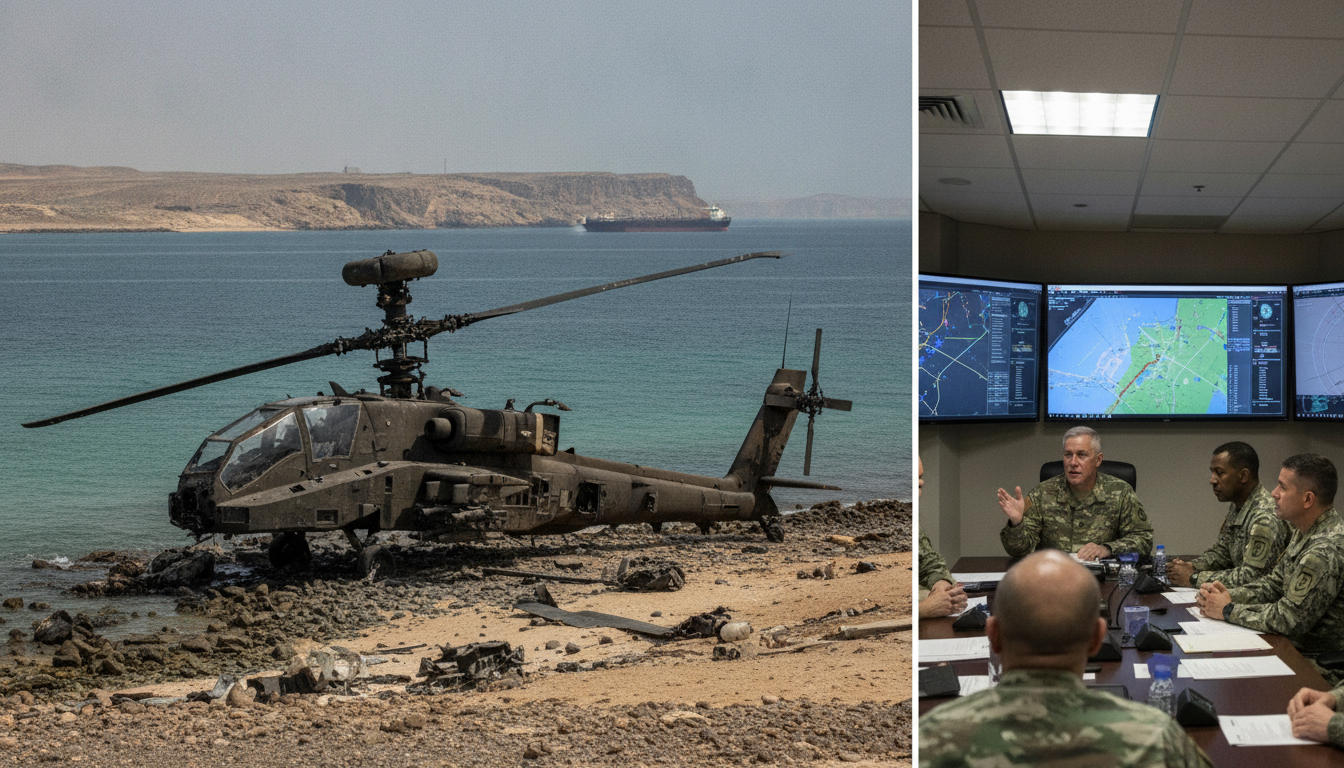
Apache helicopter downed near Strait of Hormuz as U.S. launches then halts strikes
U.S. Apache helicopter downed near the Strait of Hormuz, prompting limited American strikes that were later ordered halted by the president, underlining escalation risks and drone vulnerabilities.
The U.S. military’s AH-64 Apache helicopter was shot down on the night of June 8 near the Strait of Hormuz, according to Iranian claims and U.S. confirmations, thrusting the already tense Iran–U.S. standoff into a new phase. The incident prompted a swift U.S. counterstrike on Iranian radar and air defence installations the following day, but the president ordered the operation to be stopped hours after it began. The episode highlighted the difficulty of ending kinetic exchanges once they start and raised fresh questions about the role of low-cost drones and the limits of military options.
Details of the Apache helicopter incident
The Apache helicopter was reportedly struck while operating in international airspace close to shipping lanes off the Strait of Hormuz. Both crew members survived without injury, U.S. officials said, and were recovered after the aircraft went down.
U.S. Central Command announced that aircraft and facilities tied to Iranian air-defence and radar networks were targeted in retaliation. The strikes, described by officials as limited and defensive, focused on installations near the strait that the United States said were involved in the attack.
U.S. retaliation and presidential direction
Initial orders authorized strikes against Iranian defensive positions, with U.S. forces carrying out airstrikes on sites identified as ground control and radar nodes. Military spokespeople characterized the action as proportionate and aimed at degrading capabilities used against U.S. aircraft and regional commercial traffic.
Within hours, the president directed that the strikes be concluded, citing concerns about broader escalation. The abrupt halt to offensive operations underscored competing pressures within the U.S. administration between military commanders pressing for punitive action and political leaders wary of an expanding conflict.
Tactical implications: drones and air-defence gaps
Analysts point to the growing use of inexpensive unmanned aerial systems as a force multiplier for state and non-state actors in the region. The loss of an Apache to a relatively low-cost aerial threat would represent a sharp illustration of how asymmetric tools can challenge advanced platforms.
The strikes on radar and ground-control sites signal a U.S. attempt to blunt that vulnerability, but they also highlight persistent gaps in layered air-defence and counter-drone measures. Military planners face a difficult calculus: protecting high-value aircraft without escalating to a sustained confrontation that draws in additional forces and proxies.
Diplomatic constraints and regional escalation risks
Diplomacy has struggled to keep pace with rapid military exchanges, and officials from multiple countries warned that tit-for-tat strikes risk drawing the wider Gulf region into conflict. The president’s decision to halt further retaliation appeared aimed at reasserting political control over the tempo of operations and preserving space for diplomatic de-escalation.
Yet halting attacks after striking can also complicate diplomatic messaging by leaving questions about deterrence and consequences unanswered. Regional partners and rivals alike monitor such decisions for signs of resolve, and mixed signals can encourage further probing actions by adversaries.
Impact on maritime security and shipping routes
The Strait of Hormuz is a strategic chokepoint for global energy and shipping flows, and any military activity in its vicinity raises alarm across commercial and naval circles. Incidents that involve aircraft or missile fire near the strait exacerbate insurance and routing concerns for shippers and intensify naval escorts and surveillance missions.
Governments and commercial operators now face renewed pressure to reassess transit safeguards, convoy procedures and the deployment of military escorts. Even limited strikes and single-vehicle losses can have outsized economic and security effects because of the chokepoint’s critical role in global trade.
Political and strategic reverberations in Washington
Domestically, the episode has intensified scrutiny of presidential crisis management, with lawmakers and commentators debating whether the administration balanced military effectiveness and restraint appropriately. The rapid sequence — an attack, a military response, then an order to stop — drew attention to how political considerations shape battlefield decisions in real time.
Strategists warn that repeated cycles of limited action followed by political restraint can erode deterrence unless accompanied by a clear, credible diplomatic or operational plan. How the administration and its allies choose to follow up — through sanctions, intelligence operations, or increased regional posture — will shape perceptions of U.S. resolve.
The downing of the Apache helicopter and the truncated U.S. retaliation have reinforced the central dilemma facing policymakers: how to respond firmly to attacks without triggering a broader, uncontrollable conflict in a region already prone to escalation. The coming days are likely to see intensified diplomatic outreach even as military forces remain alert to further incidents, leaving the delicate balance between deterrence and de-escalation in sharp focus.

