
Xi-Putin meeting in Beijing marked by lavish ceremony mirroring recent Trump reception
Chinese President Xi Jinping welcomed Russian President Vladimir Putin with a lavish ceremony at the Great Hall of the People on May 20, 2026, in a Xi-Putin meeting that echoed the pomp of a recent U.S. state visit.
Ceremony and setting
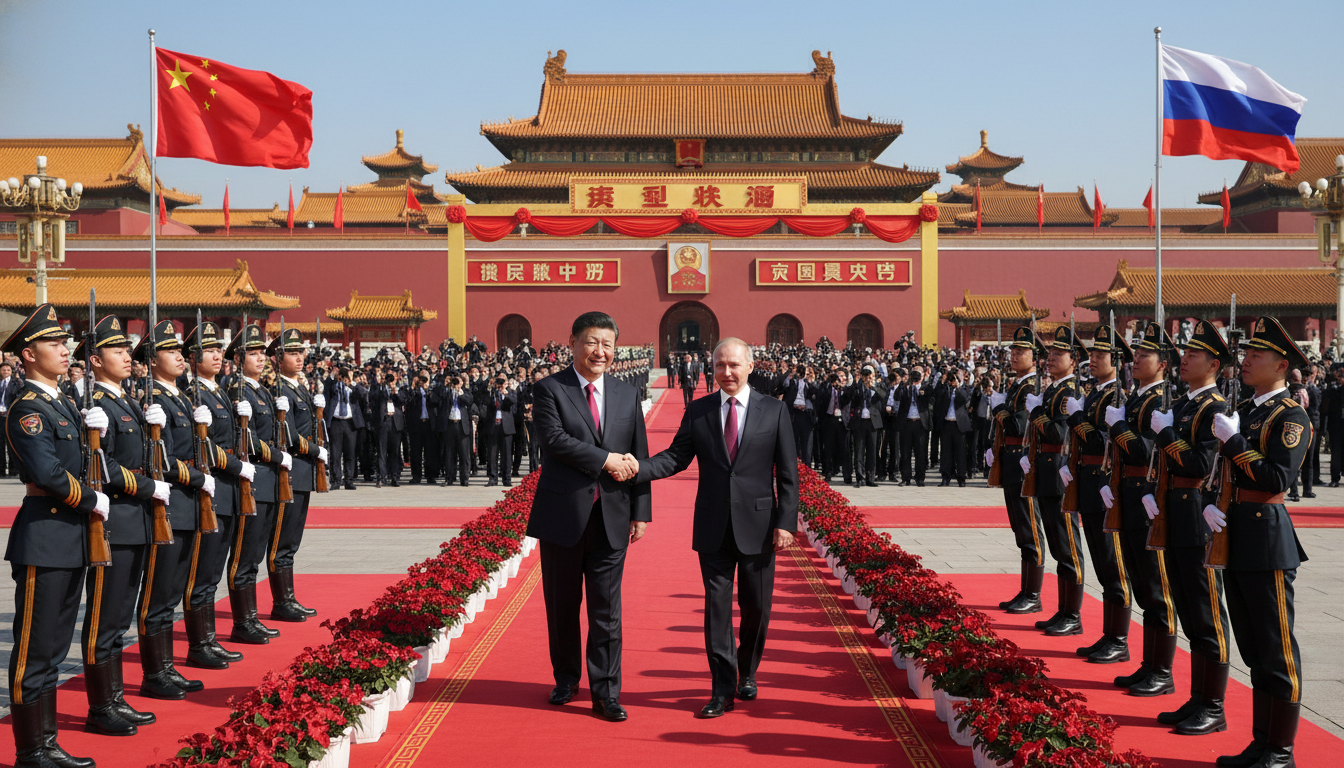
The Xi-Putin meeting opened with formal protocol at the Great Hall of the People in central Beijing, where state media released images of the two leaders shaking hands before a scheduled meeting.
The reception included ceremonial guards and a red-carpet welcome that highlighted the event’s diplomatic significance and Beijing’s intent to stage the encounter as a high-profile bilateral moment.
The visual display underscored the importance both capitals place on optics and statecraft, with carefully choreographed elements aimed at domestic and international audiences.
Officials from both sides were present to witness the exchange, which set the tone for talks to follow in the same complex where China receives visiting heads of state.
Handshake and public optics
Photographs of Xi Jinping and Vladimir Putin exchanging greetings were circulated widely, emphasizing a warm, if formal, public rapport.
The images captured in the Great Hall served to project unity and continuity in the relationship between Beijing and Moscow at a moment when global attention is focused on major power diplomacy.
Public optics played a central role in the Xi-Putin meeting, with Beijing employing the ceremonial script commonly used for top-level state visits.
For both governments, the visual narrative of cordial engagement appeared designed to reinforce a message of stable bilateral ties to foreign capitals and domestic constituencies.
Protocol echoes recent U.S. visit
Observers noted that the reception for Mr. Putin bore similarities to the greeting Beijing extended to U.S. President Donald Trump less than a week earlier.
The repetition of lavish protocol elements suggested a calibrated approach by Chinese authorities to present comparable ceremonial honors to visiting leaders regardless of geopolitical alignment.
By staging parallel receptions, Chinese officials appeared to demonstrate Beijing’s capacity to host major diplomatic interlocutors in an identical ceremonial format.
The choice to mirror elements of the earlier visit also highlighted Beijing’s focus on maintaining a consistent image of state hospitality and diplomatic formality.
Planned talks at the Great Hall
Following the ceremonial greeting, the leaders moved to a scheduled meeting in the Great Hall where agenda items typically include bilateral cooperation and strategic coordination.
While officials did not immediately release a detailed public agenda, the setting indicated discussions would cover a range of political and economic issues customary for such summit-level encounters.
State-run outlets described the meeting as part of ongoing high-level exchanges between China and Russia, a cadence that has featured ministerial visits and summit contacts in recent years.
Delegations from both sides were expected to use the talks to review ongoing projects and to set priorities for future cooperation across trade, energy, and diplomatic channels.
Signals to international audiences
The Xi-Putin meeting sent a clear signal that Beijing and Moscow continue to prioritize high-profile engagement and mutual visibility on the world stage.
By combining ceremonial display with a formal summit, the two capitals aimed to communicate stability and mutual regard in their bilateral relationship.
Such displays are often read closely by other capitals, including regional neighbors and major powers, as indicators of alignment and diplomatic posture.
Analysts suggest that summit choreography and public messaging can be as consequential as policy announcements in shaping perceptions of international partnerships.
Watchful regional capitals
Regional governments, including Tokyo, were likely monitoring the summit for any indications of policy shifts or new cooperative initiatives between Beijing and Moscow.
In the absence of immediate detailed communiqués, diplomats and analysts were expected to scrutinize subsequent statements and joint documents for substantive outcomes.
The Xi-Putin meeting therefore served both as a ceremonial reaffirmation of ties and as the opening act for more substantive exchanges that could emerge in follow-up statements.
How the summit’s optics translate into concrete policy will be a focus for observers in the coming days.
The meeting in Beijing on May 20, 2026, showcased a blend of state ceremony and summit diplomacy that both capitals used to underline their bilateral relationship, with the public choreography echoing a recent reception extended to another global leader.

