
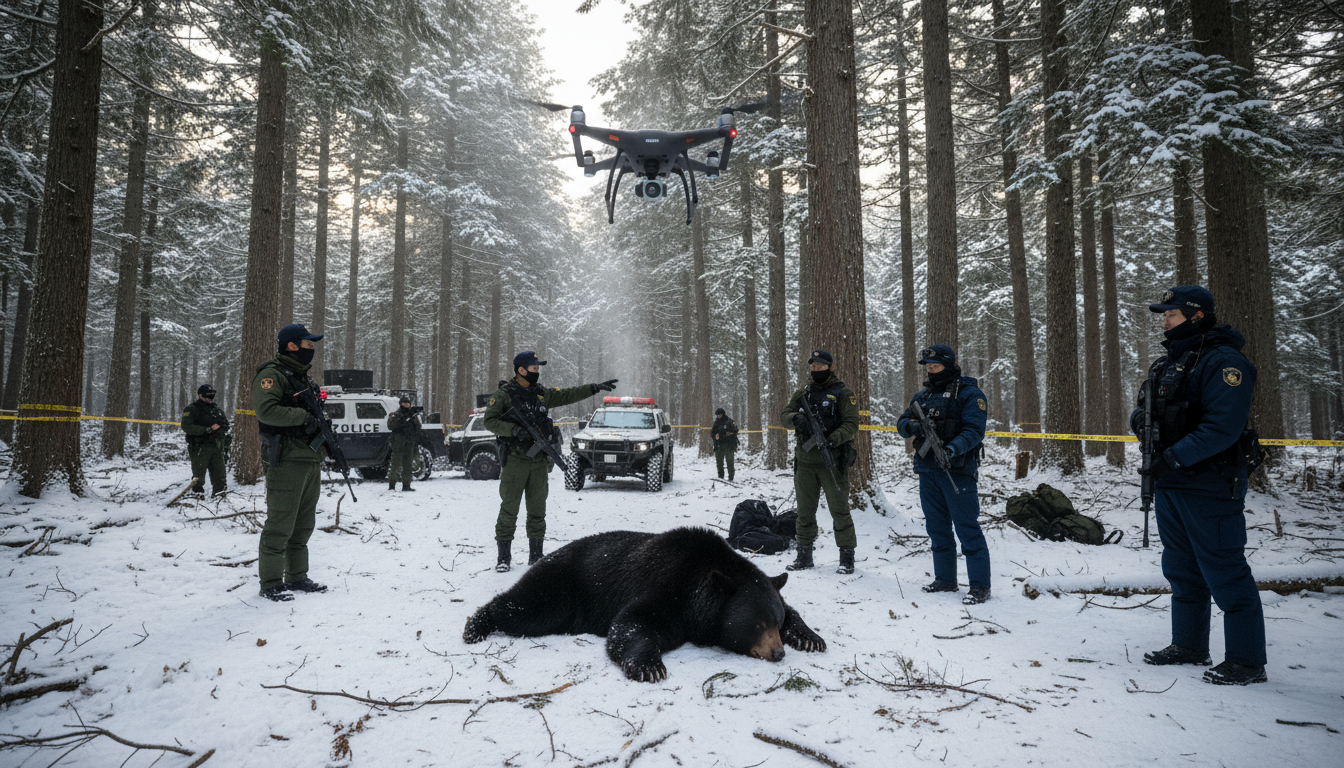
Sendai bear shot after hours-long standoff in city centre, drones and hunters aided operation
A man-sized bear that spent more than ten hours within a Sendai condominium complex was killed in an emergency shooting on April 19, 2026, after authorities weighed tranquilizer and lethal options; the Sendai bear incident prompted drone reconnaissance, trap attempts and road restrictions.
Central condominium becomes focal point
The incident began in the early hours of April 19 when a black bear was reported in the Kichimachidori area near Sendai city hall and the prefectural government offices.
Residents and officials watched as the Sendai bear remained on a condominium property for more than a dozen hours, refusing to vacate sheltered vegetation and walls.
City environmental staff mobilized wildlife and public-safety resources as the situation evolved into a prolonged standoff that raised concerns about potential nocturnal movement and harm to people.
Officials said the location, close to dense urban facilities, made standard capture options more complicated and risky for nearby residents.
Expert initially refuses night tranquilizer shot
Takeharu Uno, a 47‑year‑old head of the Tohoku Wildlife Protection Management Center and a veteran of field work, was contacted at about 2 a.m. and asked to assist with a tranquilizer gun.
Uno declined, citing the well‑known danger that an immobilized bear can continue moving for seven to eight minutes after a dart and that poor night visibility and incomplete perimeter containment would increase public risk.
Uno has nearly three decades of experience with wild mammals and served on advisory panels considering changes to the Wildlife Protection and Management Act that included emergency shooting provisions.
He advised that, in densely populated areas, a single, accurately placed lethal shot could be more appropriate than an ill‑timed tranquilizer attempt.
Drone operator locates bear under shrubbery
At about 6 a.m., drone operator Tsukasa Aoya of BlueDrone, 45, was asked to assist in searching the grounds after the animal disappeared into cover.
Aoya, a licensed first‑class unmanned aircraft pilot who has worked with hunters to survey traps, deployed a nimble FPV drone and located the animal beneath a tree root and against a boundary wall before 8 a.m.
Aoya described the animal as appearing unusually calm and unafraid, noting it sat with its back toward the crews and glanced up at the drone as if accustomed to human presence.
The drone footage played a critical role in confirming the bear’s exact position and monitoring movement throughout the daylight hours.
Trap attempts and prolonged containment
Around 9:30 a.m., members of the local hunting association set a box trap baited with honey in a capture attempt aimed at securing the Sendai bear without an open‑fire operation.
Despite those efforts, the bear remained in the same vegetated pocket for roughly seven and a half hours, creating a protracted impasse that left officials weighing next steps.
Municipal authorities grew increasingly concerned that the animal would become active after sunset and potentially flee into streets or residential yards.
Police were asked to coordinate traffic controls and to keep people clear of the immediate area as a precautionary measure while options were discussed.
Decision for emergency shooting as sunset approaches
City leaders reconvened in the late afternoon and, with Uno’s assessment and public‑safety considerations in view, asked him to proceed with an emergency operation involving a firearm.
At around 6 p.m., with daylight waning but still sufficient for a controlled attempt, officials authorized a managed emergency shooting to neutralize the immediate risk.
Law enforcement officers were positioned to block likely escape routes and to prevent bystanders from approaching, and Aoya continued to provide aerial oversight with his drone to ensure the bear had not moved.
Authorities said the timing and deployment were chosen to maximize accuracy and safety given the urban setting and the animal’s proximity to people.
Aftermath and animal details
Officials later confirmed the bear was an adult male measuring approximately 1.5 metres in body length and weighing about 125 kilograms, based on measurements provided by wildlife responders.
Emergency teams recovered the carcass at roughly 7:15 p.m., and municipal staff began procedures to inspect the site, notify neighbors and remove the animal with standard sanitary and legal protocols.
City representatives indicated they would review the incident to assess whether additional preventive measures are needed around urban‑ridge green belts and to consider expanded monitoring where human habitats and bear ranges overlap.
Local residents expressed relief that no people were injured, while some questioned whether more non‑lethal capture options could have been feasible in the densely populated environment.
The Sendai bear episode highlights growing tensions between expanding urban areas and wildlife movements, and officials said it will inform future responses to similar intrusions into city centres.

