
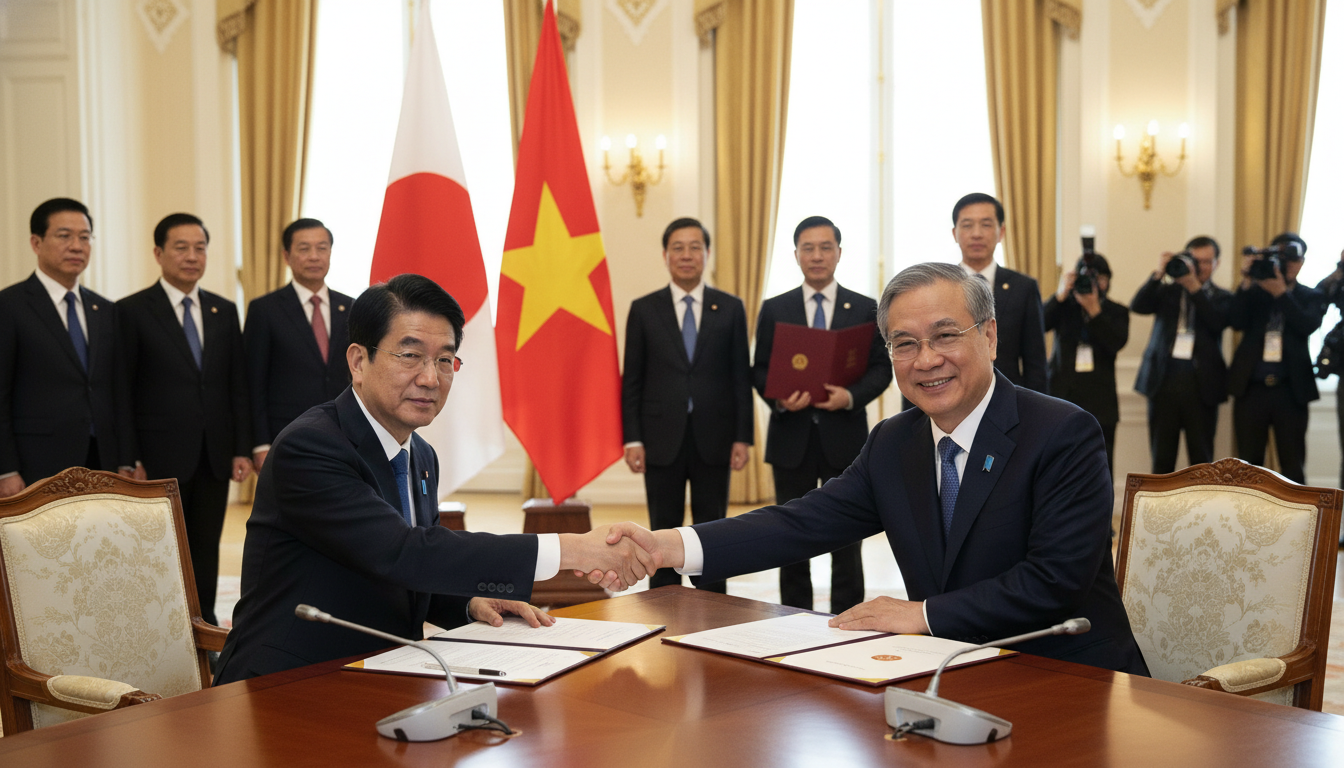
Japan, Vietnam sign joint document to bolster economic security and supply chains
Japan’s PM Sanae Takaichi and Vietnam’s Le Minh Hun signed a Hanoi agreement on May 2, 2026 to bolster economic security, energy ties and supply-chain resilience.
Japan’s Prime Minister Sanae Takaichi met with Vietnamese Prime Minister Le Minh Hun in Hanoi on May 2, 2026, and the two leaders issued a joint document committing to deepen economic security cooperation. The agreement highlights collaboration on energy supplies and critical minerals and aims to stabilize and diversify supply chains in response to rising regional and global risks. Both leaders framed the move as part of a broader effort to strengthen the Japan–Vietnam comprehensive strategic partnership and advance a free and open Indo‑Pacific.
Takaichi and Le Minh Hun sign joint document on economic security
The joint document released after the talks sets out measures to strengthen economic security, with an explicit focus on energy and strategic minerals. Japanese officials described the agreement as a step to reduce vulnerability in critical supply lines that underpin industry and national security. The leaders said they would pursue practical cooperation to ensure more predictable access to materials and energy resources.
Energy cooperation prioritized amid global uncertainty
Energy security emerged as a central pillar of the accord, reflecting concerns about volatility in global markets and disruptions to supply caused by conflicts and geopolitical friction. The document signals intentions to explore partnerships in areas such as liquefied natural gas, renewable energy development, and infrastructure that can support stable imports. Both governments indicated they will seek ways to align investments and regulatory measures to improve resilience against future shocks.
Critical minerals and supply-chain diversification outlined
Critical and rare minerals needed for electronics, batteries, and advanced manufacturing are singled out as priorities in the pact. The joint text calls for cooperation to secure these resources through diversified sourcing, joint projects, and greater transparency across supply chains. Officials noted that reducing dependence on any single supplier or route is essential to guarding industrial continuity for both economies.
Geopolitical drivers behind the agreement
Leaders cited recent deterioration in the Middle East and what they described as instances of economic coercion in the region as factors accelerating their talks on economic security. Japan framed the pact as part of a response to an unstable external environment, while Vietnam emphasized the need for resilient economic ties as it continues rapid industrial expansion. Regional observers say the move reflects an increasing tendency among Asian partners to translate geopolitical concern into concrete economic arrangements.
Commitments to a deeper strategic partnership and FOIP goals
Prime Minister Takaichi told the meeting she values Vietnam as a key supply‑chain hub and pledged to further deepen the countries’ comprehensive strategic partnership. Both leaders referenced the Free and Open Indo‑Pacific (FOIP) concept, indicating a shared interest in maintaining open trade routes and standards that support economic stability. The joint document frames bilateral cooperation as contributing to a broader regional architecture that emphasizes openness and rule‑based economic relations.
Next steps: working groups, investments and concrete measures
While the statement is not a binding treaty, it commits Tokyo and Hanoi to follow-up actions intended to turn policy goals into measurable outcomes. The joint document includes provisions for expert working groups, information‑sharing mechanisms, and discussions on joint investment in critical infrastructure. Japanese and Vietnamese officials said they would soon convene technical teams to draft action plans and identify priority projects for implementation.
Japan’s business community has been watching the visit for signs of expanded commercial ties, particularly in manufacturing and energy sectors that depend on stable mineral and fuel supplies. Vietnam, for its part, has sought to attract higher‑value investment and secure partnerships that can underpin its economic transformation. Analysts say the joint statement could accelerate projects ranging from battery material sourcing to logistics hubs that serve both markets.
The leaders’ meeting in Hanoi on May 2, 2026 underscores a pragmatic turn in bilateral relations, where strategic concerns are increasingly managed through economic instruments and supply‑chain policy. As Tokyo and Hanoi move to translate the joint document into concrete programs, the focus will be on rapid establishment of coordination mechanisms and investment commitments to deliver tangible resilience for both countries’ industries.

