
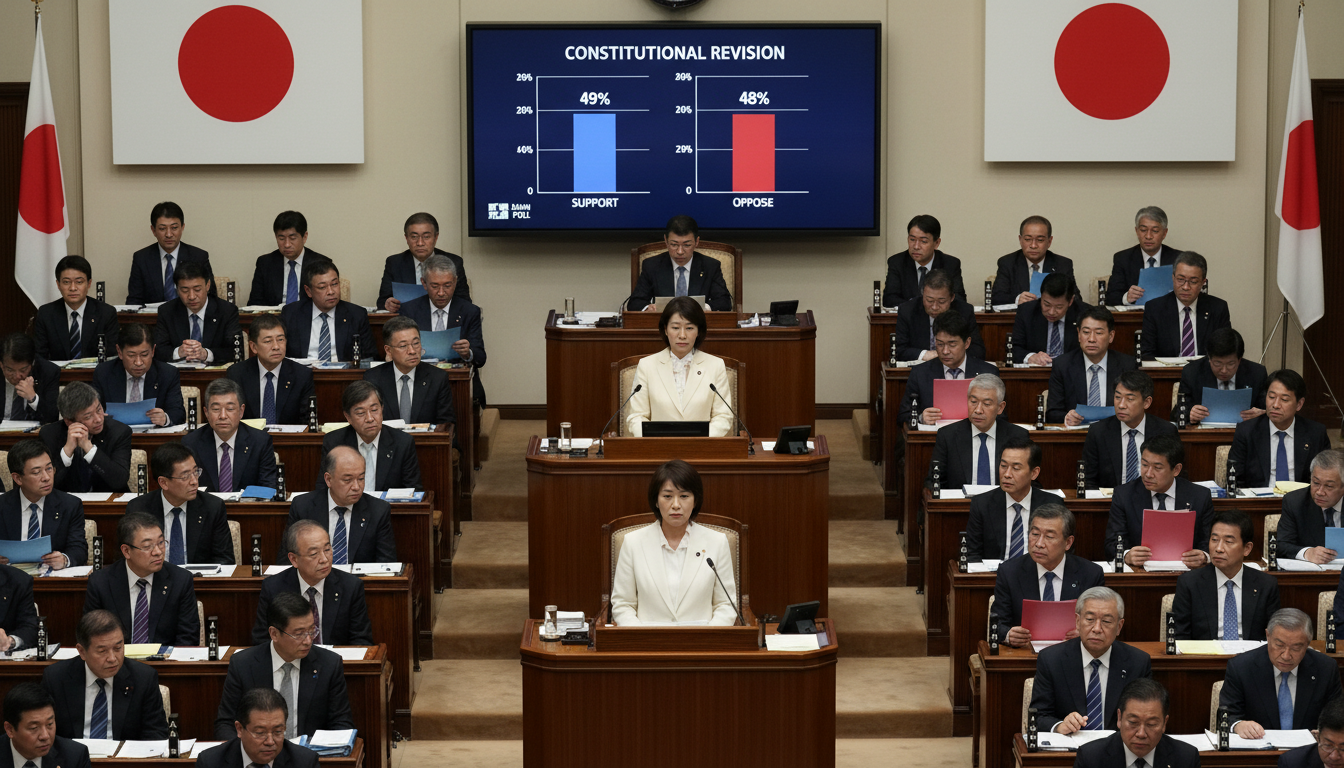
Asahi Poll Shows Public Split on Constitutional Revision Under Takaichi Administration — 47% Support, 43% Oppose
Asahi poll: 47% support, 43% oppose constitutional revision under the Takaichi administration; public divided on timing, Article 9 and reform priorities ahead of May 3.
Japan faces a sharply divided public on the question of constitutional revision under the Takaichi administration, a nationwide postal poll released ahead of Constitution Memorial Day found. The survey shows 47% of respondents favor pursuing constitutional revision while 43% oppose it, underscoring a narrow but politically significant split. The poll, conducted by a national daily in late April, also captured strong resistance to altering Article 9 and differing views on whether lawmakers should accelerate debate in the Diet.
Key poll result: 47% back revision, 43% oppose
A plurality of respondents indicated support for constitutional revision under the current administration, while opposition trailed closely behind. The margin reflects a polarized electorate rather than a decisive mandate for change. Pollsters noted that demographic differences—age, region and party support—help explain much of the variation in opinion.
The result comes as Prime Minister Takaichi’s government signals renewed emphasis on constitutional debate as part of its broader policy agenda. The proximity of Constitution Memorial Day on May 3, 2026, elevated the issue in public discussion and likely influenced response rates to the postal questionnaire. The poll’s timing gave respondents a chance to weigh recent statements from political leaders.
Strong resistance to changing Article 9
When questioned specifically about Article 9, the self-defense clause that renounces war, respondents displayed greater reluctance to endorse change. Separate items in the survey show roughly 63% of respondents said Article 9 should be left unchanged, a share that edged up compared with previous years. That contrast indicates voters may support some constitutional revision in principle but balk at altering Japan’s pacifist core provision.
Experts say the gap between general support for constitutional revision and opposition to touching Article 9 suggests the public distinguishes between piecemeal policy updates and far-reaching changes. For many voters, Article 9 carries symbolic importance tied to postwar identity, and any proposal to amend it faces steep public scrutiny.
Views on timing and parliamentary urgency vary
The poll also asked whether the Diet should accelerate deliberations on constitutional change. Responses revealed skepticism about rushing the process, with a substantial portion of those surveyed saying there is no urgent need to press forward. That hesitation complicates the government’s timeline for any legislative or referendum push.
Political strategists caution that a narrow lead in favor of revision does not translate into a clear pathway for lawmakers seeking rapid action. Parties supportive of amendment will need to build broader consensus across regions and demographic groups, and convincing voters that revision is both necessary and well-timed remains a key hurdle.
Party reactions and political implications
Ruling party officials welcomed the plurality that favors revision, framing it as public validation for pursuing constitutional debate. Opposition parties seized on the close split and the strong resistance to changing Article 9 to argue for a more cautious, consultative approach. Lawmakers from across the spectrum signaled plans to reference the poll in upcoming Diet debates and campaign messaging.
Analysts note the poll’s mixed findings could reshape party strategies ahead of elections and referendum planning. A government intent on advancing constitutional revision may pivot to proposals that avoid radical changes to Article 9 while emphasizing other areas of reform. Conversely, opposition forces may focus on mobilizing voters who remain wary of any constitutional reworking.
Public sentiment shaped by security and identity concerns
The survey results reflect broader anxieties at the intersection of national security and national identity. Discussions about regional tensions, alliance commitments and domestic safety have made constitutional language a flashpoint for voters weighing the trade-offs between legal clarity, deterrence and long-standing pacifist values. For many respondents, the debate over constitutional revision is not only legal but also moral and symbolic.
Sociologists and constitutional scholars pointed to shifting emotional narratives—concerns about safety and pride on one hand, and fears about sacrificing civil liberties or historical commitments on the other—as key drivers of opinion. The poll suggests that while a plurality accepts the idea of constitutional revision in abstract terms, many remain cautious about changes they perceive as compromising foundational principles.
Outreach and public education are likely to shape how the constitutional revision debate unfolds. Advocates for revision will need to articulate concrete benefits and safeguards, while opponents will press for broader deliberation and transparency.
Public debate now moves from headlines into the parliamentary process and civic forums as Japan observes Constitution Memorial Day on May 3, 2026. The poll’s narrow margin underscores the political stakes: lawmakers face a deeply divided electorate that demands clear justification for any move to alter the nation’s founding legal framework.

