
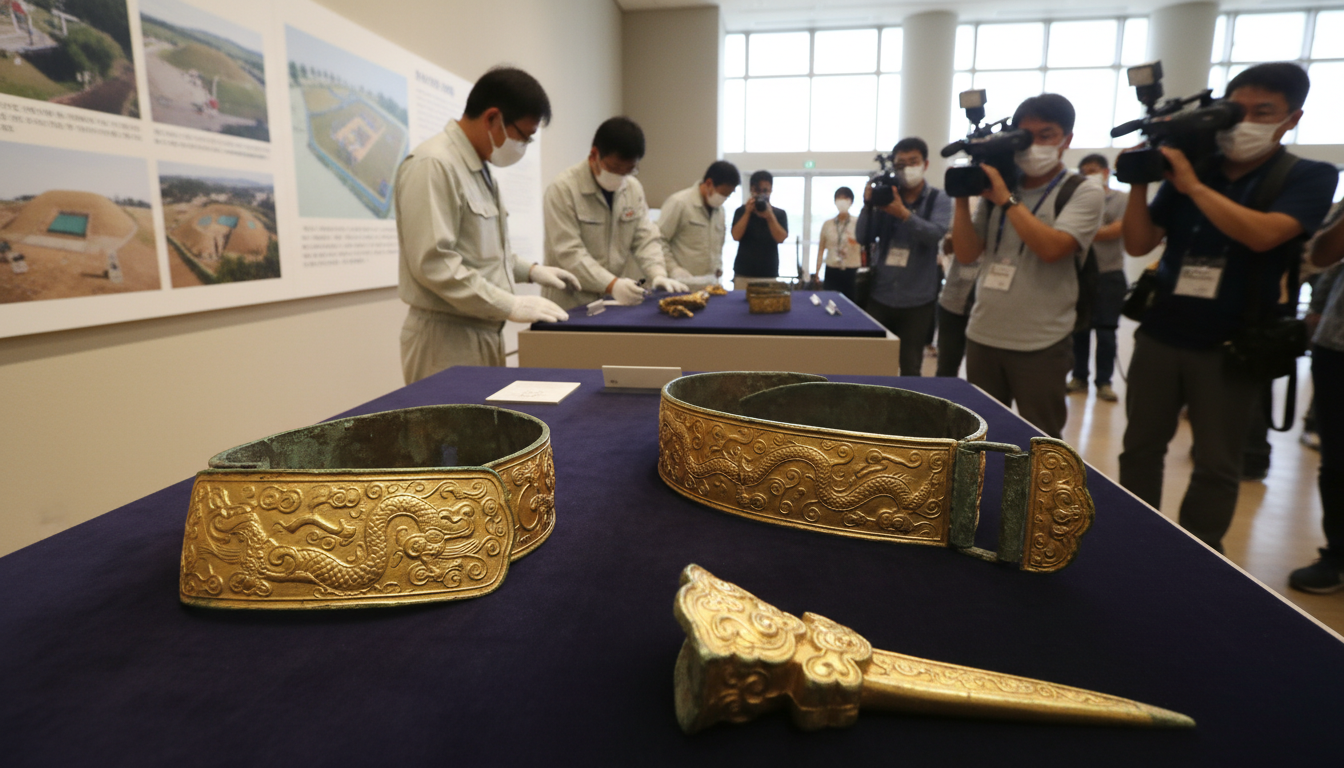
Baekje belt fittings with phoenix and demon motifs unearthed at Sudo Senninzuka Kofun in Fuji City
Gilded Baekje belt fittings with phoenix and demon motifs were unearthed at Sudo Senninzuka Kofun in Fuji City, the first such discovery in Japan. Now.
Discovery announced by Fuji City
Fuji City announced on May 7, 2026 that archaeological work at the Sudo Senninzuka Kofun in the city’s outskirts produced three gilded belt fittings identified as Baekje belt fittings. The city said the objects were recovered from the stone chamber of the tumulus during recent excavation and conservation efforts.
Officials provided photographs showing the fittings in situ and noted that the find represents the first confirmed instance of such Baekje-produced belt ornamentation recovered within Japan. The announcement has prompted renewed attention from archaeologists and historians studying early East Asian networks.
Description of the artifacts
The unearthed set comprises three gilt copper-alloy fittings: one elongated belt tip measuring approximately 11 centimeters and two circular plate fittings with attached rings designed for the belt surface. Each piece displays finely executed iconography, with the belt tip showing two phoenixes, a fierce demon-like face, and a depiction of the three sacred mountains known in ancient Chinese cosmology.
Metalwork specialists who examined the photographs noted the use of chasing, repoussé and engraved techniques consistent with high-grade artisanship in late Six Dynasties and Three Kingdoms–period Korea. The surface retains gold plating, and the motifs are rendered with a level of detail that points to workshop production rather than local imitation.
Connection to Baekje and the Sabi era
Scholars assessing the assemblage linked the design and manufacturing methods to Baekje, one of Korea’s Three Kingdoms, particularly to the period when its final capital was at Sabi (modern Buyeo County) between roughly 538 and 660 CE. The city’s report and subsequent expert commentary suggested the fittings were either made in Baekje or by craftsmen trained in Baekje techniques.
The presence of Baekje belt fittings in a Japanese tumulus reinforces evidence of close diplomatic and cultural exchange across the Sea of Japan during the sixth and seventh centuries. Such items were often used to indicate official rank, and their arrival in the Japanese archipelago implies direct acquisition through elite contact, gift exchange, or the movement of specialists.
Comparative evidence from domestic and Korean sites
Similar demon and phoenix motifs appear in known continental assemblages and in important Japanese votive treasures, notably some items associated with early Nara-period temples. Domestic parallels have been cited from objects linked to Horyu-ji holdings and early courtly regalia, though none match the provenance of the Fuji City find until now.
On the Korean peninsula, comparable artifacts are scarce because Baekje burial practice shifted away from including rich grave goods in many contexts. That scarcity increases the significance of the Fuji City discovery, as it offers a rare example of court-associated ornamentation connected to Baekje material culture.
Scholarly interpretations and significance
Archaeologists calling the find “a first for Japan” emphasize its value for understanding artisan mobility and the transmission of court culture across East Asia. Experts argue that the fittings are not mere decorative novelties but tangible indicators of administrative and ceremonial fashions imported from continental polities to the emerging Japanese state.
Researchers also caution that establishing a firm production origin will require metallurgical analysis, microscopic study of manufacturing marks, and comparative typological work. The city indicated that the artifacts will undergo detailed conservation and scientific testing before any definitive attribution is published.
Next steps: conservation, analysis, and public access
Fuji City’s board overseeing cultural properties plans to stabilize and conserve the fittings under controlled laboratory conditions and to commission further analysis by university specialists. Proposed studies include elemental composition assays, X-radiography, and comparisons with published Baekje metalwork to refine dating and provenance.
Officials said the city aims to balance conservation needs with public interest and intends to display the fittings in a local museum once analysis and preservation work are complete. The board stressed that any exhibition will be accompanied by explanatory material situating the objects within broader East Asian networks of the sixth and seventh centuries.
The appearance of Baekje belt fittings at Sudo Senninzuka Kofun adds a significant chapter to the archaeological record linking Japan and the Korean peninsula, and ongoing study is expected to clarify the social and diplomatic contexts that brought such finely wrought objects to a Fuji burial mound.

