
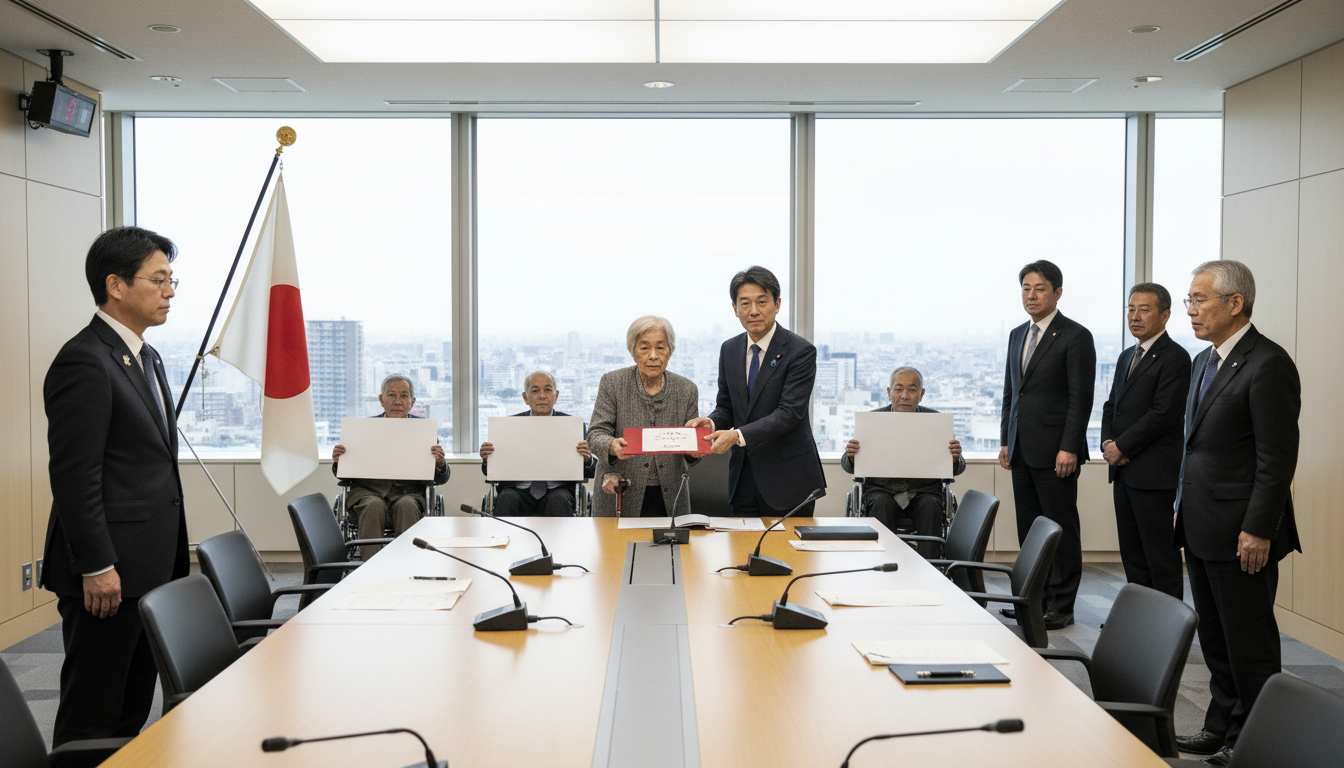
Minamata disease patient protest: supporters demand apology after minister retracts care pledge
Supporters of Minamata disease patient Yuji Kaneko demand an apology and sustained talks after Environment Minister Hirotaka Ishihara reversed a care pledge.
The groups representing fetal and pediatric Minamata disease patients delivered a formal protest to the Environment Ministry on May 6, 2026, saying Minister Hirotaka Ishihara’s change in stance had deeply wounded the patient community. The protest stems from comments made by Ishihara at a press conference on May 1, after he had appeared supportive during a visit to a care home on April 30. The dispute centers on Kaneko’s request for disability-based welfare services rather than care under the public long-term care insurance system.
Protest letter delivered to ministry officials
The protest was submitted by the Association of Minamata Fetal and Pediatric Patients, Families and Supporters and the local aid group Kibou Mirai Minamata. Representatives handed the document on May 6 to Haruhiko Hakuno, director of the Environment Ministry’s Environmental Health Department, during a visit to Minamata City. The letter demands Ishihara retract the May 1 statement and issue a direct apology to Yuji Kaneko.
Supporters described the May 1 remark — that the minister had only spoken of pressing the city because “the person was in front of me” and that in reality it would be difficult — as a reversal of a prior commitment. They argued the public backtrack in a formal press setting amounted to an insult to victims who have long sought recognition and adequate support. The groups urged the minister to return to Minamata and apologize in person to Kaneko.
Criticism of ‘lip service’ and call for direct apology
At a May 7 press briefing, veteran supporter Takeko Kato, 75, called the explanation that the statement was made because “the person was present” a form of deceit and humiliation. Kato and other advocates demanded that Ishihara meet Kaneko directly to offer a sincere apology, not a mediated or bureaucratic response. The protest letter accuses the minister’s abrupt change of tone of reopening wounds for victims who have suffered decades of health and social consequences.
The complaint labels the May 1 comment as “lip service” that trivialized the pleas of a patient whose condition they assert results from Minamata disease rather than natural aging. Supporters pressed the Environment Ministry to treat Minamata-related disabilities as distinct from normal age-related care needs and to pursue measures that reflect the damage caused by industrial pollution.
Dispute over eligibility for disability welfare services
The immediate policy dispute involves Kaneko’s request to receive home-visit bathing care under disability welfare services rather than services provided under Japan’s Long-Term Care Insurance Act. Kaneko, now 70, rejects the characterization that his needs stem from ordinary aging and seeks support tailored to Minamata-related disabilities. He has become bedridden in recent years and requires 24-hour assistance, according to his supporters.
Waterfront municipal authorities in Minamata City have maintained that individuals aged 65 and older should be served primarily under the long-term care insurance system, a position that blocks Kaneko’s application for disability-specific services. Kaneko’s camp argues that care under the long-term care insurance framework may not adequately meet the complex medical and welfare needs of patients whose impairments are the result of industrial pollution.
Ministry meetings with city officials and internal explanations
According to sources, Ishihara met Minamata Mayor Toshiharu Takaoka after a memorial ceremony on May 1 and relayed Kaneko’s request, but the mayor expressed reservations about changing the city’s position. Haruhiko Hakuno told Kaneko’s supporters on May 6 that the ministry’s response at the May 1 press conference reflected insufficient ministerial briefing and that the use of the word “difficult” had been an over-generalized, bureaucratic turn of phrase.
Hakuno acknowledged to the patient group that ministry staff had not provided adequate support to prepare the minister for the public question and pledged to report back on next steps. Nevertheless, supporters said the explanation did not address the emotional impact of the minister’s words and reiterated their demand for an apology directed to Kaneko himself.
Supporters seek sustained negotiations and policy recognition
The protest letter asks the Environment Ministry to exert continued pressure on Minamata City and to create a standing forum for discussion with patient representatives until a durable solution is achieved. Supporters emphasized that Minamata disease disabilities arise from pollution and cannot be equated with ordinary senescence, which they say requires different medical, welfare and administrative treatment. They also requested that the ministry commit to ongoing, practical engagement rather than intermittent expressions of sympathy.
Advocates said they will monitor whether the ministry follows through with direct engagement, including a ministerial visit to Minamata to meet Kaneko, and whether it establishes repeated dialogue with the patient community. They stressed that mere verbal promises without institutional follow-up would be insufficient to restore trust.
Local implications and national attention on Minamata care
The episode has renewed scrutiny of how municipalities and national ministries adjudicate welfare entitlements for aging victims of pollution. Legal and social-service specialists say similar disputes may emerge elsewhere as Minamata-era survivors age and their service needs increase. Observers note the case highlights tensions between standardized care systems and the specific requirements of pollution-related disabilities.
Patient advocates and legal counselors are considering administrative appeals and additional public campaigns to press for policy adjustments that recognize the distinct origins and care needs of Minamata disease survivors.
Environment Minister Ishihara has not yet announced a date to return to Minamata for a direct meeting and apology, and patient groups say they will make any further developments public as they press for concrete, continuing engagement from both the ministry and Minamata City.
The outcome of this dispute may set a precedent for how the government addresses long-term care and welfare for survivors of environmental pollution across Japan.

