
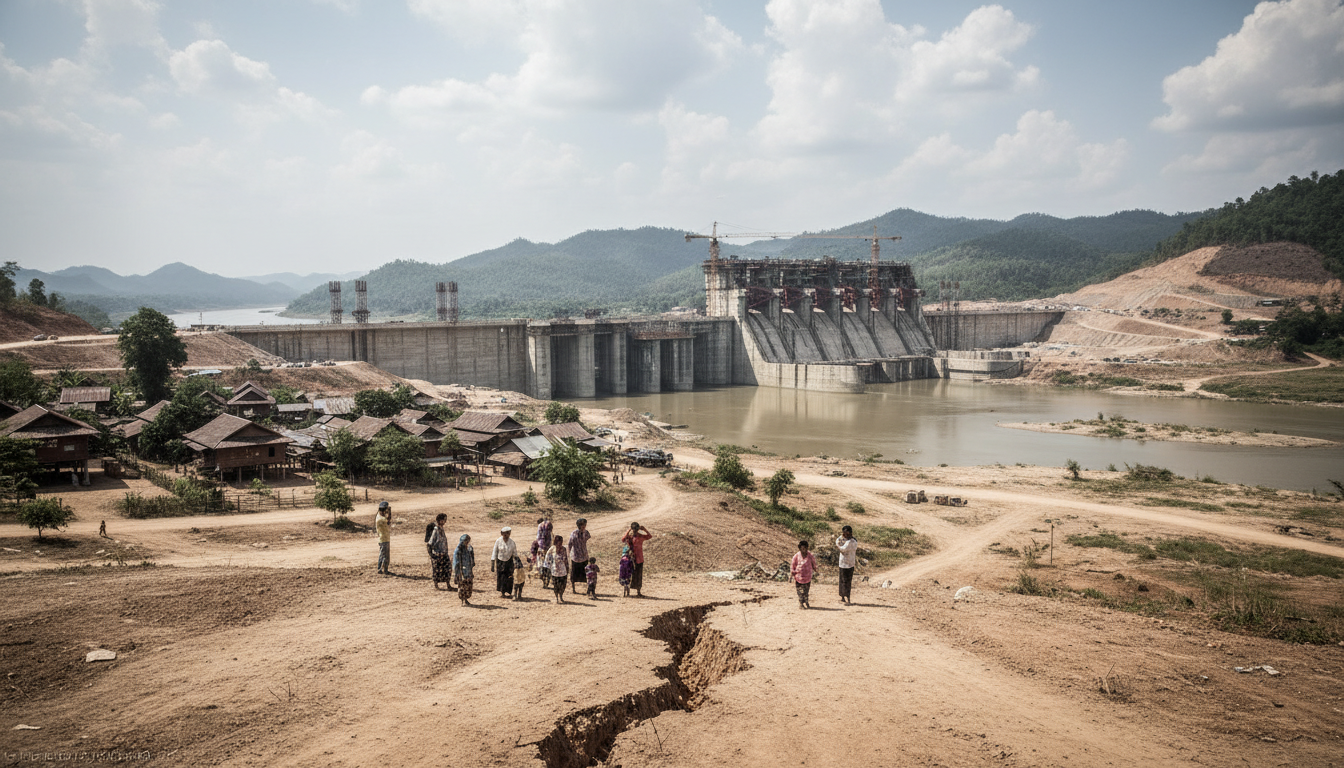
Luang Prabang hydropower dam construction transforms Mekong landscape, raising safety and social concerns
Luang Prabang hydropower dam construction ($3.5bn, 1,460MW) is reshaping the Mekong near Luang Prabang and raising seismic, ecological and social concerns.
Travelers and residents near Luang Prabang are witnessing the rapid rise of a 1,460-megawatt hydropower dam on the Mekong River, a $3.5 billion project that has cleared hillsides and altered riverbanks. The construction site, visible from routes to the Pak Ou caves, now hosts earth movers, silos and a newly built bridge used to deliver materials. Local observers warn the scale of works and proximity to a fault line could have long-term consequences for communities, the river and tourism.
Construction visible from Pak Ou caves
Construction activities for the Luang Prabang hydropower dam are increasingly prominent along the river corridor that leads to the Pak Ou caves, a well-known tourist destination. Trucks frequently cross a new bridge built over the Mekong to ferry concrete and equipment to the site, and denuded hillsides have replaced stretches of riverine vegetation. Tour operators and shopkeepers report that visitors now encounter heavy machinery and construction access roads on journeys that until recently were largely scenic.
Project scale, capacity and cost
The dam is designed to generate 1,460 megawatts of electricity and represents an investment of roughly $3.5 billion, making it one of the largest infrastructure projects in northern Laos. The structure’s base already rises from the river and associated facilities extend along the banks, requiring extensive earthworks and material logistics. Such a footprint reflects the project’s aim to deliver significant generation capacity, but it also concentrates environmental and social pressures in a compact river valley.
Displacement of riverside communities
Riverside villages and farming settlements along the Mekong are facing disruption as construction advances and reservoir works are prepared. Residents report that planned inundation and access restrictions will require relocation of households and limit traditional river-based livelihoods such as fishing and small-scale agriculture. Local community representatives and aid groups are calling for clear, enforceable resettlement plans and compensation measures to address loss of land, income and cultural sites.
Seismic and geological concerns near a fault line
The dam site is sited close to a known fault line, a factor that has heightened concern among scientists and local stakeholders about seismic risk. Large reservoirs can alter stress on local geology and have in some cases been associated with increased seismicity, according to general engineering literature. Observers say the combination of a major concrete structure and active tectonics demands rigorous, transparent seismic assessment and long-term monitoring before and after impoundment.
Environmental effects on Mekong flow and biodiversity
Engineers working on the structure have already reshaped riverbanks and altered sediment pathways, changes that can cascade through the Mekong’s ecological network. Dams trap sediment that would otherwise replenish downstream floodplains, affecting soil fertility and habitats relied upon by migratory fish and freshwater species. Conservationists warn that changes to flows and seasonal pulses could reduce fish numbers and imperil species that local communities depend upon for food and income.
Economic and tourism implications for Luang Prabang
Luang Prabang has long drawn international visitors for its cultural sites and river scenery, and stakeholders say the dam’s proximity could change the visitor experience and local economy. The new infrastructure may bring jobs and investment during construction, but tourism operators fear that altered vistas, reduced river accessibility and environmental degradation could undermine the destination’s appeal. Municipal authorities face the challenge of balancing short-term economic gains with preservation of long-term tourism value.
Government and developer communications emphasize the project’s role in expanding national power capacity and supporting development objectives. Officials have stated that the plant will contribute to electricity supply and economic growth in the region, and developers say mitigation measures and environmental management plans are being prepared. Critics argue that published commitments must be matched by independent oversight, enforceable safeguards and meaningful participation of affected communities.
The Luang Prabang hydropower dam marks a pivotal moment for the Mekong valley near one of Laos’ most visited towns, combining large-scale engineering with complex social and environmental trade-offs. As construction proceeds, the balance between energy goals and the protection of riverine communities and ecosystems will be tested, and close monitoring by authorities, independent experts and local stakeholders will determine whether impacts are mitigated or compounded in the years ahead.

