
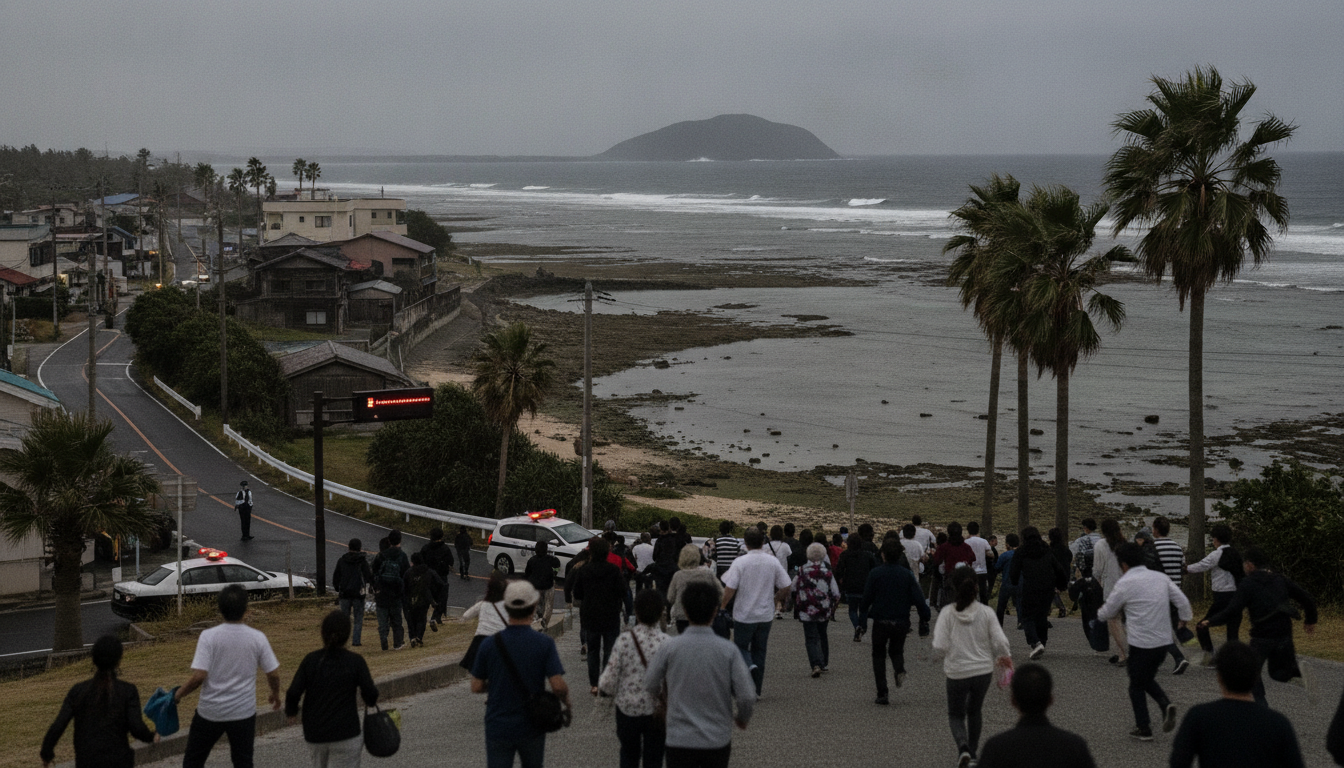
M8.2 earthquake near the Philippines prompts JMA tsunami advisory for Ibaraki to Okinawa
M8.2 earthquake struck near the Philippines on June 8 at 8:38 a.m. JST; JMA issued tsunami advisories for coasts from Ibaraki to Okinawa with 1m waves.
Japan’s Meteorological Agency reported a magnitude 8.2 (M8.2) earthquake occurred near the Philippines on June 8, 2026, at approximately 8:38 a.m. Japan Standard Time. The JMA issued a tsunami advisory covering coastal areas from Ibaraki Prefecture in the northeast through to Okinawa Prefecture in the southwest and warned of possible 1‑meter waves. Residents along affected shorelines were urged to move away from beaches, river mouths and other low-lying coastal areas and to avoid returning to the coast to observe conditions.
Earthquake location and magnitude
The quake was recorded as a magnitude 8.2 event centered offshore near the Philippines, according to the Japan Meteorological Agency. Such a magnitude denotes a major seismic event capable of generating hazardous tsunamis, especially when the epicenter is under or near the ocean. The JMA and seismic monitoring networks immediately analyzed the event’s depth and focal mechanism to assess tsunami risk for surrounding seas.
Tsunami advisory scope and expected height
The JMA’s advisory applies to coastal prefectures from Ibaraki through to Okinawa, covering a broad swath of Japan’s Pacific and southern coastlines. The agency estimated an expected tsunami height of around one meter for affected areas, while cautioning that local effects could vary significantly depending on shoreline shape and bathymetry. Officials stressed that even modest apparent heights can produce strong currents and dangerous undertows near beaches, harbors and river mouths.
Safety instructions and public guidance
Authorities advised people in advisory zones to move away from the shoreline and river mouths and to refrain from returning to the coast to watch incoming waves. The JMA warned that tsunamis can arrive multiple times and may suddenly increase in height, posing a strong risk of sweeping people and objects into the sea. Coastal and marine workers were instructed to suspend operations and secure vessels; the public was warned not to approach damaged piers, beaches or shallow waters.
Local government and emergency response measures
Prefectural and municipal governments within the advisory area activated their local emergency systems and issued evacuation guidance for vulnerable coastal communities. Port authorities and maritime operators in affected regions began implementing precautionary measures, including moving smaller craft to safer locations and restricting harbor activities where necessary. Emergency services remained on alert to respond to possible incidents and to support evacuation efforts if conditions deteriorate.
Monitoring, forecasting and next steps
The JMA will continue to monitor sea level gauges, tide stations and seismic data to update tsunami forecasts and to determine whether advisories should be upgraded or canceled. Residents are advised to follow official JMA announcements and local government instructions and to use only verified information channels for updates. Given the potential for waves to reappear over several hours, authorities urged the public to remain vigilant until the JMA declares the advisory lifted.
Emergency managers also reminded residents to check household emergency kits, confirm evacuation routes to higher ground and maintain communications with family members. Those living in coastal evacuation zones were told to move to safer areas away from immediate shoreline exposure and to avoid driving into flooded or debris-laden roads.
Officials cautioned that conditions can change rapidly and emphasized the importance of heeding professional guidance rather than personal assessment of coastal conditions. The JMA noted that initial height estimates are subject to revision as additional observational data are analyzed, and urged residents to remain prepared for further updates.
While tsunami advisories do not always result in widespread coastal damage, authorities highlighted that even relatively small waves can exert powerful currents and cause hazardous conditions. The JMA reiterated that the safest course for those in advisory areas is to stay away from coasts until officials confirm it is safe to return.
Residents and travelers in the affected prefectures should monitor local media, municipal alert systems and JMA bulletins for the latest information. Emergency hotlines and municipal websites offer region-specific instructions and the locations of designated evacuation sites for those requiring assistance.
Local agencies are coordinating with national authorities to assess coastal impacts, and teams remain ready to conduct rapid damage and safety checks once the immediate tsunami threat subsides.
People living or working in coastal areas are urged to follow official guidance, prioritize safety over curiosity, and report any coastal damage or missing persons through local emergency channels.

