
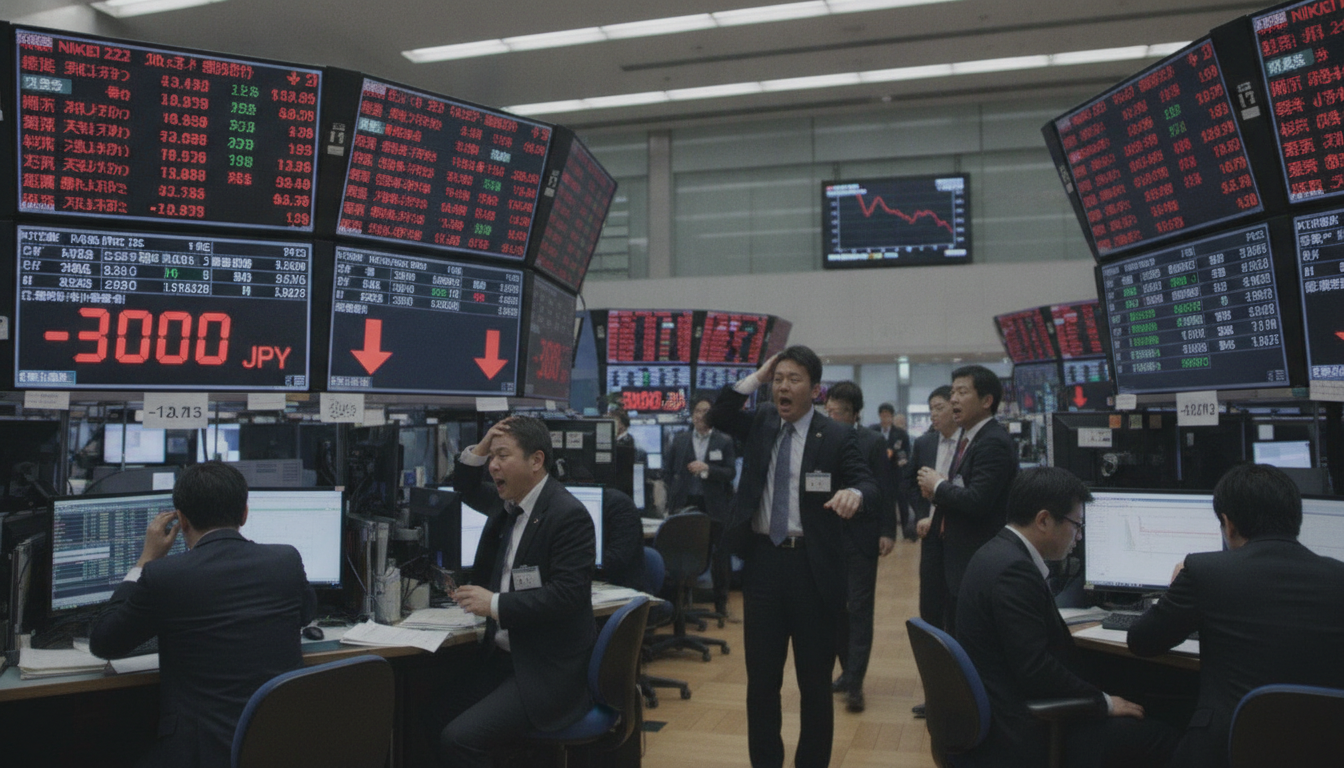
Nikkei Drops More Than 3,000 Yen in Fourth-Largest Intraday Slide on June 8
Nikkei plunges over 3,000 yen on June 8 after U.S. jobs data stokes Fed rate-hike bets; Nasdaq tech sell-off spreads losses across Tokyo markets and investors.
The Nikkei suffered a sharp intraday fall on Monday, June 8, with the index tumbling more than 3,000 yen at one point in trading. The drop ranks as the fourth-largest single-session intraday decline on record and reflected a sudden shift in global risk appetite. Tokyo’s losses followed a weekend of heavy declines in U.S. technology shares after fresh employment data raised expectations of earlier Federal Reserve tightening.
Market Moves and Intraday Metrics
The early session sell-off in Tokyo was broad-based but concentrated on stocks that had led recent gains, accelerating the index’s descent. Trading volume surged as stop-loss orders and profit-taking pushed prices lower across multiple sectors. Market participants noted that the intraday swing was unusually fast, leaving little time for buyers to step back in.
Analysts tracking intraday metrics highlighted volatility in both price and implied volatility measures, which spiked alongside the sell-off. Derivatives desks reported widened bid-ask spreads and increased demand for short-dated hedges as traders scrambled to manage exposure. The rapid move amplified losses for leveraged positions and exchange-traded funds linked to the Nikkei.
U.S. Jobs Data and Fed Rate Expectations
The catalyst for global selling was a stronger-than-expected U.S. employment report that revived speculation the Federal Reserve could resume rate increases later this year. Investors interpreted the data as evidence that the U.S. labor market remains resilient, undermining earlier hopes of a prolonged policy pause. That shift in expectations put immediate pressure on risk assets, particularly growth-oriented technology stocks.
Higher rate expectations tend to weigh on valuations for companies with earnings projected far into the future, a dynamic that played out across markets. Economists and strategists said the renewed prospect of tightening altered discount rates used in models, prompting reassessments of equity valuations. The linkage from U.S. macro data to global markets underscored how sensitive Tokyo trading has become to overseas policy signals.
Nasdaq Decline and Global Spillover
Over the weekend, the Nasdaq suffered a steep correction, driven largely by heavyweight technology names, and the resulting risk-off mood spilled into Asian markets. The Nasdaq’s fall reduced risk tolerance among international investors, who then scaled back positions in equity markets including the Nikkei. Regional trading opened with a pronounced bias to sell, and Tokyo followed that pattern from the first bell.
Market strategists said correlations between U.S. tech stocks and Japanese equities have increased, particularly for firms tied to global technology supply chains and semiconductors. The concentrated nature of the Nasdaq decline meant that any market exposed to high-growth, high-valuation stocks was vulnerable to rapid repricing. As a result, even defensive sectors in Tokyo saw sporadic weakness amid broad-based portfolio adjustments.
Selling Focused on Recent Winners
Stocks that had led the Nikkei’s advance in recent weeks were among the hardest hit, as investors rotated out of recent winners into perceived safety. The sell-off targeted names in technology, discretionary, and select industrial sectors that had outperformed during the recent rally. Portfolio managers cited a combination of profit-taking and rebalancing as contributors to the concentrated pressure.
Smaller-cap and momentum-driven issues experienced particularly sharp intraday losses as liquidity thinned, amplifying price moves. Some institutional traders reported forced selling from funds that needed to reduce equity exposure quickly, exacerbating downward momentum. The patchwork of selling highlighted how uneven market structure can magnify shocks when sentiment turns.
Analyst Reactions and Short-Term Outlook
Analysts emphasized that while the sharp drop was alarming, it reflected a rapid reassessment of policy risk rather than a structural breakdown in Japan’s economy. Several brokerage notes suggested that volatility could remain elevated while investors parse incoming economic data and central bank commentary. Short-term trading strategies are likely to prioritize liquidity and hedging until clarity on the Fed’s path improves.
Observers cautioned that headline intraday numbers can overstate long-term implications and urged investors to monitor corporate earnings and domestic economic indicators for a fuller picture. Fixed-income markets will also be watched closely, as a sustained rise in U.S. yields would reinforce pressure on equities. For now, market participants expect episodic bouts of volatility tied to macro releases and speeches from central bankers.
The Nikkei’s dramatic intraday swing on June 8 serves as a reminder of how quickly global sentiment can change when influential economic signals arrive. Investors will be watching the Federal Reserve, upcoming U.S. and Japanese economic data, and corporate earnings as they reassess allocations and risk controls in the days ahead.

