
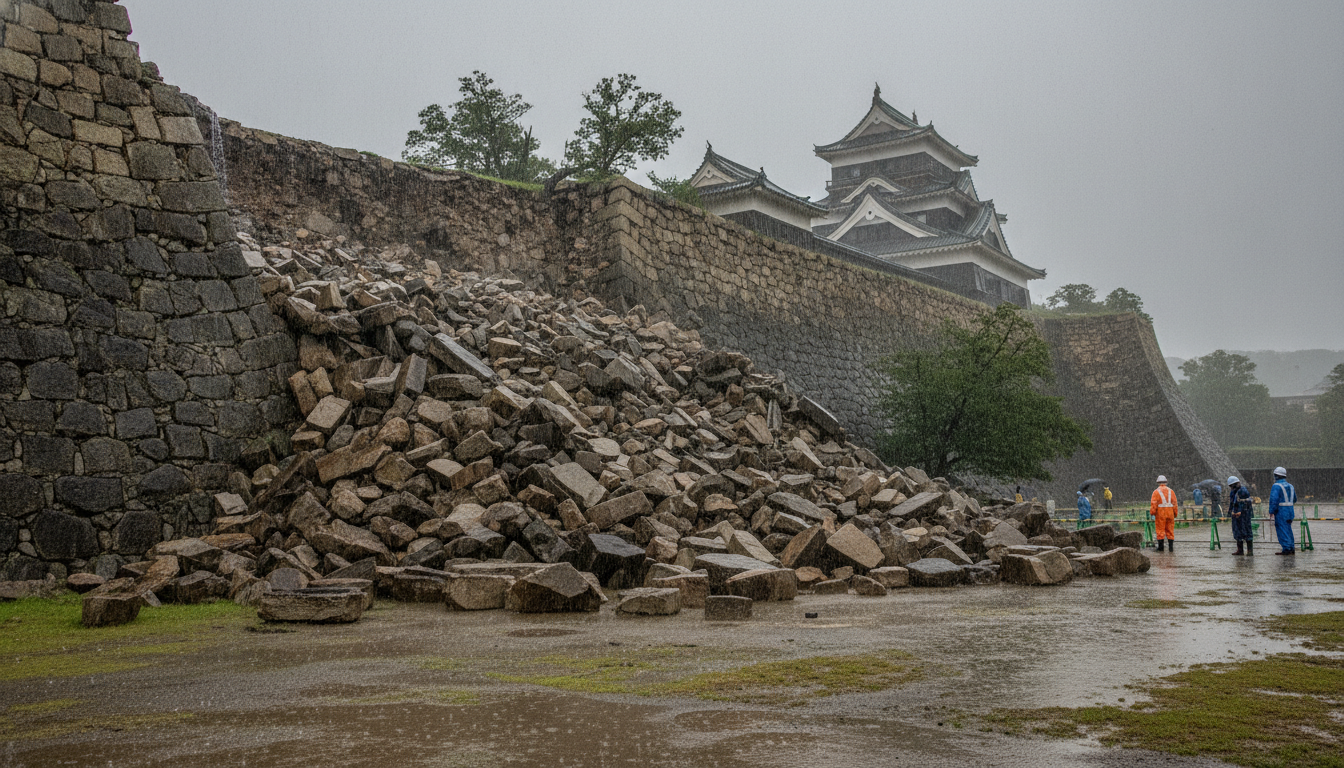
Hikone Castle stone wall collapse discovered after heavy rain damages 6.5‑metre section
Hikone Castle stone wall collapse found by city officials after heavy rain from an approaching typhoon; a 6.5‑metre breach near the national treasure keep was reported on June 28, 2026.
The city of Hikone, Shiga Prefecture, announced on June 28, 2026 that a section of the stone wall at Hikone Castle has collapsed, likely the result of heavy rainfall that accompanied an approaching typhoon through June 27. The breach was discovered on the morning of June 27 by staff from the municipal cultural property division and affects the west side of the castle’s national treasure main keep. No injuries were reported.
Stone Wall Collapse Found by Cultural Property Staff
The collapse was first observed during an early morning inspection on June 27, and the city made a public announcement the following day. The affected area lies adjacent to the castle’s main keep, a structure designated as a national treasure, and sits within the site’s specially protected historic zone.
City officials said the fallen section spans a substantial horizontal distance and was identified during routine monitoring after several days of intense rain. The discovery prompted immediate internal reporting and the activation of steps to secure the area while officials prepared consultations with prefectural and national cultural authorities.
Extent of Damage and Physical Measurements
Municipal engineers measured the damaged portion at approximately 6.5 metres in width, 2.7 metres in depth and 2.5 metres in height. The failure appears localized to the stone revetment rather than the wooden or earthen structures of the keep itself.
Between the collapsed faces lies the historical opening once used to move rice to and from storehouses, locally known as the Rice Storehouse Water‑Gate stone walls. That feature underscores both the functional and cultural value of the damaged masonry within the broader castle complex.
Historic Repairs and Ongoing Restoration Work
The section that collapsed in late June 2026 was previously repaired in the 2001 fiscal year as part of an earlier conservation project. A separate, opposing stone wall at the site suffered a collapse during heavy rain in July 2024 and has been undergoing restoration with a target completion in fiscal 2026, according to municipal records.
Conservation specialists note that the castle’s composite of restored and original stonework requires ongoing maintenance and periodic reinforcement to withstand natural hazards. The twin history of past repairs and recent weather stress highlights the complexity of preserving centuries‑old masonry in a climate increasingly prone to intense rainfall events.
City Coordination with Prefecture and Cultural Authorities
Hikone City said it will consult immediately with Shiga Prefecture and the Agency for Cultural Affairs to determine the full extent of the damage and the appropriate next steps. Officials plan detailed surveys, temporary stabilization measures, and a coordinated plan for conservation work that meets legal and technical standards for nationally designated properties.
The city also indicated it will consider visitor safety and access controls around the affected sector while assessments and emergency work proceed. Any decisions on temporary closures or traffic restrictions near the castle will be communicated once structural engineers complete their initial inspection.
World Heritage Registration Effort Not Affected, City Says
Hikone City stated that the collapse will not affect its ongoing effort to pursue World Heritage registration for the castle and its surrounding historic precincts. Municipal spokespeople said the city will incorporate the damage into conservation records and continue to press for timely restoration under the existing preservation framework.
Experts advising on the site’s nomination and conservation work will likely review the incident as part of broader risk management for the property. The episode may also prompt a reassessment of emergency response protocols and reinforcement priorities for vulnerable stonework across the complex.
Preservation teams are expected to begin follow‑up surveys and emergency shoring within days, pending agreement with prefectural and national cultural officials. The immediate focus will be preventing further slippage and protecting the structural integrity of the adjacent sections of the castle wall.
The city emphasized that there were no injuries and that the collapse is a material but localized loss to the stonework of Hikone Castle. Officials pledged to provide regular updates as assessments and restoration planning progress, with the aim of returning the damaged area to a stable, historically appropriate condition as soon as practicable.

