
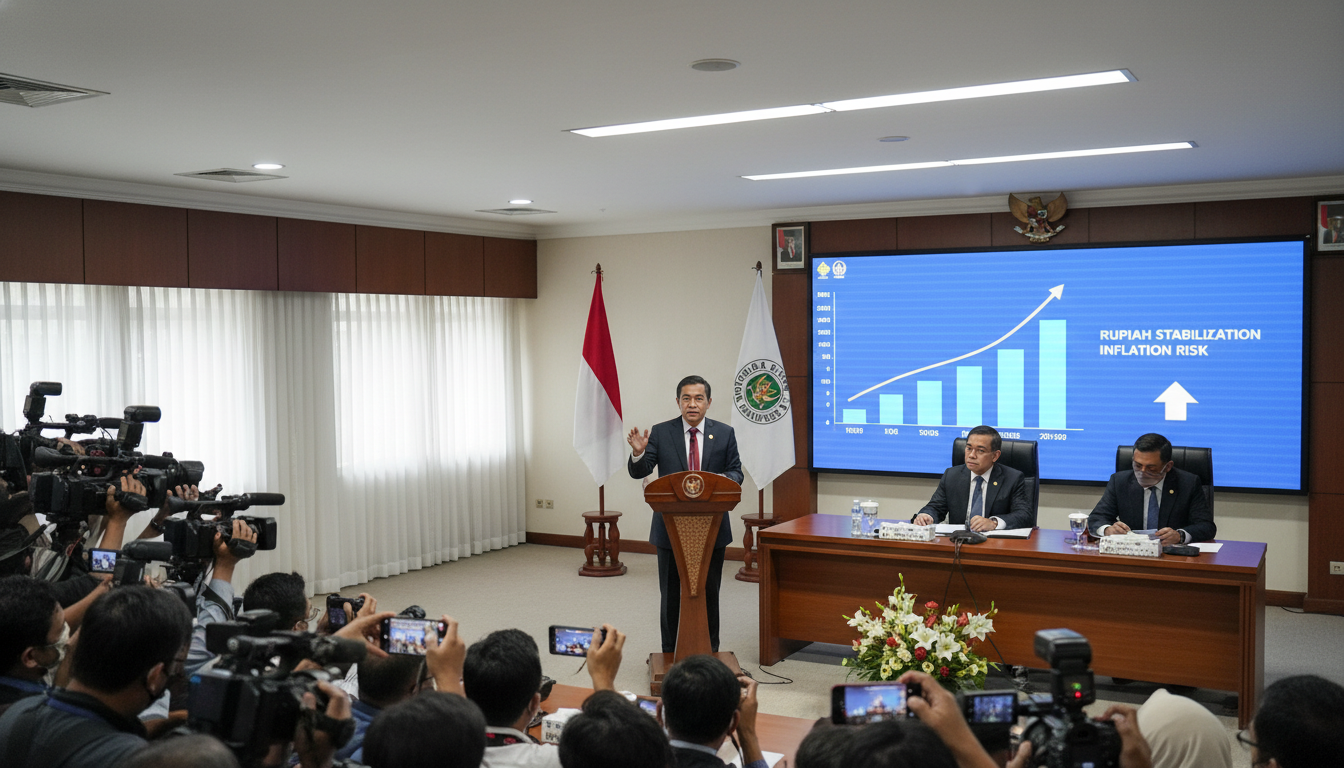
Bank Indonesia raises key rate to stabilise rupiah after two-year pause
Bank Indonesia raises key rate at two-day meeting concluded May 20, 2026, aiming to shore up the rupiah and draw foreign portfolio inflows amid sharp currency weakness.
Policy decision ends two-year pause
Bank Indonesia raised its key policy rate at the two-day Board of Governors meeting that concluded on Wednesday, May 20, 2026, marking the first increase in more than two years and signalling a shift in priority toward exchange-rate stability. The central bank said the move was intended to support the rupiah and attract short-term foreign portfolio capital as global yields diverged and external pressures intensified. (bi.go.id)
The decision breaks a long period of accommodative policy during which benchmark rates were held steady to support domestic growth while inflation remained contained. Officials have faced a trade-off between supporting post-pandemic growth and defending the currency as capital outflows and a stronger US dollar put pressure on Indonesia’s external balance. (marketscreener.com)
Rupiah weakness forced the debate
Financial markets flagged the urgency of action after the rupiah slid to fresh lows in recent sessions, prompting renewed calls from analysts and some policymakers for higher yields to stem capital flight. Traders cited a combination of seasonal dollar demand, rising global yields and investor concerns about fiscal pressures as drivers of the currency’s slide. (mufgresearch.com)
Ahead of the meeting, a slim majority of economists in a Reuters poll and a number of domestic broker reports had expected a 25 basis-point increase to be the most likely outcome, reflecting market pricing that had already started to discount a policy shift. Those forecasts put the balance of risks on the side of a defensive tightening to stabilise short-term flows. (marketscreener.com)
Markets and bond yields responded quickly
Local bond markets and equities moved sharply in the run-up to the announcement, with benchmark yields rising and stock indices reflecting investor caution about tighter monetary conditions. Market participants had also seen central-bank measures such as SRBI (Sekuritas Rupiah Bank Indonesia) yield adjustments and liquidity tools as partial substitutes for outright rate hikes. (mufgresearch.com)
Following the announcement, traders indicated increased demand for rupiah securities as foreign buyers reassessed yields and the carry trade environment. However, analysts warned that any stabilization may prove fragile unless accompanied by clear communication on the central bank’s inflation tolerance and the likely path of future policy. (bareksa.com)
Government coordination and policy mix
The rate decision comes after a series of high-level consultations between Bank Indonesia and government officials aimed at coordinating actions to stabilise the currency and the financial system. Authorities have in recent weeks deployed measures including intervention in the FX market, selective bond purchases and adjustments to SRBI yields to manage volatility. (koranmanado.co.id)
Observers said the combined use of monetary tools and targeted fiscal measures reflects a preference to avoid a disorderly adjustment in financial markets while preserving room for growth-supporting policies. Yet the approach raises questions about how long the central bank will prioritise currency stability over looser domestic financing conditions. (bi.go.id)
Inflation and the limits of rate defence
Raising the policy rate to defend the rupiah carries the risk of feeding through to domestic interest rates and, over time, to consumer prices if exchange-rate pass-through accelerates. Economists cautioned that a premature or overly aggressive tightening could slow credit growth and weigh on consumption just as the economy is rebounding from earlier easing cycles. (marketscreener.com)
Bank Indonesia’s public statements have emphasised a careful calibration of tools, signalling that the central bank will use both rates and market operations to balance objectives. Market-watchers will be looking for guidance on whether the move represents a single defensive step or the start of a more sustained tightening cycle. (bi.go.id)
Outlook for foreign capital and policy path
Analysts say the immediate aim of the rate increase is to make rupiah assets more attractive to non-resident investors and to slow the pace of capital outflows that widened yields and pressured the currency. If sustained, renewed foreign inflows could help rebuild reserves and lower volatility in the medium term. (mufgresearch.com)
Looking ahead, the central bank’s next communications and data on inflation, external balances and bond flows will determine whether further adjustments are necessary. Markets will also be attentive to global rate moves and commodity prices, both of which have outsized influence on Indonesia’s external position and the central bank’s policy calculus. (bareksa.com)
The central bank’s challenge now is to cement credibility for its dual goals: stabilising the rupiah while keeping inflation anchored and supporting a fragile domestic recovery. The coming weeks of market reaction, data releases and official guidance will be decisive in defining whether the rate move achieves its intended stabilising effect.

