
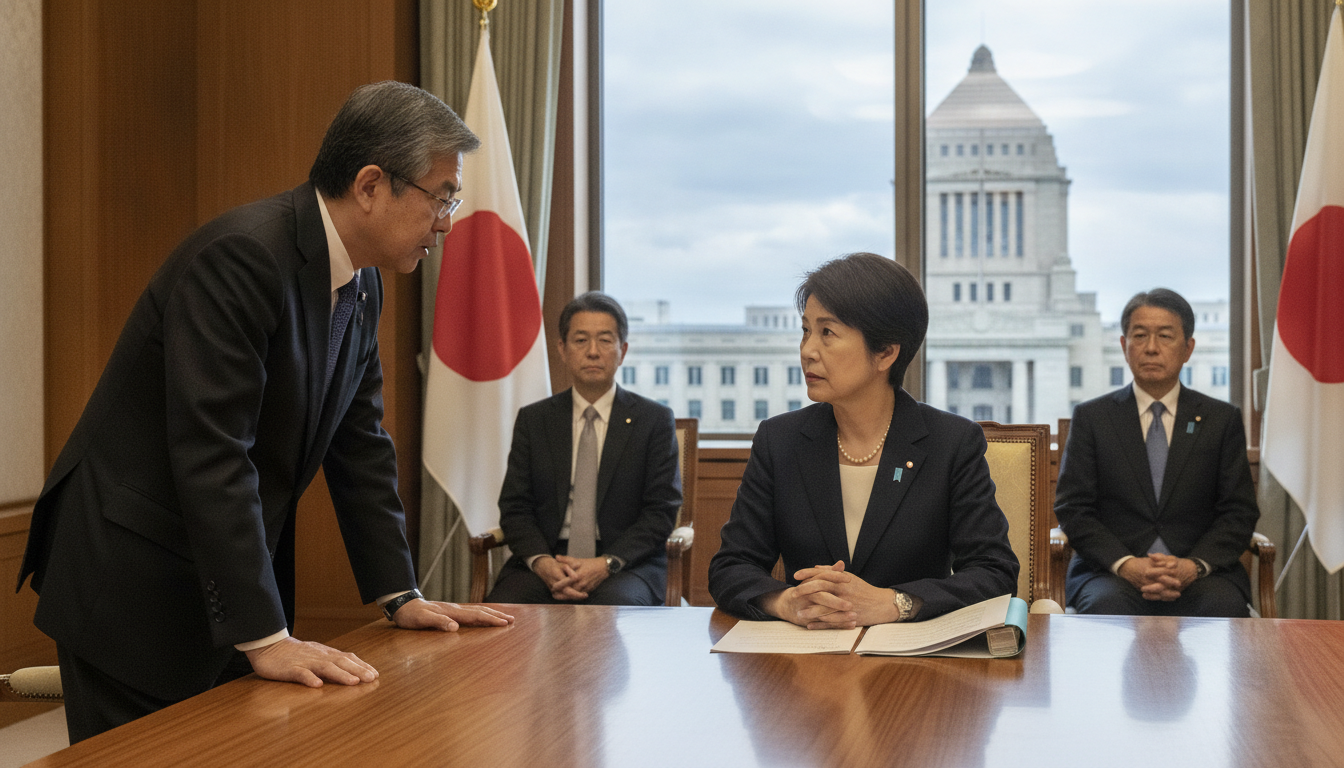
Speaker Mori Presses for Prime Minister Takaichi’s Diet Attendance, Calls to End Parliamentary Deadlock
Speaker Eisuke Mori on July 1 urged swift Diet normalization and pressed for Prime Minister Takaichi to attend the Budget Committee and party leaders’ debate.
Prime Minister Takaichi’s Diet attendance was the central appeal made by House of Representatives Speaker Eisuke Mori as he convened a meeting of party secretaries-general on July 1, 2026 to urge a rapid end to the current parliamentary stalemate. The session brought together leaders from seven parties and aimed to prod the ruling bloc toward scheduling high-profile debates that the opposition has demanded. Mori framed the push as necessary to restore regular legislative functions and to address pressing bills awaiting deliberation.
Speaker Mori’s Appeal to Seven Parties
House Speaker Eisuke Mori opened the meeting in the Diet building by stressing the urgency of resuming normal parliamentary business. He explicitly urged lawmakers to prioritize calm deliberation and to show “mutual concession” when negotiating pending legislation. Mori told the gathered secretaries-general that a swift return to ordered debate would serve the institutions of government and the public interest.
Mori also pressed the ruling coalition to step up efforts to hold the Budget Committee and a party leaders’ debate, two venues the opposition has insisted the prime minister attend. His appeal was framed as an indirect request for Prime Minister Sanae Takaichi to take part in those proceedings. The speaker emphasized that prolonged suspension of committee work damages policy scrutiny and public trust.
How the Deadlock Began on June 22, 2026
The standoff traces back to a parliamentary exchange on June 22, 2026 when Prime Minister Takaichi offered a secretary’s written statement instead of an in-person answer over allegations tied to a contentious video report. Opposition parties responded by demanding that the prime minister appear at the Budget Committee and at a leaders’ debate to account directly to lawmakers. The ruling Liberal Democratic Party, after consulting with the prime minister, signaled reluctance to comply.
Tensions escalated as the ruling side moved forward with deliberations on several contentious bills, prompting the opposition to mount a full boycott of Diet proceedings. That refusal has left deliberations on significant measures stalled and has prevented routine oversight functions from proceeding as lawmakers remained polarized.
Legislation Caught in Limbo, Including Imperial Household Law
Among the measures highlighted by Speaker Mori as requiring prompt attention was the proposed revision of the Imperial Household Law, which he described as an urgent matter that cannot be postponed. Lawmakers from multiple parties have flagged the issue as time-sensitive and called for a tranquil legislative environment to resolve it. Mori urged that passage of the amendment be treated as a priority for national governance.
Other bills at the center of contention include a proposed reduction in the number of seats in the House of Representatives and legislation linked to the government’s “vice-capital” concept. Those items have proven difficult to move forward amid reciprocal distrust between the ruling coalition and opposition ranks, and they have become focal points in the broader fight over parliamentary procedure.
Ruling Party Strategy and Opposition Response
Ruling party lawmakers faced criticism from the opposition for pressing ahead with committee sessions on the seat-reduction bill and related measures despite the absence of cross-party agreement. The LDP’s decision to advance deliberations after internal consultations with Prime Minister Takaichi deepened the impasse, prompting opposition leaders to refuse participation as a form of leverage.
Opposition parties have maintained that the prime minister’s direct appearance is vital to restoring deliberative legitimacy and to answering questions related to the contested report. They argue that written statements supplied after the fact cannot substitute for accountable, live testimony in committee, and they have linked their participation to concrete assurances that the prime minister will attend high-level debates.
Options on the Table to Restart Diet Business
Parliamentary actors now face a narrow set of options to break the deadlock, ranging from behind-the-scenes negotiations and concessions on bill text to a formal schedule that secures Prime Minister Takaichi’s participation in the Budget Committee and a party leaders’ debate. Speaker Mori’s call for “mutual concession” suggests an effort to broker compromises that would allow both sides to claim some measure of success.
Some lawmakers pointed to phased negotiation—where certain non-controversial items proceed while contentious bills await mediated agreement—as a pragmatic route forward. Others said that a high-level meeting directly involving the prime minister, opposition leaders, and key cabinet ministers could yield the concessions needed to restart committee work without further escalation.
Political observers say public pressure may also influence parties’ calculations, as extended paralysis in the Diet risks eroding voter confidence in the political class. Legal experts and senior bureaucrats have warned that delayed consideration of priority legislation could have administrative and social consequences if left unresolved.
Despite the immediate impasse, Mori underscored the institutional imperative of restoring ordinary parliamentary scrutiny and suggested that the speaker’s office would continue to facilitate talks. His intervention marks a rare and pointed effort by the presiding officer to prod the executive branch toward parliamentary engagement.
The coming days will test whether the ruling coalition can deliver the assurances the opposition seeks and whether the prime minister will accept entreaties to appear directly before lawmakers. If Prime Minister Takaichi agrees to take part in the Budget Committee or a leaders’ debate, it could create the opening needed to repair procedural relations and resume deliberations on the Imperial Household Law and other stalled bills.

