
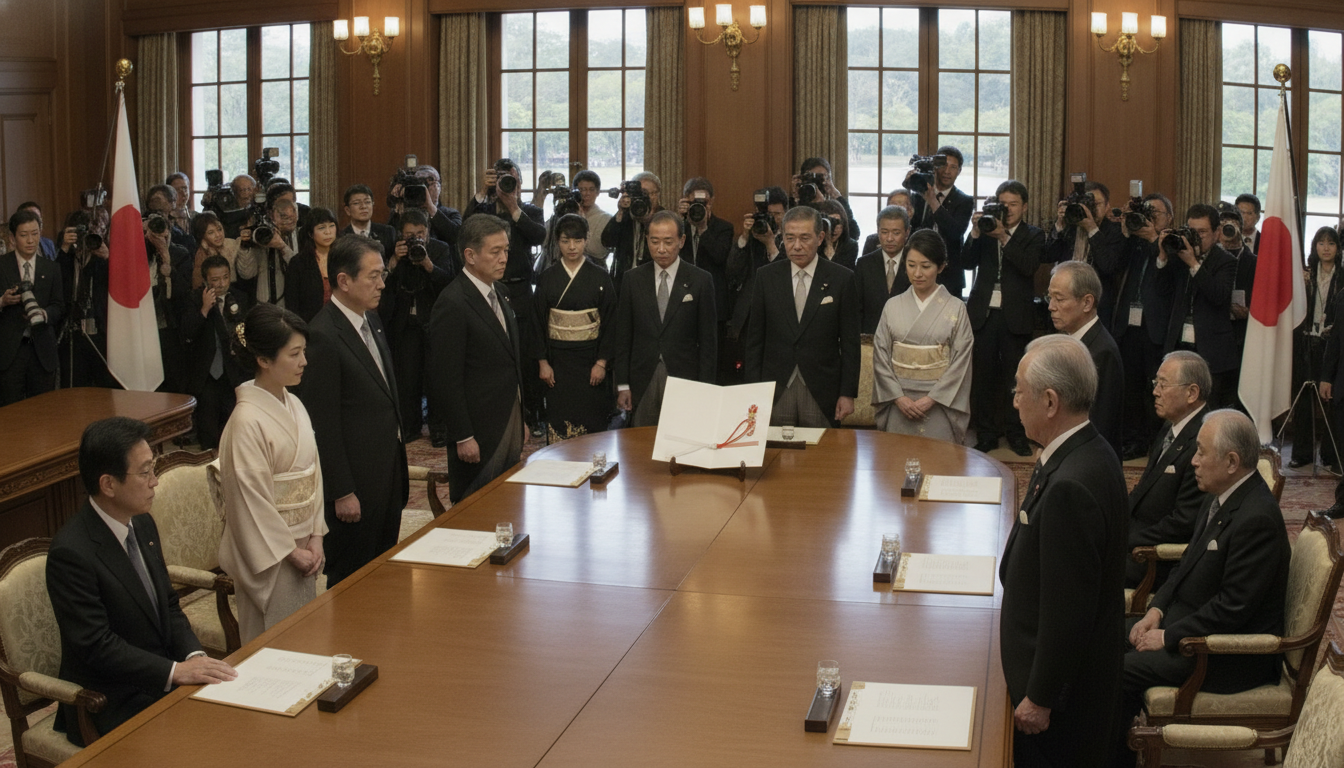
Government unveils Imperial Household Law revision to allow adoption of former imperial males
Government unveils Imperial Household Law revision on June 26, 2026 to allow male-line adoptees from former imperial houses and grant succession to their sons.
Government presents draft amendment on June 26, 2026
The government presented a draft Imperial Household Law revision to party leaders on June 26, 2026 that would expand options to secure the imperial line. The proposal would permit the adoption of male-line males from former imperial houses into the imperial family and establish succession eligibility for sons born to those adoptees.
Officials said the draft was developed as part of measures to address a shrinking pool of male heirs under current succession rules. Lawmakers were given the text of proposed articles after the chairs of both Diet chambers and party representatives agreed on a policy outline.
Key change applies Article 2 to descendants of adoptees
The draft explicitly alters the scope of Article 2 of the Imperial Household Law, which currently sets the order of imperial succession, to cover males born under the care of an adopted member. Under the revision, a son born to a male adopted from a former imperial household would be placed in the line of succession.
The measure does not, however, confer succession rights on the adopted individual himself. Government sources said the adoptee would enter the imperial family in status but would not automatically be made eligible to ascend to the throne.
Provision to let female imperial members retain status after marriage
Alongside the adoption measure, the revision would enable female members of the imperial family to retain their imperial status after marriage. The government framed this as a separate option aimed at preserving the size and functions of the imperial household.
Proponents argue that allowing married female royals to remain within the imperial family would help maintain imperial duties and presence. Critics caution that such a change would alter long-standing practices and would need careful public and legal consideration.
Political friction expected over succession principle
The draft has the potential to provoke debate because the fundamental question of how succession should be determined was not included in earlier cross-party deliberations. Party representatives involved in preparatory talks were reportedly not given sufficient time to discuss the deeper constitutional and dynastic implications of the proposals.
Opposition figures and some lawmakers within the ruling coalition are expected to raise concerns about restoring lines from former imperial houses through adoption. Observers note that adopting male-line heirs and granting succession to their offspring effectively broadens the male-line principle, a point likely to be contested in parliamentary debate and public discourse.
Legal and practical implications for the imperial institution
Legal scholars say the proposal raises technical and symbolic questions about the nature of imperial membership and dynastic continuity. Extending Article 2 to children of adoptees would require precise drafting to avoid ambiguity over status, domicile and ceremonial roles.
Practically, the move could increase the number of eligible male descendants over the medium term, but it would not immediately produce additional adults eligible for succession. Adoption processes, family consent, and the willingness of potential adoptees to accept imperial duties are all factors that will determine the measure’s impact.
Next steps in Diet and public scrutiny
With the draft now circulated to party officials, the government plans to pursue enactment during the current Diet session, citing the need for legal certainty in the imperial succession. Parliamentary committees are expected to begin detailed consideration of the bill following internal party reviews.
Public reaction is likely to shape the pace of debate, and lawmakers will face pressure to explain the rationale for adopting former imperial males and for the decision not to confer succession rights on adoptees themselves. Hearings with constitutional experts and representatives of affected households may be scheduled as part of the legislative process.
The government’s presentation on June 26, 2026 sets the stage for intensified debate over the future of the imperial succession and the legal framework governing membership in the imperial family.

