
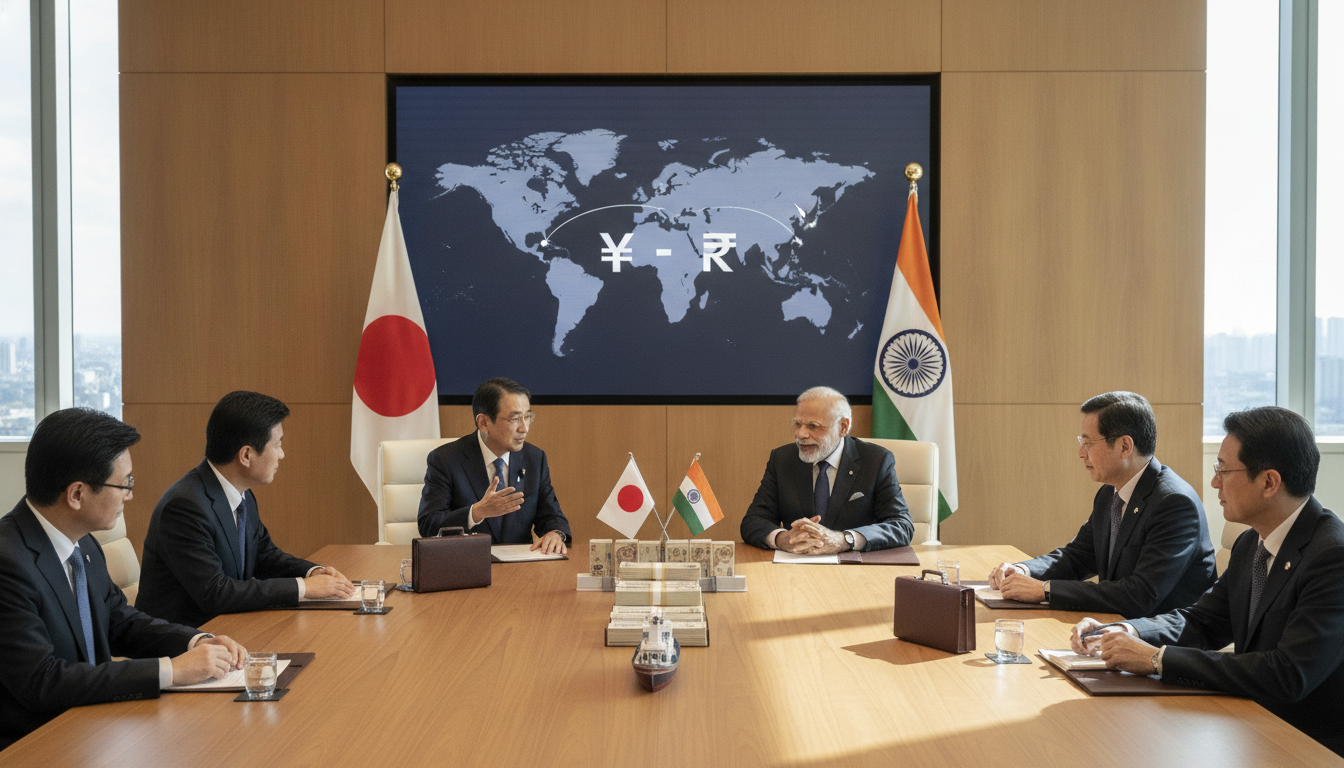
Japan and India Move Toward Yen-Rupee Settlement System to Bypass U.S. Dollar
Japan and India are exploring a yen-rupee settlement system that would enable direct, dollar-free transactions for bilateral trade and remittances, potentially cutting costs and speeding payments.
Japan and India are considering a yen-rupee settlement system that would allow direct currency settlement without routing through the U.S. dollar, Nikkei reported. The initiative is aimed at reducing foreign-exchange and remittance costs for companies and individuals engaged in bilateral trade and cross-border payments. Officials in both countries have begun technical discussions to assess the feasibility of a local-currency mechanism for yen-rupee transactions.
Bilateral talks focus on dollar-free yen-rupee settlement
Japan and India have elevated talks on establishing a bilateral settlement channel that bypasses the dollar to senior financial and trade officials. The proposal would let banks and payment providers settle transactions directly in yen and rupees, removing an intermediate dollar conversion step. Officials say the move could be particularly valuable for trade in goods and services and for the growing volume of cross-border transfers between the two economies.
Mechanics of a local-currency settlement system
Under the proposed arrangement, participating banks would maintain correspondent accounts in each other’s currencies or use a central bank-facilitated corridor to net flows. Settlement could be routed through designated clearing banks or a bilateral central bank link that performs conversion and final settlement in local currencies. Technical work will be required on liquidity provisioning, intraday credit, and the messaging standards that underpin cross-border payment flows.
Benefits for exporters, importers and remitters
A direct yen-rupee settlement system could lower transaction and hedging costs by removing the need to swap into and out of dollars. Exporters and importers could see narrower spreads and faster receipt of funds, improving working capital dynamics. For migrant workers and other remitters, a local-currency route has the potential to reduce fees and accelerate delivery, which policymakers view as an immediate social as well as commercial benefit.
Regulatory, liquidity and operational hurdles
Designing a reliable bilateral settlement channel will require regulators to address liquidity management and the allocation of settlement risk. Central banks will need to coordinate oversight, set limits on intraday exposures, and ensure robust anti-money-laundering and sanctions screening. Operationally, participating banks and payment firms must upgrade systems to support new messaging formats and real-time reconciliation to prevent delays and settlement failures.
Regional and strategic implications for global payments
A yen-rupee corridor would join a growing number of local-currency arrangements aimed at diversifying payment pathways beyond the dollar. Policymakers in both capitals view the scheme as a pragmatic step to enhance financial resilience and reduce dependency on a single currency for bilateral flows. Market participants caution that while the system would not displace the dollar in global markets, it could serve as a model for other bilateral corridors seeking cost-effective payment solutions.
Potential impact on currency markets and corporate finance
If scaled, wider use of direct yen-rupee settlement could alter short-term demand patterns in foreign-exchange markets by reducing intermediate dollar conversions. Corporates with regular trade between Japan and India might revise hedging strategies and treasury operations to take advantage of improved predictability and lower costs. Financial institutions will watch trading volumes closely to determine whether new liquidity pools emerge in the yen-rupee pair.
Officials outline cautious next steps and pilot options
Japanese and Indian authorities are reported to favour a phased approach that begins with a pilot among a limited set of banks and trade corridors. Pilots would allow authorities to test operational flows, settlement finality, and risk controls without exposing the broader financial system. Depending on pilot outcomes, the initiative could be expanded to include more participants and additional payment use cases such as trade finance and corporate payrolls.
The yen-rupee settlement proposal underscores a shared interest in improving the efficiency of bilateral financial links while managing prudential and technical risks. As talks proceed, businesses and payment providers will be watching for pilot details that could define the pace at which direct, dollar-free settlement becomes a routine option for transactions between Japan and India.

