
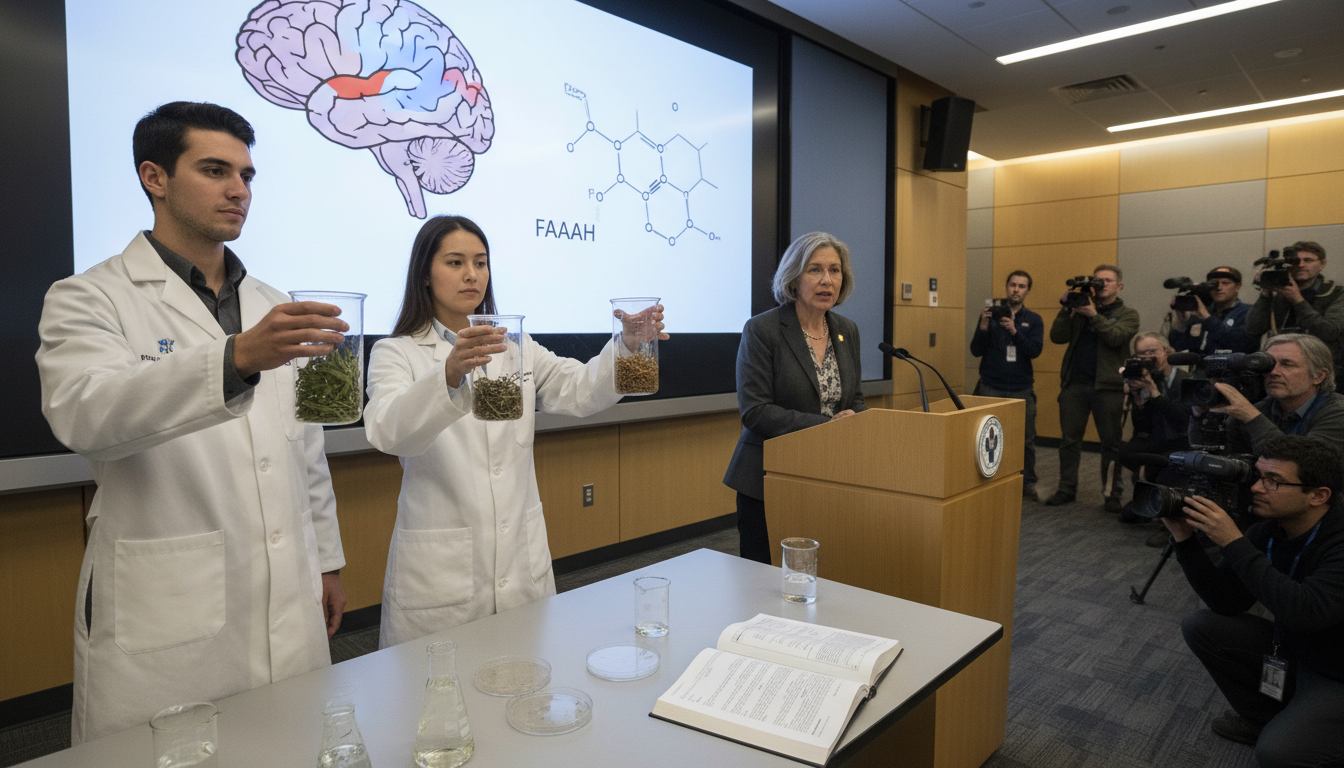
McGill study links cannabis and tobacco co-use to higher brain FAAH and lower anandamide
McGill finds cannabis and tobacco co-use raises brain FAAH, lowers anandamide and is linked to anxiety, depression and harder to quit in young adults.
People who use both cannabis and tobacco show measurable differences in brain biochemistry compared with those who use cannabis alone, according to a new study from McGill University’s Douglas Research Centre. The research, which focused on the enzyme FAAH and its role in regulating anandamide, provides the first human evidence suggesting a molecular pathway that may explain worse mental-health outcomes and greater difficulty quitting among co-users of tobacco and cannabis. The finding was reported in Drug and Alcohol Dependence Reports and funded by the National Institute of Mental Health.
Key PET findings on co-use
Positron emission tomography scans revealed that individuals who smoked cigarettes daily in addition to using cannabis had elevated levels of fatty acid amide hydrolase, or FAAH, compared with people who used only cannabis. FAAH breaks down anandamide, an endocannabinoid commonly called the “bliss molecule” because of its role in mood regulation and stress response. Higher FAAH activity implies lower anandamide availability, a profile previously associated with anxiety, depressive symptoms and increased relapse risk in substance use contexts.
Study authors emphasized that the effect size was notable despite the small sample and the study’s exploratory nature. Lead investigator Rachel Rabin, an associate professor in McGill’s Department of Psychiatry, described the results as an early but important step toward identifying pharmacological targets for cannabis use disorder, particularly in people who co-use tobacco. Co-author Romina Mizrahi, director of McGill’s Research Center for Cannabis, said the contrast between co-users and cannabis-only users was “surprisingly strong.”
Participant profile and study limitations
The analysis drew on neuroimaging data from 13 young adults, of whom eight were cannabis-only users and five were daily cigarette smokers who also used cannabis. Self-reported cannabis consumption averaged slightly above one gram per day, while cigarette intake among co-users ranged from one to 12 cigarettes daily. Because the dataset originated from an unrelated project, the study did not include a tobacco-only comparison group.
That absence leaves open the possibility that tobacco alone could account for the observed FAAH differences, a caveat the researchers acknowledge. The small sample size and cross-sectional design also limit the ability to draw causal conclusions about whether tobacco triggers FAAH changes, whether pre-existing FAAH variation predisposes people to co-use, or whether a bidirectional interaction exists.
Endocannabinoid system implications
FAAH is the principal enzyme that degrades anandamide, a lipid neurotransmitter that binds cannabinoid receptors and influences mood, reward and stress pathways. Reduced anandamide signaling has been linked in prior research to heightened anxiety, depressive symptoms and poorer outcomes when attempting cessation of substance use. The McGill team’s observation that co-users show higher FAAH suggests a biological mechanism by which tobacco might worsen affective symptoms and increase relapse vulnerability among cannabis users.
Understanding shifts in the endocannabinoid system is clinically relevant because it points to potential medication targets beyond behavioral therapies. Current treatments for cannabis use disorder are limited to psychosocial interventions, and FAAH inhibitors have been proposed as one pharmacological avenue to restore anandamide signaling. The new human data provide a rationale for exploring such approaches specifically in populations that co-use tobacco.
Public-health context in Canada
Although tobacco use has declined overall in Canada, the majority of frequent cannabis users still report using tobacco as well, researchers noted. National estimates indicate that roughly one in 20 people who used cannabis in the past year meet criteria for being at risk of cannabis use disorder, and that rate rises to about one in three among heavier cannabis users. Those statistics underscore the potential public-health impact of co-use, given the added mental-health and cessation challenges suggested by the study.
Public-health experts have long warned that combining tobacco and cannabis can introduce additive harms, including greater dependence and respiratory risks, but the McGill findings add a biological dimension to those concerns. Policymakers and clinicians may need to consider co-use patterns when designing prevention, screening and treatment programs for cannabis-related problems.
Planned follow-up research and next steps
To address the tobacco-only question and better isolate nicotine’s role, the McGill team is recruiting cigarette smokers and people who vape nicotine for a follow-up project that will examine whether similar FAAH elevations appear without concurrent cannabis use. That next phase aims to disentangle whether tobacco exposure alone produces the endocannabinoid changes or whether the interaction between the two substances is required.
Authors of the published paper—Rachel Rabin, Joseph Farrugia, Ranjini Garani and Romina Mizrahi—report the study as preliminary and call for larger, longitudinal work to confirm the findings and clarify directionality. They also highlight the importance of replicating results across broader age ranges and patterns of use, and of linking biochemical markers to clinical outcomes such as relapse and treatment response.
The McGill study provides an initial human signal that cannabis and tobacco co-use may alter a core component of the brain’s endocannabinoid system, with implications for mood and cessation efforts. Further research is needed to determine causality, to test whether FAAH-targeted treatments could benefit co-users, and to guide clinicians in tailoring interventions for people who use both substances.

