
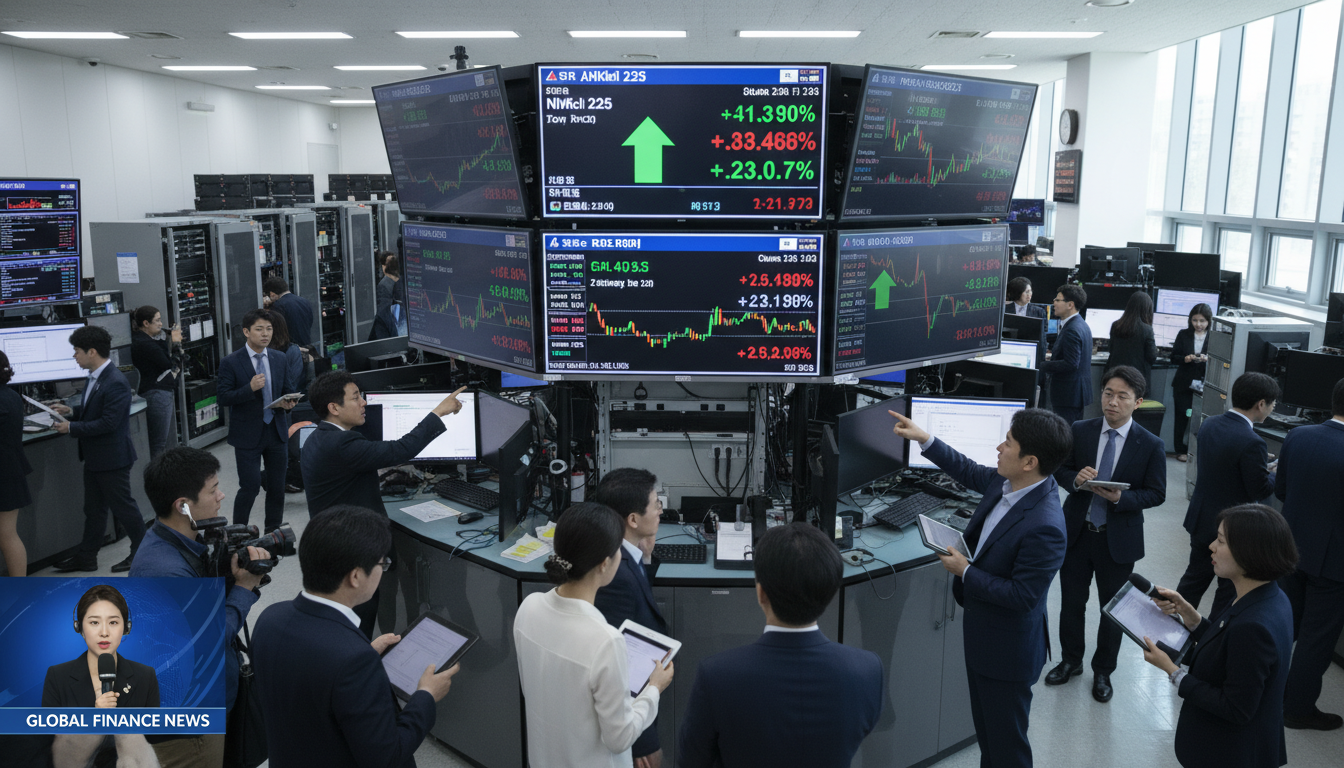
Nikkei Stock Average Nears Record as Tech-Led Rally Sends Tokyo Markets Higher
Nikkei Stock Average climbs toward a record close as investors pour money into technology shares on April 27, lifting Tokyo and broader Asian equities.
Japanese stocks jumped on Monday, April 27, with the Nikkei Stock Average rising sharply in morning trade and moving toward a potential record close as investors rotated into technology names. The surge was driven by sustained flows into chipmakers, software and other tech-linked firms, a shift that also supported gains in South Korean markets. Market participants cited improving earnings prospects in key technology sectors and renewed investor appetite for growth assets after recent macro data.
Nikkei advances sharply in early trading
The Nikkei Stock Average rose by roughly 900 points at one point in the morning session, reflecting broad buying across the Tokyo market. Gains were most concentrated in technology-related sectors, whose strong performance lifted the overall benchmark. Traders noted that the intensity of buying suggested both domestic funds and overseas investors were reallocating into growth-oriented equities.
Volume picked up as the rally accelerated, with market makers and institutional desks reporting heavier-than-normal order flows on the buy side. Market breadth favored advancing issues, and the move increased expectations that the index could test or surpass its previous intraday highs before the day’s close. The momentum was underpinned by a mix of earnings optimism and sentiment around next-generation technology demand.
Technology stocks lead gains across Tokyo
Technology shares accounted for a large proportion of Monday’s advance, with chip-related suppliers, equipment makers and software firms seeing notable inflows. Analysts said investors were looking beyond short-term macro noise and focusing on longer-term catalysts such as artificial intelligence, cloud spending and semiconductor demand. That dynamic helped lift smaller-cap tech names as well as larger, more liquid technology constituents.
Sector rotations into tech coincided with profit-taking in interest-rate-sensitive areas, a pattern that has appeared intermittently as investors rebalance portfolios. The relative performance differential favored growth over defensive sectors on Monday, reinforcing the narrative that the market’s leadership may be shifting. Traders emphasized, however, that sentiment can change quickly and that positioning remains tactical for many funds.
Regional impact: South Korea and broader Asia rally
South Korean stocks rose alongside Tokyo, reflecting cross-border money flows into technology stocks across Asian markets. Seoul’s benchmark gained as investors bought into chipmakers and tech exporters, amplifying the regional rally. The synchronized movement underscored the interconnectedness of Asian technology supply chains and investor sentiment toward the sector.
Other Asian markets also showed pockets of strength, with tech-heavy listings and related suppliers generally outperforming peers. Market strategists highlighted that global investors often treat Japan and South Korea as complementary exposure to semiconductor and advanced manufacturing themes. Currency moves and bilateral trade data remained additional factors that traders monitored during the session.
Market drivers cited by investors and analysts
Observers pointed to several near-term factors underpinning the rally, including stronger-than-expected corporate guidance from a handful of tech firms and renewed optimism about AI-driven revenue growth. Low bond market volatility in recent sessions helped reduce hedging costs for equity investors, encouraging more aggressive positioning in risk assets. Some fund managers also referenced rebalanced model portfolios that increased exposure to technology late in the quarter.
Macro considerations, such as central bank commentary and inflation trends, continued to shape risk appetite but did not materially dent the tech-led advance on Monday. Currency dynamics — particularly any moves in the yen — were watched closely because of their potential effect on exporters’ earnings. Overall, market participants described the move as a results-driven rotation rather than a broad, economy-wide rerating.
Trading behavior and liquidity observations
Institutional traders said execution strategies shifted as momentum became clear, with more aggressive buying through the morning and limit orders giving way to market orders. That execution pattern amplified intraday moves and contributed to the steep rise in the Nikkei Stock Average during peak hours. Liquidity across some mid-cap names thinned as demand outpaced the available supply of shares to buy.
Retail participation also increased, according to brokerage commentary, particularly in technology ETFs and high-profile tech stocks listed in Tokyo. The combination of institutional and retail flows created a feedback loop that sustained the rally through multiple trading sessions. Traders warned, however, that volatility could return if any unexpected macro headlines or profit-taking emerged.
Outlook and risks for investors
Analysts said the near-term outlook now hinges on upcoming corporate earnings, central bank communications and whether current flows into technology sustain through the quarter. While the Nikkei Stock Average’s advance reflects genuine demand for tech exposure, valuation sensitivity is rising for some names after a sharp run-up. Investors were advised to monitor earnings revisions and sector-specific order books for signs of durability.
Risks include potential profit-taking after a rapid move, shifts in global monetary policy expectations, and any sudden currency swings that could affect export-centric earnings. Still, for many portfolio managers, the current environment presents an opportunity to adjust exposure toward areas they view as benefiting from structural trends such as AI and semiconductor upgrades. The market’s next directional cues are likely to come from corporate results and any fresh macro signals.
As trading continued into the afternoon, market watchers remained focused on whether the Nikkei Stock Average would finish the day at a record level, noting that intraday volatility and late-session flows could determine the final outcome.

