
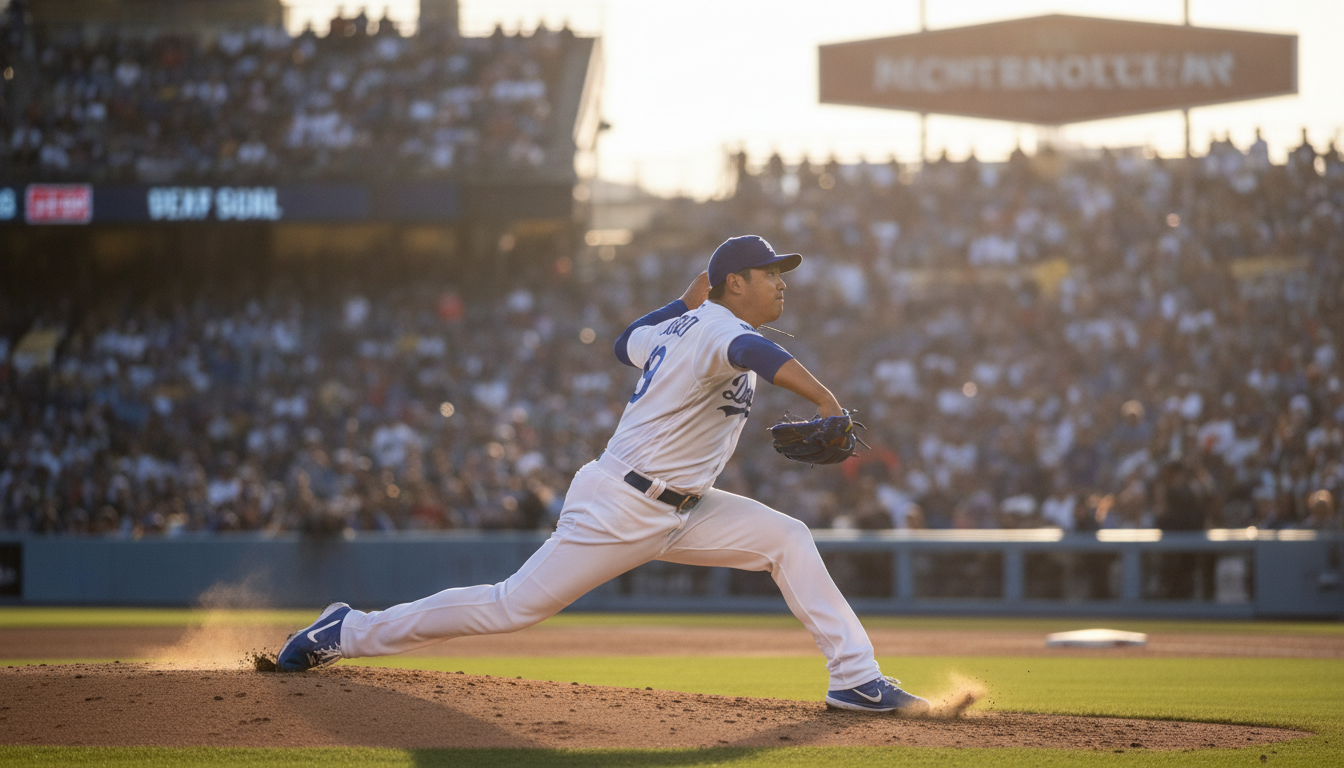
Ohtani pitching form shifts toward lower center of gravity and ‘triple flexion,’ sharpening Dodgers performance and Cy Young prospects
Ohtani’s revised pitching form, using a lower center of gravity and ‘triple flexion’ mechanics this season, has boosted his performance and Cy Young prospects.
Shohei Ohtani’s pitching form has undergone a noticeable transformation this season, and the change is already reflected in his results for the Los Angeles Dodgers. The Ohtani pitching form — now characterized by a lower center of gravity and a pronounced translational start — has coincided with an 8-2 record and a 1.58 ERA through 13 appearances. Team staff are managing his workload carefully as he completes his second season after Tommy John surgery, while analysts suggest the adjustments are designed to maximize both effectiveness and longevity.
Season performance and standing
Ohtani has appeared in 13 games this season, compiling an 8-2 record with a minuscule 1.58 earned run average. He remains just short of qualifying innings for official ERA rankings, but if he reaches the threshold he would move into second place in the National League. Those figures mark a sharp improvement in run prevention compared with the early post-surgery months and underline the effectiveness of recent mechanical adjustments.
Ohtani’s win-loss line and ERA have drawn renewed attention because they come while the Dodgers have paced his starts on a carefully monitored schedule. The club is balancing between leveraging his current form and protecting his arm after reconstructive elbow surgery. That cautious approach has not prevented Ohtani from ramping up his presence on the mound relative to initial post-recovery timelines.
Mechanics shift: lower center of gravity and translational motion
Video and analyst breakdowns show Ohtani now begins with a higher left-leg lift and a more pronounced forward translation of his body toward home plate. Observers note that his posture at foot strike sits noticeably lower than in pre-surgery seasons, producing a deeper hip and knee flexion. The net effect is a reduced vertical center of gravity that appears to stabilize his delivery and may improve repeatability of release point.
Pitching coaches say the combination of a pronounced leg lift and forward translation can help synchronize the lower and upper body, allowing the pitcher to use ground force more effectively. For Ohtani, whose value rests on both velocity and command, the altered mechanics seem to be helping him get on top of hitters earlier in counts while keeping his shoulder and elbow load controlled through more efficient sequencing.
‘Triple flexion’ explained by trainer Takayuki Kikuchi
Takayuki Kikuchi, a 42-year-old trainer and physiotherapist who works with many professional players, identified the central theme of the change as “triple flexion.” He described the term as the coordinated, deeper bending of the hip, knee and ankle at critical points in the delivery. Kikuchi said the adjustment lowers the pitcher’s center of mass and creates a stable base from which to drive explosively toward the plate.
Kikuchi emphasized that triple flexion is not a one-size-fits-all prescription but a targeted biomechanical tweak aimed at improving force transfer and consistency. He added that when properly trained and monitored, the pattern can reduce stress spikes on the elbow by distributing load through larger muscle groups in the hips and legs, which is particularly relevant for a pitcher returning from Tommy John surgery.
Workload management and rotation timing
The Dodgers have generally scheduled Ohtani on a six-day turn, giving him regular rest while allowing for a steady accumulation of innings. Team medical staff are monitoring pitch counts, interstarts recovery, and the cumulative effects of his altered mechanics to avoid overuse. That approach reflects a balancing act: maximize his immediate competitive value without undermining long-term arm health.
Managers and trainers have publicly stressed individualized recovery metrics rather than applying a fixed innings cap alone. For a pitcher like Ohtani, who is both an elite starter and a high-profile two-way player historically, this nuanced monitoring allows the Dodgers to reshape his usage while preserving his ability to contribute deep into the season.
Implications for Cy Young race and long-term durability
Analysts inside and outside the game have speculated that the mechanical adjustments are consistent with a deliberate effort to place Ohtani in contention for the Cy Young Award. The lowered center of gravity and triple flexion pattern support better command and repeatable release, two attributes that correlate with sustained excellence over a full season. If he maintains his current ERA and reaches qualifying innings, his candidacy will gain substantial momentum.
At the same time, the long-term success of this change will depend on consistent conditioning and careful load management. Biomechanical gains can be negated if they are paired with sudden increases in innings or pitch counts, which would risk recurrence of elbow or shoulder issues. For now, the blend of refined mechanics and disciplined oversight offers a promising path for both immediate performance and career longevity.
As Ohtani progresses through the season, his evolving pitching form will remain a focal point for opposing hitters, Dodgers personnel and award voters alike. The combination of measurable results and a clearly intentional mechanical shift has turned what might have been a mere curiosity into a consequential development for one of baseball’s most closely watched pitchers.

